




![Alberto Beingolea: “If they insist on not giving [the powers], they are complicating life for Peru”](https://insightermedia.com/wp-content/uploads/2026/09/bb3fa9e11304ea13fe2cd333955007bc-150x150.webp "Alberto Beingolea: “If they insist on not giving [the powers], they are complicating life for Peru”")


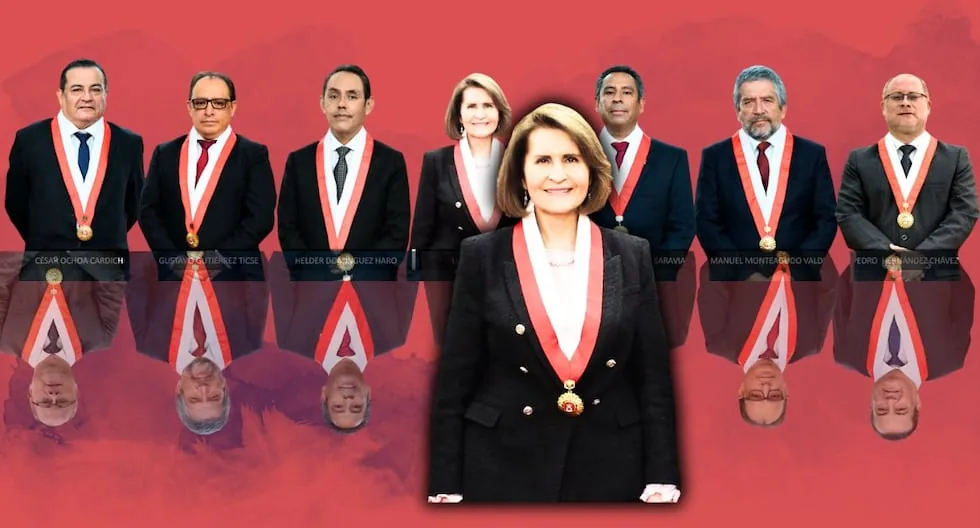
Pacheco had been elected in September 2024 to serve as president of the body composed of seven magistrates until September 2026. However, following the decision — presented on Monday before the plenary, but only made known this Wednesday, May 27 — her term will be interrupted just over three months before the end of the period for which she was elected.
Read more Somos Awards 2026: complete list of nominees
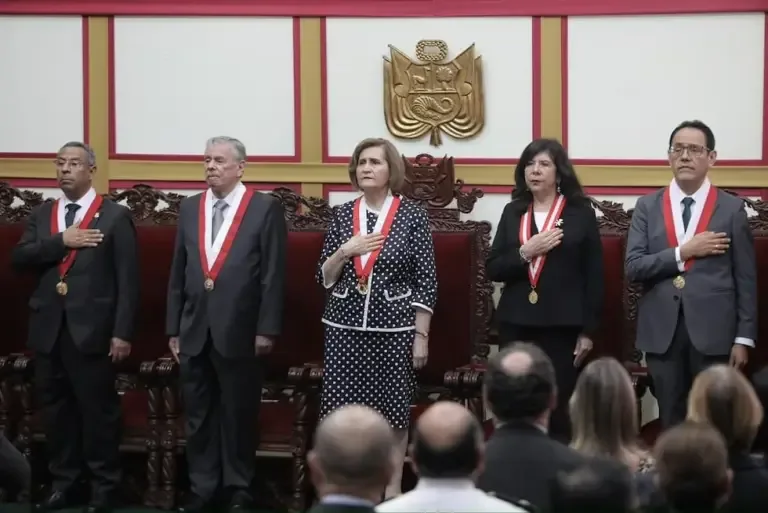
She will remain in office only until this May 31. After that, the leadership of the collegiate must be assumed by Vice President Helder Domínguez Haro. Her decision, however, does not imply her departure from the TC, as Pacheco specified that she will continue to perform duties as a magistrate.
The reasons behind
What her decision does reveal are the internal frictions within the highest interpreter of the Constitution. An unsustainable situation that puts the spotlight on internal management. Although her decision to resign became known in the morning, it was through a statement signed by Pacheco Zerga herself that she publicly settled her position in the afternoon.
Pacheco specified that her resignation from the presidency of the TC was submitted this Monday, while denying that her decision was due to health reasons or any other kind.
According to details, this occurred “due to the repeated decision of a majority of magistrates” in the plenary to “maintain confidence in an official” of the senior management and, as she explained, “on whose management the proper administrative conduct of the institution largely depends.”
She added that, since last year, she had already expressed her “loss of confidence” in the official in question and had raised from the presidency of the TC “the need for his replacement.” However, as detailed, neither was her request attended to nor was the official’s removal accepted. This ultimately triggered her decision.
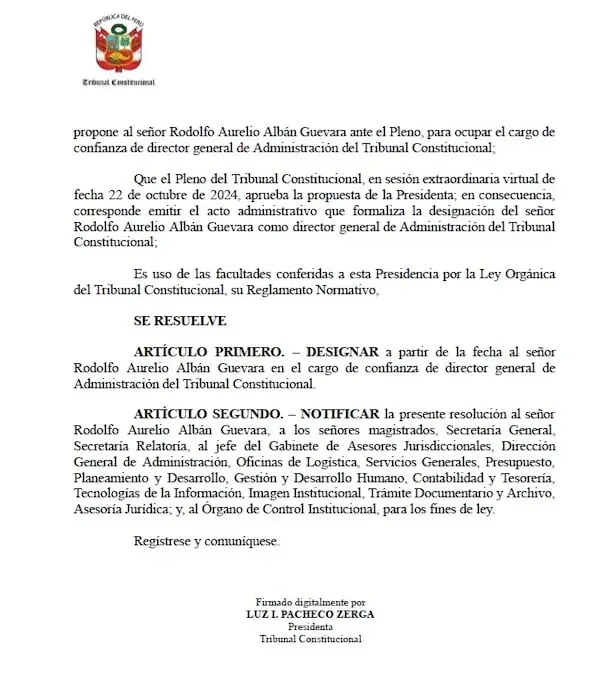
Although Pacheco did not explicitly mention any name in the statement, sources from El Comercio detailed that the conflict would have arisen around the departure of economist Rodolfo Aurelio Albán Guevara, general director of Administration of the TC, who still remains in the position.
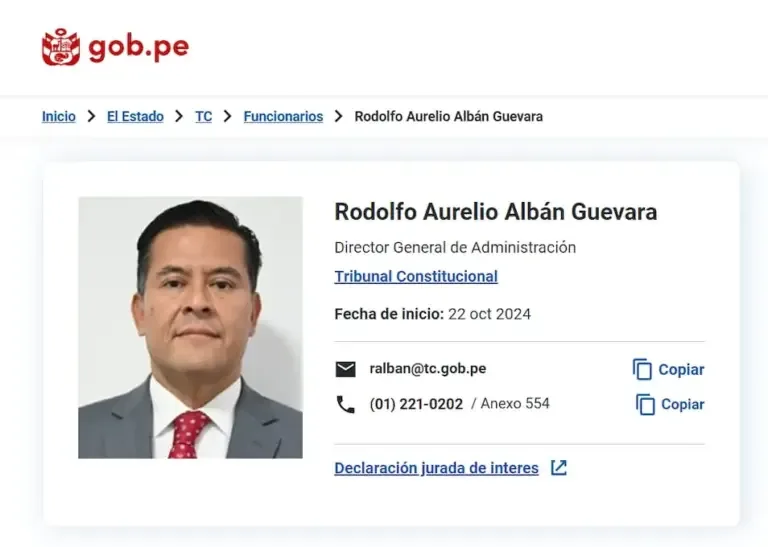
In October 2024, through Administrative Resolution 170-2024-P/TC, signed by Pacheco, Albán Guevara was appointed to the trusted position of general director of Administration of the TC. As stated in the document, the TC plenary approved the proposal and subsequently formalized his appointment.
In short, it is the most important administrative position within the court, as it is cross-linked with all offices and is responsible for managing the requests of the magistrates.
According to the sources consulted, Pacheco sought support from the plenary to review some administrative practices and requested the official’s removal. However, this was rejected by five votes to two, the latter being those of magistrate Manuel Monteagudo Valdez and Pacheco herself.
That is, the still president of the TC did not obtain the support of magistrates Helder Domínguez Haro, Francisco Morales Saravia, Gustavo Gutiérrez Ticse, César Ochoa Cardich, and Pedro Alfredo Hernández Chávez for the removal of a key position within the institution she was in charge of presiding over.
Already last April, the magistrate had sought to establish commitments to institutional integrity, where it is pointed out that public service implies providing a service to the citizenry oriented to the general interest and for which it was necessary to “have honest servants and public organizations that ensure the conditions to serve, without acts of corruption.”
The sources consulted refer to a “great power struggle” within the TC. The magistrates hold opposing positions regarding Pacheco’s decision and question that during the plenary only “alleged ineptitudes” were mentioned. At the close of this report, none had spoken out.
Weeks ago, Pacheco herself had acknowledged that “something irregular” occurred in the expedited processing of the habeas corpus in favor of the fugitive Vladimir Cerrón, as the case was brought before the plenary without having been previously approved in the assigned commission and had been worked on between an “advisor and a law firm.”
As this newspaper reported, the procedure was carried out in just 15 business days, with the file prioritized and scheduled for the plenary hearing held on March 11.
However, later, the TC plenary stated — in a communiqué — that “there was no irregularity” in the processing of the file and that there were “different coordination practices.” Although Pacheco ruled out jurisdictional reasons behind her departure, tensions within the TC had already been evident.
Everything that is coming
In an interview with El Comercio, former TC president Óscar Urviola explained that the regulation contemplates the possibility of resignation from the position and that, according to article 6 of the Organic Law of the TC, it corresponds to the vice president — Helder Domínguez — to assume to complete the constitutional period started by Pacheco. Once that term is completed, he added, a new president must be elected for the next two-year period.
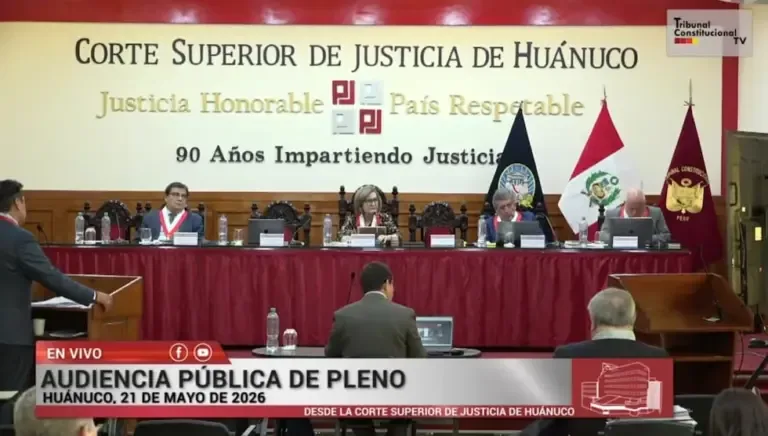
There is no similar precedent of resignation from the presidency of the TC. However, in April 2013, magistrate Ricardo Beaumont Callirgos submitted his resignation, although directly to the TC. In any case, the regulation contemplates exits.
For the election of the president of the TC, no fewer than five votes are required in a first vote. If that number is not reached, a second round is held, in which the one who obtains the most votes is elected. In case of a tie, a final vote is held.
Urviola mentioned that Domínguez, current vice president of the TC, could run for the position. He also added that Pacheco will continue to perform duties as a magistrate until the constitutional period for which she was elected is completed.
And here another key point comes in. In May 2022, Pacheco was elected — along with five other members — by Congress for a five-year term. That mandate ends next year.
In this regard, Urviola pointed out that the next magistrate election process will be handled by the Senate and expressed his expectation that the Legislature will act more swiftly in this task, since when the unicameral Congress held that responsibility, the deadlines provided by law were not met.
“With six months in advance of the expiration of the respective terms, the court notifies Congress to choose. In advance of the expiration; it never did. I believe the Senate, which now has that responsibility exclusively, will have more time so that, with due anticipation, the new collegiate is chosen and assumes functions at the expiration of the five years of those who have already completed that period,” he emphasized.
Constitutional lawyer Heber Joel Campos told this newspaper that it is unusual for a TC president to resign before the end of their term and that “the reasons” that motivated her departure from the position “must be clarified.”
He highlighted that it is “a key institution in the country” and that, therefore, its internal functioning is of public interest. Looking ahead to the next election, he stated that, as happens in any internal vote, “tensions” always arise, although he considered that this is not what is really relevant.
“The priority is that whoever assumes the institutional leadership of the TC is aware of the decisive role this institution plays in the justice administration system. The TC is the closing body of the legal system. Its decisions are unappealable. Hence, its members must act thinking not only about the legal sense of their decisions but also about their consequences,” Campos emphasized.
In a similar view, Erick Urbina, constitutional lawyer and university professor, highlighted that in any collegiate body there are different positions, “but what must always prevail is institutionality.” In that line, he considered that Pacheco possibly decided to step aside to allow an internal reorganization of the situation.
“It is common for TC presidents to complete their mandate. We have to evaluate what the reasons were for Dr. Luz Pacheco’s decision to resign from the position. (…) It seems to me that it is, let’s say, clearly a wake-up call. Dr. Pacheco has never had criminal complaints, etc., so her actions, I believe, show that there may be unrest within the body,” Urbina asserted.
He also confirmed that the regulation establishes that the vice president must assume to complete the mandate, which will occur until the first days of September. He added that the collegiate body could adopt a different decision, although he specified that the regulation is that the vice president assumes leadership to conclude the mandate and then elections are called to elect a new TC president.
“And that is what, I believe, must prevail,” he said.
- How to know my polling place for the second round? Check with DNI
- Presidential debate 2026: know the topics that Keiko Fujimori and Roberto Sánchez will address and the order of participation
- Keiko Fujimori on “irregularities” in the 2021 elections: “They won’t fool us again”
- Radiography of Fuerza Popular: The new ‘bench’ and the internal groups that will dispute spaces in the bicameral Congress