







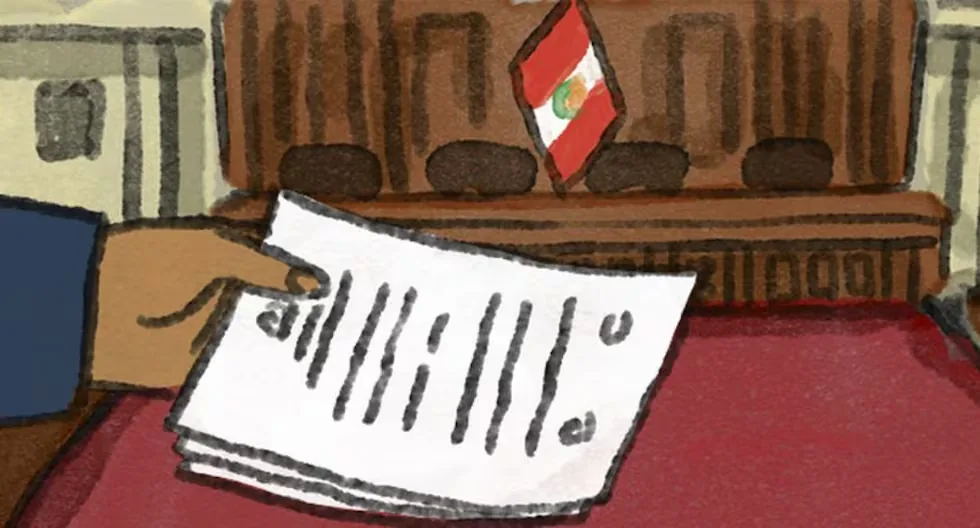
The Executive has requested Congress the delegation of powers to legislate on a wide variety of matters. Although the request has been made in general terms, the statement of reasons reveals the underlying objectives, and raises alarms about possible impacts on the environment, natural resources, and the rights of indigenous peoples. The text of the bill cannot be read in isolation. It is the statement of reasons that explains what the Executive really intends to legislate with each power requested, and it is what will later serve as a reference to verify if the legislative decrees remained within what Congress authorized.
First, the statement of reasons proposes to apply positive administrative silence (automatic approval of requests when the State does not respond in time) to certain management instruments. While this measure may work in many procedures, in the environmental case it can be harmful: an environmental impact assessment, for example, is not a procedure that can be considered fulfilled without the authority having conducted a rigorous evaluation that can identify and anticipate the impacts of a project and, in this way, determine its environmental viability.
Another point of concern is the possibility of reducing protected natural areas to allow projects of “public necessity and national interest.” The statement of reasons mentions the high potential of Madre de Dios for hydrocarbon exploitation; however, the identified areas of interest overlap with Manu National Park, Bahuaja Sonene National Park, and the Amarakaeri Communal Reserve, including part of a historical-cultural zone linked to the Harakbut people, where sites such as the Harakbut Face and the Inca House are located.
Protected natural areas are not created temporarily waiting for a project that is later considered a priority to appear. They are created because the State decides to permanently protect places that have special value for the country. Opening the door to reduce them to remove restrictions for subsequent economic projects fundamentally changes that logic.
There is also concern about the proposal that permanent production forests and forest concessions prevail over later and incompatible rights. In the case of indigenous peoples, the date of titling does not necessarily determine when a right over the territory was born. A community may receive its title after a concession has been established, although its rights are prior. Applying a rule of precedence solely based on dates could end up disregarding pre-existing rights and the mechanisms provided to resolve these overlaps.
Read more Earthquake in Peru today, Monday, September 7: recent tremors reported by the IGP
An even greater alert arises regarding indigenous peoples in isolation and initial contact (PIACI). The statement of reasons proposes to guarantee the continuity of rights linked to hydrocarbon activities, without sufficiently developing what would happen when these could affect the life, health, integrity, or self-determination of these populations in situations of extreme vulnerability. With them, the State has a protection obligation that should not be weakened without especially rigorous justification.
All this discussion also forces us to ask how much we are planning. Many of the decisions that today appear urgent are also the consequence of tasks that the State has been postponing. We have been talking for years about energy transition and the need to diversify our matrix, but how much have we really advanced in generating the conditions to better harness unconventional renewable energies? Without a long-term view, we end up deciding based on what we have available or what is easiest at that moment.
We know that there is much to simplify and modernize in the State, but this must be done without reducing environmental protection. It is not about choosing between conservation and development, because they are not opposing options. Simplifying also cannot mean eliminating controls or replacing technical criteria with the mere passage of time. It is about making the State more efficient, without giving up its obligation to protect rights, natural resources, and goods that belong to everyone.
For now, the decision is in the hands of Congress, which must conduct a thorough review of this request, including the reasons that support it. From the SPDA we are convinced that a State is not better if it resolves faster at any cost, but when it resolves well, with information, with technical criteria, and taking care of what, once lost, cannot be recovered.
Read more “Black Clover” Season 2: Confirmed Premiere Date