




![Alberto Beingolea: “If they insist on not giving [the powers], they are complicating life for Peru”](https://insightermedia.com/wp-content/uploads/2026/09/bb3fa9e11304ea13fe2cd333955007bc-150x150.webp "Alberto Beingolea: “If they insist on not giving [the powers], they are complicating life for Peru”")



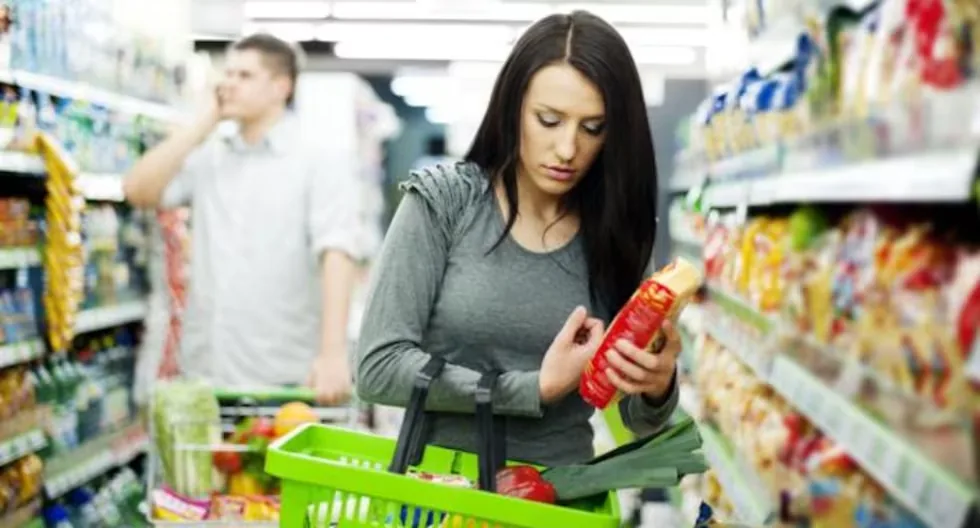
“The brand reading is clear: purpose no longer differentiates, the absence of purpose punishes; today it is a necessary factor, not a plus,” says José Oropeza, managing partner of Impronta Research. Ángela Álvarez, CEO of BBK Group, adds that sustainability has become a concrete expectation from users.
Read more Yvonne Frayssinet, Johanna San Miguel and Andrea Luna star in the comedy “Corazón de Loba”
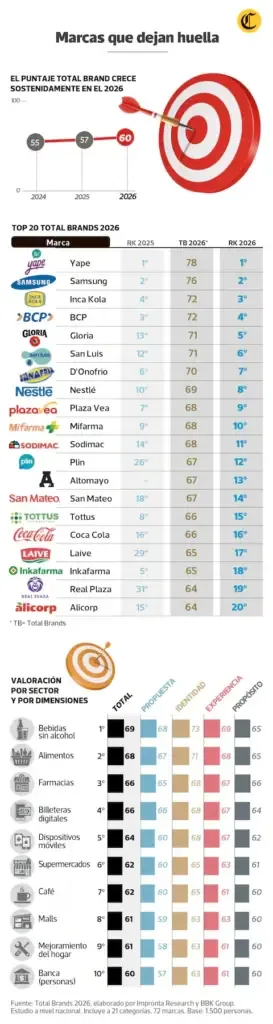
The Total Brands indicator measures the relevance of brands by consumers through four dimensions: Value Proposition, Identity, Experience, and Purpose. According to the specialist, with this 2026 the index has steadily increased over the last three years. “The average relevance index went from 55 points in 2024 to 57 in 2025, and to 60 in 2026. The general perception that the evaluated brands are responding (to consumer expectations) with greater adaptation, updating, and innovation has improved,” he explains. For Total Brands, he adds, a relevant brand is one that has vigor and energy to fulfill its promises and position itself against its alternatives. Additionally, it is perceived as capable of adapting to a demanding environment, manages to feel close, and builds bonds.
Oropeza explains that the growth of this indicator (Total Brands) is leveraged on the pillars of Identity and Experience, but the surprise has been the growth of the value proposition. In his view, this reflects that brands stopped competing only on image and renewal, and began to move the needle on the rational side (price/benefit, suitability, relevance), which was their weakest flank.
However, although the relevance indicator has improved by four points compared to last year, it continues to have the lowest score. Regarding this, Oropeza adds that while brands have improved in relevance, they still have difficulties being considered indispensable.
“Consumers recognize that brands are modernizing, but they are more open to change when they find an option with better price, experience, or convenience. This is the greatest risk for market brands – low structural loyalty – and explains why the ranking rotates so much year after year,” he maintains.
A ranking in motion
The ranking shows stability in its first two positions, but quite a bit of movement from third place onwards, analyzes the executive.
This 2026, Yape leads the list of the most relevant brands for the third consecutive year. It is followed by Samsung. Also, Inca Kola moves to third place; BCP to fourth, and Gloria rises to fifth place. Some of the most notable changes are seen in the jump of Agua San Luis, from 12th to 6th place, and in the advance of Plin, from 26th to 12th. (See infographic)

“Yape consolidates itself as the most relevant brand in the country. Why does it lead? Because it meets the three conditions of relevance simultaneously: it is in motion (it went from wallet to ‘marketplace’, services, and credit), it is imposing and current in identity, and above all, it is unique; it became a verb (“yapéame”). This is the highest degree of connection,” analyzes the specialist. For Álvarez, Yape has three strengths: everyday utility, experience, and identification, and it has benefited from the good performance of the digital wallets category which has 66 points in relevance. However, she indicates that although it leads by a wide margin, its challenge lies in preventing mass adoption from affecting the experience and in continuing to build trust.
“In a mass-use brand, an operational failure can affect millions of people, generating a greater reputational impact than in categories with lower frequency,” she warns.
Alessandra Pinto, Brand Strategy and External Communications Manager at Yape, comments that the app constantly listens to its users to understand what they need. She assures that its relevance is explained because the brand builds beyond functionalities; it creates impactful initiatives like “For a Peru for All,” with which they promote financial inclusion. She also highlights that they promote women’s soccer and bring useful information closer to the user, such as electoral information. “Our main challenge is to continue simplifying the lives of our users and accompany them in increasingly relevant moments of their daily lives,” she points out. Today there are more than 20 million ‘yaperos’ registered.

Samsung, for its part, consolidates as the second most relevant brand in the country. Mauricio Revollar, Integrated Marketing Communications (IMC) and Public Relations Manager of the brand, considers that its strength is not only in having a broad portfolio but in offering a connected ecosystem where smartphones, televisions, and appliances work in an integrated way thanks to artificial intelligence. He anticipates that they will focus on investing in research and development to strengthen AI as a transversal axis of their portfolio and access to these innovations for a greater number of users.
The third place, this time, is occupied by Inca Kola, which surpassed BCP. Álvarez explains that Inca Kola benefits from the strong performance of non-alcoholic beverages, which is the best-rated category in the study, with 69 points of relevance. Additionally, she indicates, it combines a very recognizable identity and generates cultural connection.
On the other hand, she adds, BCP continues to show significant strength. “It is the only banking entity in the top 10. BCP transcends the average performance of the category, possessing a superior identity and daily presence, according to the study, since the rest of the banking sector shows difficulties in differentiation and closeness, beyond financial products,” she details.
Read more Was it a red card? Olise’s hard tackle on Rodri sparks controversy in Spain vs. France | VIDEO
Anna Lenka Jáuregui, Marketing and Communications Manager at BCP, mentions that they seek to be an ally of Peruvians in their daily lives. For this, they not only offer products and services; they create initiatives with a positive impact. Today, she notes, the challenge of the banking industry is to find a balance between offering customers more and more products, services, and solutions, and also taking care of their financial health.
The ranking also includes Gloria, San Luis, D’Onofrio, and Nestlé. In the case of San Luis (from Coca-Cola), the jump of 6 positions compared to last year stands out. For Álvarez, the brand also benefits from the growth in relevance of the non-alcoholic beverages category, as does Nestlé, which has shown a jump of two positions. “In food, all evaluated dimensions grow but identity stands out, driven by a more current image and the renewal of the experience,” she emphasizes.
Moreover, Oropeza states that waters have been protagonists and the innovation in the category has played an important role in improving their renewal and experience indicators, which has improved their relevance as a sector.
From the multinational food side, Silvana Rosso, Legal & Corporate Affairs Director for Nestlé Peru & Bolivia, highlights that the corporate brand is a global company that maintains deep local roots. “We believe this progress – in relevance – in Peru responds to sustained work to better understand the local consumer,” she indicates. And while having products in multiple categories is a strength, she points out that it also implies choosing well where to focus.
D’Onofrio, a Nestlé brand, also appears in the top 10 of the ranking, with a slight drop of one position compared to last year. Álvarez comments that it is a minor change, which can be explained by the strong growth of other brands like San Luis.
Meanwhile, Oropeza considers that the sale of Nestlé’s ice cream business had an impact on the ranking. “When the future of a brand becomes news, its relevance suffers, from the brand perspective. This usually first impacts the Value Proposition dimension (relevance and price/benefit) and the perception of ‘brand in motion’ typical of Identity, because the consumer perceives uncertainty about continuity,” he asserts.
Plaza Vea and Mifarma complete the top 10 of the ranking. The supermarket showed a slight drop of two positions. For the Impronta Research executive, incidents in store (lines, stockouts, events that go viral) impact the experience pillar.
One of the surprises of the ranking has been the great leap of Plin, which although it is not in the top 10, advanced 14 positions and is now in 12th place. “The brand manages to capitalize in a context where interoperability broadens its real relevance of use and its multibank backing (Interbank, BBVA, Scotiabank), which gives network muscle against Yape. Its advance confirms that Peruvians have adopted the habit of using it,” he notes. Still, the gap with Yape shows that winning transactions does not equate to winning connection.
Álvarez highlights that Plin has advanced rapidly, but still has room to build a more differentiated identity and a stronger emotional relationship. In her view, Plin seems to be closing the distance between being a banking functionality and becoming a brand recognized on its own.
Data:
– There is an important sectoral component that explains why some brands like Cabify, Scotiabank, Movistar, or Bitel appear at the bottom of the ranking, the specialists agree.
“Telecommunications scores 53 points in relevance, and taxi apps, 51 points. These are two of the categories with the lowest performance. They are sectors where experience usually depends on sensitive operational factors: coverage, service continuity, billing, customer service, availability, waiting times, and complaint resolution,” he highlights.
Oropeza adds that telecommunications and taxi apps are considered sectors of low trust and high experience wear.
Read more Bonus for National Holidays 2026: until what date can the deposit be made?