




![Alberto Beingolea: “If they insist on not giving [the powers], they are complicating life for Peru”](https://insightermedia.com/wp-content/uploads/2026/09/bb3fa9e11304ea13fe2cd333955007bc-150x150.webp "Alberto Beingolea: “If they insist on not giving [the powers], they are complicating life for Peru”")


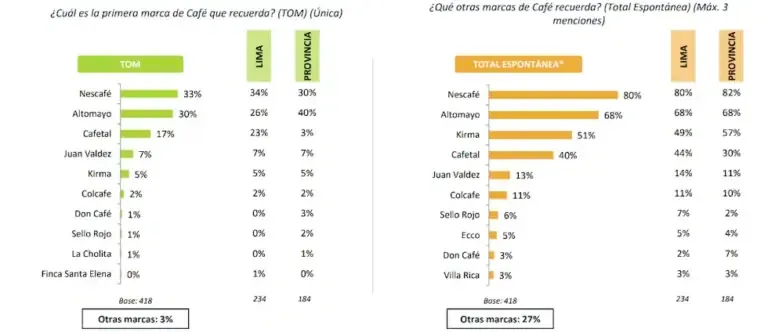
They are followed by Altomayo (68%), Kirma (51%) -also from Nestlé-, Cafetal (40%) and Juan Valdez (13%).
Also, Nescafé leads the ‘top of mind’ in the category, with 33%, followed by Altomayo (30%) and Cafetal (17%).
Alejandra Montoya, director of Coffee, Beverages and Culinary at Nestlé Peru, points out that Nescafé has positioned itself as a reliable brand, with tradition and an intense flavor that accompanies people throughout the day.
On the side of Kirma, she says, there are 60 years of presence in the market, characterized as a product close and accessible to people, as well as being recognized for its yield and familiar flavor.
“This [recall] reflects the closeness that both brands have built with Peruvian households over time. Both have managed to be present in everyday and relevant moments for families, although from different roles,” she indicates.
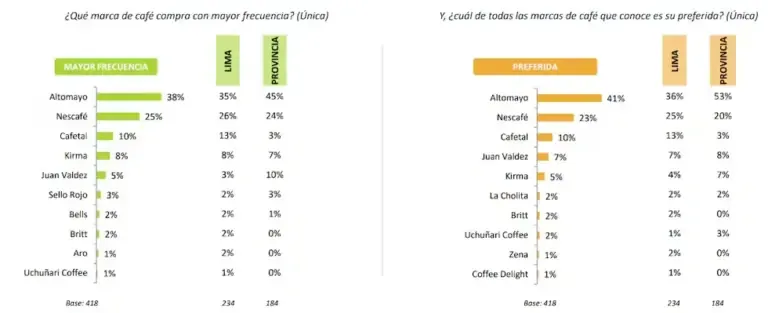
On the other hand, Altomayo leads consumption frequency (38%). Jorge Rubiños, commercial manager of Arellano Consultoría, points out that this translates into greater preference, as the brand is the favorite of 41% of those surveyed.
For its part, Cafetal is third in consumption and preference, with 10% in each of these indicators.
José San Martín, general manager of Romex, owner of Cafetal, recalls that the brand has existed for more than 60 years and is a benchmark in Peruvian roasted coffee.
He adds that they have presentations for every type of consumer, such as their recent presentation of freeze-dried instant coffee (premium dehydrated coffee).
Read more Julio Velarde and the value of stability
“Our work has always sought to reinforce the image that we are the brand with real coffee. It is a very traditional brand, in which you can fully trust for its quality and product homogeneity,” he says.
Consumption
According to Rubiños, Peru is a “very coffee-loving” market, as 82% of people consume this product.
Thus, San Martín comments that one of the challenges is to compete with the hot beverage segment, since there may be different customs in the various areas of the country.
A potential segment in which coffee consumption can increase is among young people, he indicates. And, for example, Cafetal has a high recall –with 73%– among people aged 56 to 65, while among young people aged 18 to 24 the percentage reaches 23%.
San Martín considers that young people appreciate coffee, and assures that a category that has benefited from this age group is specialty coffee, which has other preparation methods.
On the other hand, Montoya points out that there is an opportunity to continue developing the category due to its high relevance in the lives of Peruvians.
“Our focus is on continuing to build the habit of the first cup in the morning, opening new consumption occasions and bringing proposals that respond to market trends, such as more sensory and premium experiences, as well as the growth of cold coffee,” she expresses.
With Kirma, one of the focuses is to strengthen the local brand and consolidate its consumption volume.
Read more These are the top 15 bakeries in Lima, according to the Somos Awards 2026