




![Alberto Beingolea: “If they insist on not giving [the powers], they are complicating life for Peru”](https://insightermedia.com/wp-content/uploads/2026/09/bb3fa9e11304ea13fe2cd333955007bc-150x150.webp "Alberto Beingolea: “If they insist on not giving [the powers], they are complicating life for Peru”")



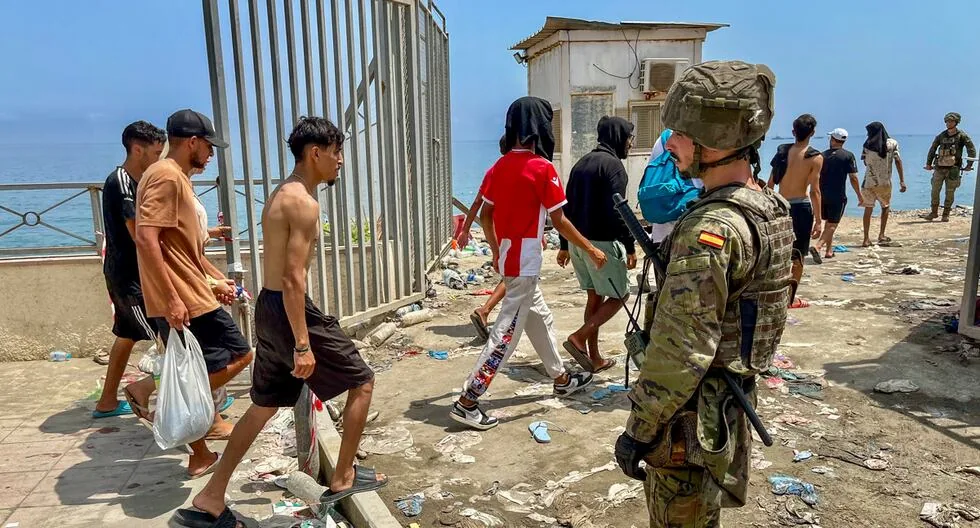
In small groups, migrants cross the border in the opposite direction and return to Morocco after spending two or three days in the Spanish enclave of Ceuta, wandering the streets with hardly any food.
At the border post, Spanish soldiers and civil guards directed a continuous flow of people, mostly very young, to exit on Saturday morning.
SEE HERE: Ceuta exposes Spain’s migration cracks: the keys to a crisis revealing a “failing” state
Some go barefoot, others carry a Red Cross blanket over their shoulders; many are visibly exhausted after several days of wandering.
“I’m leaving because there is no food, I thought I would find a warm welcome, but I didn’t,” explains Abdel Latif, 23, before crossing the border.
He had tried his luck to “find work” because “there is no work in Morocco,” laments this young man who lives off odd jobs, such as a mechanic.
Like him, several tens of thousands of migrants arrived within a few days in Ceuta, causing an unprecedented crisis in this small Spanish territory, as well as a diplomatic dispute within the European Union over the migration policy to be applied within the bloc of the Twenty-Seven.
Some daring ones still tried on Saturday to reach the enclave by swimming. Two men collapsed on the sand before the eyes of the soldiers, exhausted from their sea crossing.
One of them, very weak, had to be attended by Red Cross lifeguards, who wrapped him in blankets despite the heat, before evacuating him on a stretcher.
A soldier was pushing another man towards the exit, whose still wet clothes testified to his recent arrival.
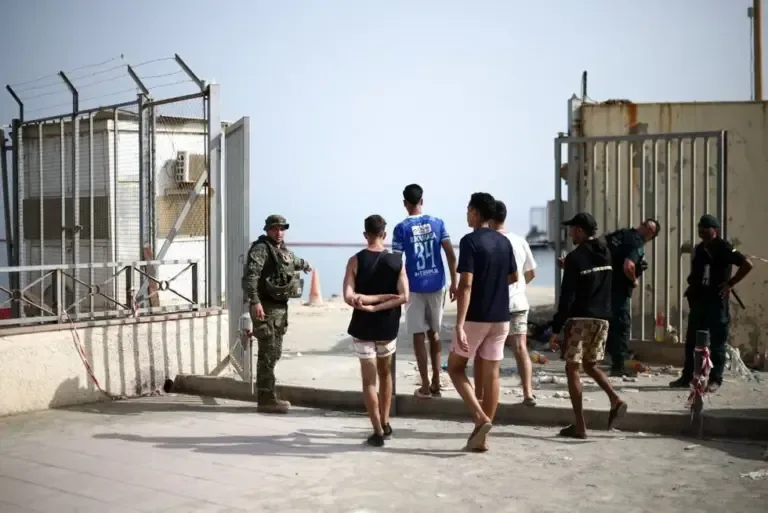
Further away, another man who was also trying to reach by swimming was rescued by a Spanish Civil Guard boat and then returned to Morocco.
No future in Morocco
About 60,000 migrants arrived within two or three days, according to an estimate by the local government president, Juan Jesús Vivas. The Spanish Ministry of the Interior raises the figure to 50,000 people.
MORE INFORMATION: At least 67 migrants died trying to enter Spanish territory of Ceuta
At least 67 of them died trying to reach Ceuta by swimming, according to the Interior Minister, Fernando Grande-Marlaska, who lamented “dramatic” events.
Read more Loto Plus 3905 of Saturday, August 1: prizes, broadcast, and draw time
“Virtually all” of the tens of thousands of migrants who entered the Spanish enclave of Ceuta in recent days have returned to Morocco, according to the Spanish government.
Ceuta, a small territory of 84,000 inhabitants located at the northern tip of Morocco and next to the Strait of Gibraltar, constitutes one of the two land borders between Africa and Europe (along with the other Spanish enclave of Melilla).
“Invasion? No. That is a lie,” said Soufian, a 42-year-old Moroccan who entered Ceuta by swimming on Thursday, in Spanish to AFP.
In his country, he works as a security agent twelve hours a day “for ten euros” daily, he explains to AFP, without giving his last name.
He has a black eye and a cut on his left cheek, after a fight among migrants during a food distribution, he said.
At the border, two boats were installing a floating barrier in the sea on Saturday to block access.
In Ceuta, most shops have reopened, cafes are full, and traffic is dense again.
In front of a supermarket in the city center, a small group of Moroccans was waiting to enter, but the staff had closed the doors and asked them to form a line.
ALSO SEE: Spain announces “normality” in Ceuta and calls for an urgent meeting on migration
Two police officers chased them away, making them run, before the eyes of soldiers stationed nearby. A few minutes later, the Moroccans returned and the line immediately reformed.
The situation has returned to a “reasonable normality” announced the Spanish Interior Minister, Fernando Grande-Marlaska.
But the residents have a different opinion. “The truth is there is no calm,” said Irene Cuadro, who works as a kitchen assistant and was waiting in line at a supermarket.
Read more Sastrería Martínez no longer needs a password: the new proposal from the award-winning bar
RECOMMENDED VIDEO