




![Alberto Beingolea: “If they insist on not giving [the powers], they are complicating life for Peru”](https://insightermedia.com/wp-content/uploads/2026/09/bb3fa9e11304ea13fe2cd333955007bc-150x150.webp "Alberto Beingolea: “If they insist on not giving [the powers], they are complicating life for Peru”")



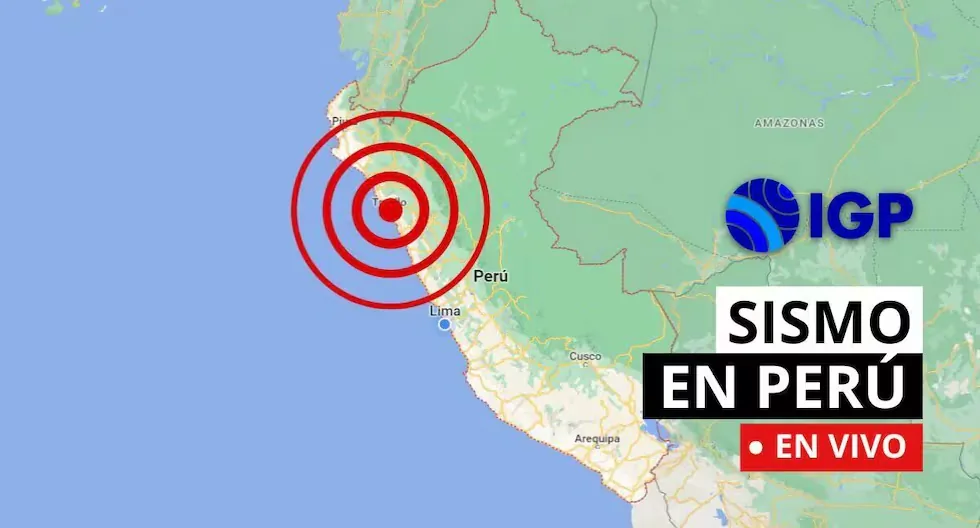
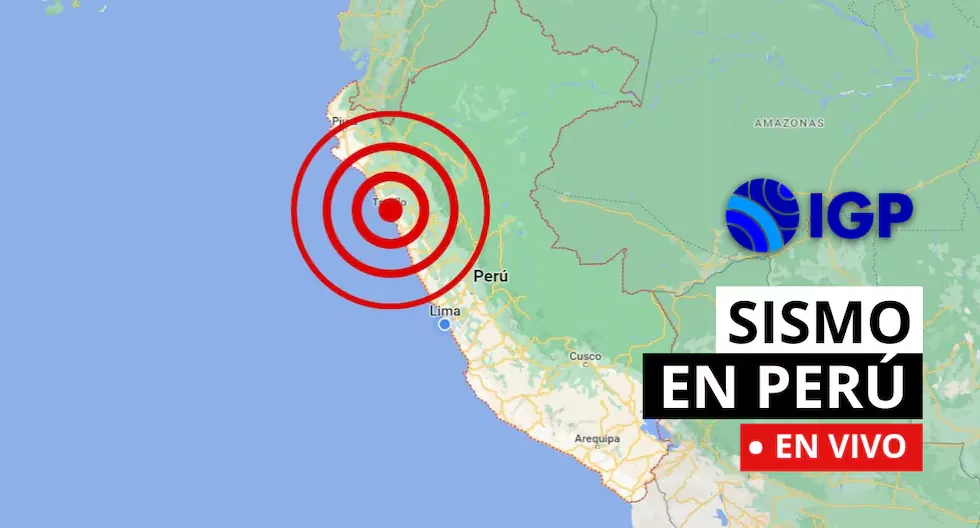
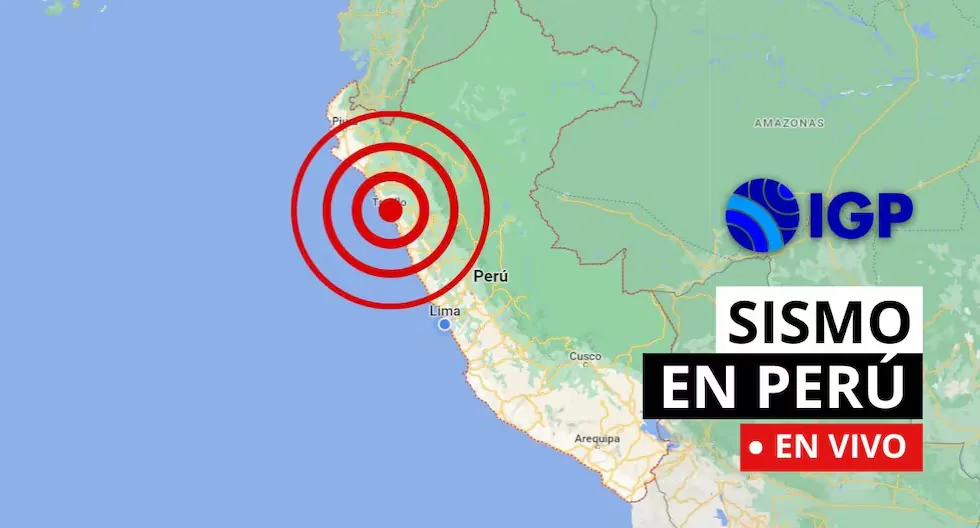
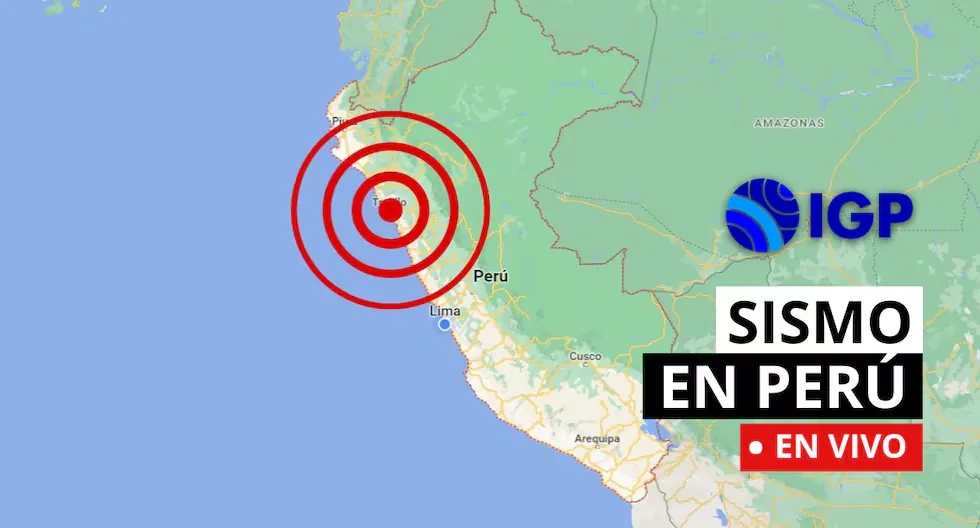
Follow live all seismic movements in the country, according to the reports published by the Geophysical Institute of Peru. Also check news related to this, as well as recommendations in these types of situations.
Earthquake in Peru via the IGP
- How much should the survival backpack weigh?
The ideal weight should not exceed 25% of the body weight of the person who will carry it, ensuring a quick and agile evacuation.
- Can an earthquake be predicted?
Currently, it is impossible to determine, since the Earth itself presents a wide dynamic regarding its movements, considering that it is not only about predicting when it will shake, but being able to determine the intensity, magnitude, depth, and other important factors.
- Earthquake 12 km W of Cangallo, Cangallo – Ayacucho
Local Date and Time: 08/21/2026,19:40:44
Magnitude: 3.5
Depth: 11 km
Latitude: -13.66
Longitude: -74.25
Intensity: II-III Cangallo
- What is the purpose and why is the emergency backpack important?
An emergency backpack is composed of important items to protect your health and that of your family for at least the first 24 hours of the emergency. As mentioned in the initial paragraphs, Peru is located in a high seismic activity zone, so it is necessary to be prepared for any emergency to assist those who need it most and protect their health.
For this, it is essential that you have an emergency backpack containing basic items (according to your family’s needs) to protect your health and well-being. Generally, these should weigh 8KG, but if your family is large, you may extend the capacity of the bag up to a maximum of 20KG.
- Earthquake 11 km E of Ilo, Ilo – Moquegua
Local Date and Time: 08/21/2026,18:23:52
Magnitude: 3.5
Depth: 46 km
Latitude: -17.62
Longitude: -71.24
Intensity: II-III Ilo
- Earthquake 15 km N of Huasicancha, Huancayo – Junín
Local Date and Time: 08/21/2026,17:09:44
Magnitude: 3.4
Depth: 10 km
Latitude: -12.21
Longitude: -75.33
Intensity: II-III Huasicancha
- Earthquake 96 km S of Ilo, Ilo – Moquegua
Local Date and Time: 08/21/2026,15:39:40
Magnitude: 3.8
Depth: 25 km
Latitude: -18.49
Longitude: -71.13
Intensity: II-III Ilo
- What does the emergency backpack contain?
Below, we will show you a list of items that cannot be missing from your emergency backpack and others recommended by the Ministry of Health of Peru (Minsa):
- 1. First aid kit
When an emergency or a situation that puts us in danger occurs, you may need some type of medicine or item to treat yourself or a family member. Therefore, to be prepared for any inconvenience, having a first aid kit is essential in every emergency backpack.
What does a first aid kit contain? Discover below the most important items it should currently have according to the Ministry of Health of Peru (MINSA):
Bandages
Gauze
Adhesive tape
Hydrogen peroxide
Painkillers
Antibiotics
Topical cream
Masks
2. Food
As explained in the initial paragraphs, emergency backpacks serve the purpose of providing assistance for at least the first 24 hours, depending on the number of items they contain. Therefore, to prepare your backpack in advance, it is necessary to include non-perishable foods and some others.
What types of food can you include in your emergency backpack? Know the list of the most recommended below:
Canned tuna
Noodles
Legumes
Cookies
Chocolates
- 3. Blankets and warm clothing
Without a doubt, equipping your emergency backpack with blankets and clothing to keep you and your family warm during the night is something that cannot be missing. For their health and safety, try to have at least one for each family member to ensure your health.
- Earthquake 96 km S of Ilo, Ilo – Moquegua
- Local Date and Time: 08/21/2026 15:39:40
- Magnitude: 3.8
- Depth: 25km
- Latitude: -18.49
- Longitude: -71.13
- Intensity: II-III Ilo
- 4. Water bottles
Staying hydrated during an emergency is essential. Therefore, water bottles play an important role inside emergency backpacks. They have a long shelf life, so storing them will not be a problem.
- 5. Battery-powered radio
A source of information that will always be valid even when the electricity goes out is the radio. Therefore, we recommend having one that works with batteries to use when you need it.
- 6. Portable charger
In case of earthquakes or other emergencies, there is a possibility that the electricity goes out for a moment. Therefore, it is necessary to have a power source that allows you to charge your smartphone, tablets, or any other electronic device, such as portable chargers.
How do you know when it will shake?
Earthquakes cannot be predicted, but seismographs and accelerographs detect ground movements in real time to alert us as quickly as possible.
Read more Dollar price in Peru, Friday, August 21: what was the exchange rate closing today
- 7. Flashlights
Following the topic of possible power outages, flashlights are items that will provide you with the necessary light to assist those who need it or to carry out any other activity that requires it.
How to know if an earthquake is strong?
There are two ways:
– Magnitude, measured on the Richter scale, indicates the energy released.
– Intensity, measured on the Mercalli scale, measures the impact on people and structures.
What to do after an earthquake?
Check for injuries, turn off gas and electricity leaks, avoid using the elevator, and stay away from damaged structures. If you are in a coastal area, check for tsunami alerts.
Why does the Earth shake?
Because tectonic plates move and accumulate energy. When this energy is released suddenly, an earthquake occurs.
What should my emergency backpack have?
It should contain the essentials to survive the first hours after an earthquake:
– Hygiene items
– First aid kit with bandages, alcohol, gauze, pills, among others
– Warm clothing
– Non-perishable foods such as tuna, energy bars, chocolates, and nuts, as well as cash
– Radio or flashlight with batteries
– Specific items according to needs, such as products for babies, elderly, or pets
How to prepare before an earthquake?
Conduct drills, have your emergency backpack ready, and plan an evacuation route with your family. Prevention saves lives.
What is the difference between earthquake, tremor, seismic event, and tectonic movement?
They are synonyms, but in some countries “earthquake” is used for the most destructive seismic events.
Report of the magnitude 3.4 earthquake with epicenter in Ocuviri, Lampa – Puno.
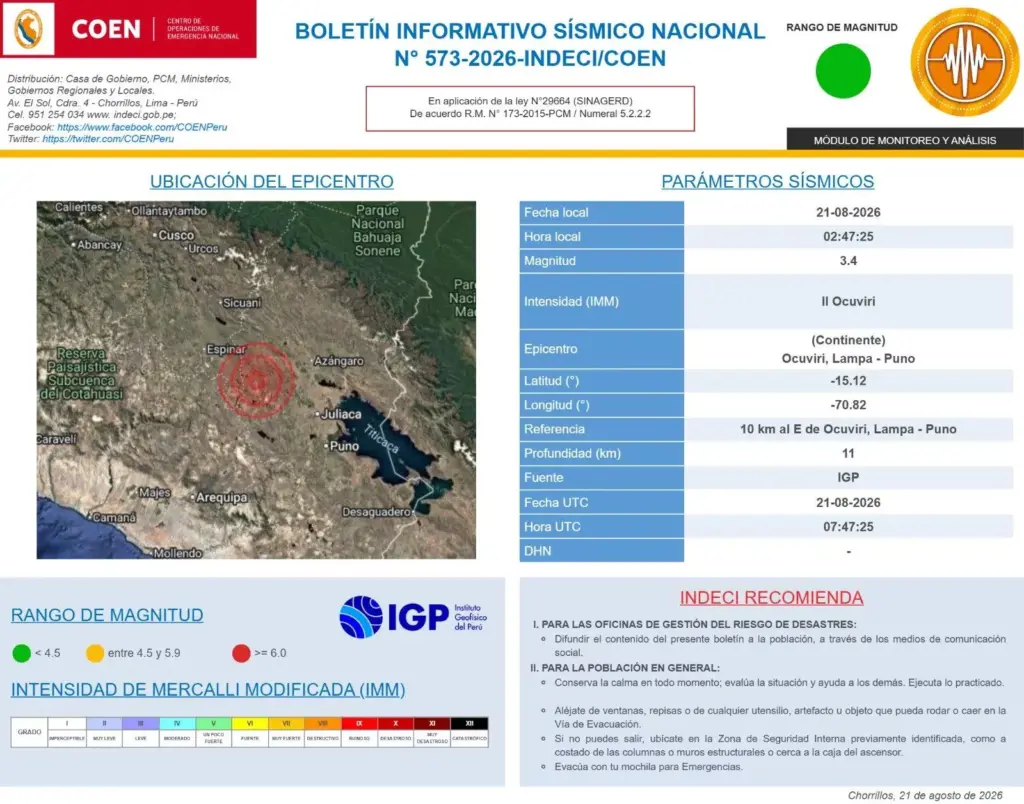
Earthquake 10 km E of Ocuviri, Lampa – Puno
Local Date and Time: 08/21/2026,02:47:25
Magnitude: 3.4
Depth: 11 km
Latitude: -15.12
Longitude: -70.82
Intensity: II Ocuviri
Report of the magnitude 3.5 earthquake with epicenter in Quilca, Camaná – Arequipa.
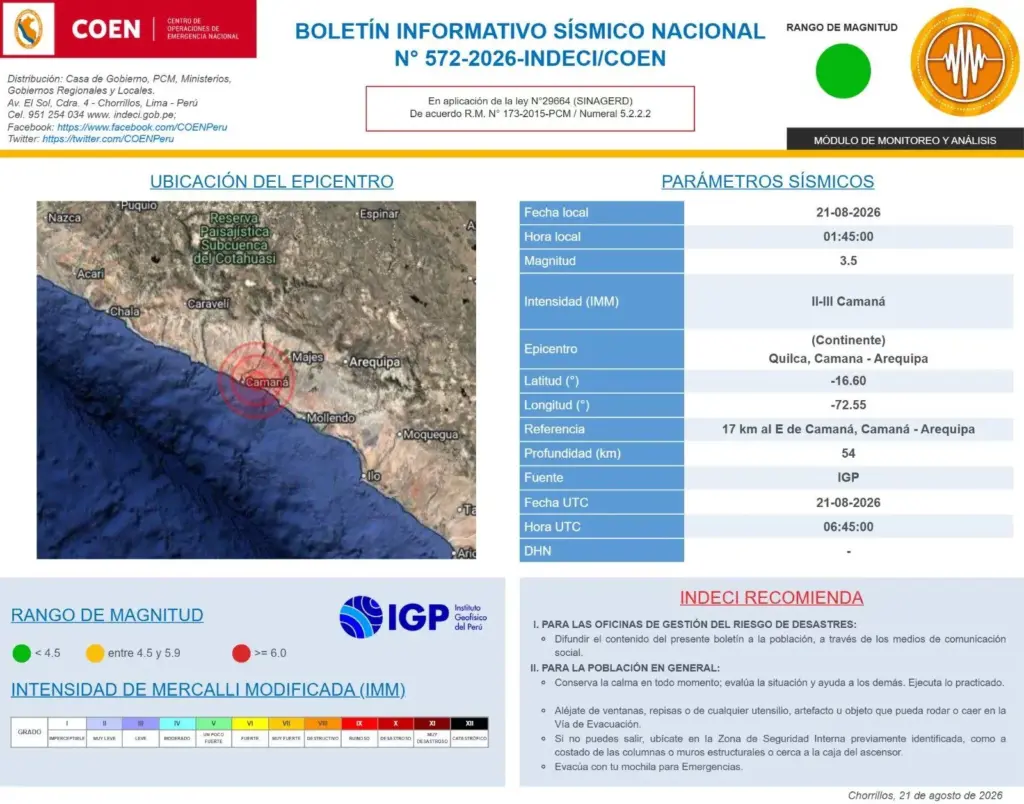
Earthquake 17 km E of Camaná, Camaná – Arequipa
Local Date and Time: 08/21/2026,01:45:00
Magnitude: 3.5
Depth: 54 km
Latitude: -16.60
Longitude: -72.55
Intensity: II-III Camaná
What to do before an earthquake
• Have your emergency backpack ready.
• Identify safe zones at home, work, and on the street.
• Participate in drills.
What to do during an earthquake
• Stay calm.
• Protect yourself under a sturdy table or in the triangle of life.
• Stay away from windows and objects that may fall.
What to do after an earthquake
• Assess damage and check for injuries.
• Use text messages to communicate and avoid overloading phone lines.
• Stay away from damaged buildings and follow authorities’ instructions.
- WHAT IS THE LARGEST MAGNITUDE EARTHQUAKE RECORDED BY INSTRUMENTS IN PERU?
On Thursday, October 3, 1974, an 8.0 magnitude earthquake was recorded in Lima at 9:21 a.m., striking the capital of Peru as well as much of the Peruvian coast to the south. The movement lasted about 90 seconds and resulted in 252 deaths and 3,600 injuries.
Peru is located in a seismic zone and the occurrence of earthquakes is inevitable. A study by the IGP indicates that there is accumulated seismic energy in the south of the country, which should encourage participation in drills.
The entity responsible for recording every tremor in the country is the Geophysical Institute of Peru (IGP). It also provides official information every time an earthquake occurs through its social media accounts.
- HOW ARE EARTHQUAKE DATA OBTAINED IN PERU?
The CENSIS obtains its data from the National Seismic Network (DS-0017-2018MINAM), composed and integrated by a series of velocity, acceleration, and displacement sensors distributed throughout the country.
- WHY IS PERU A HIGHLY SEISMIC ZONE?
Peru is a highly seismic country because it is located within the Pacific Ring of Fire.
- Check here the latest records from the Geophysical Institute of Peru about seismic movements in the country.
• Kabbalah: results from Thursday, August 20, 2026