





![Alberto Beingolea: “If they insist on not giving [the powers], they are complicating life for Peru”](https://insightermedia.com/wp-content/uploads/2026/09/bb3fa9e11304ea13fe2cd333955007bc-150x150.webp "Alberto Beingolea: “If they insist on not giving [the powers], they are complicating life for Peru”")



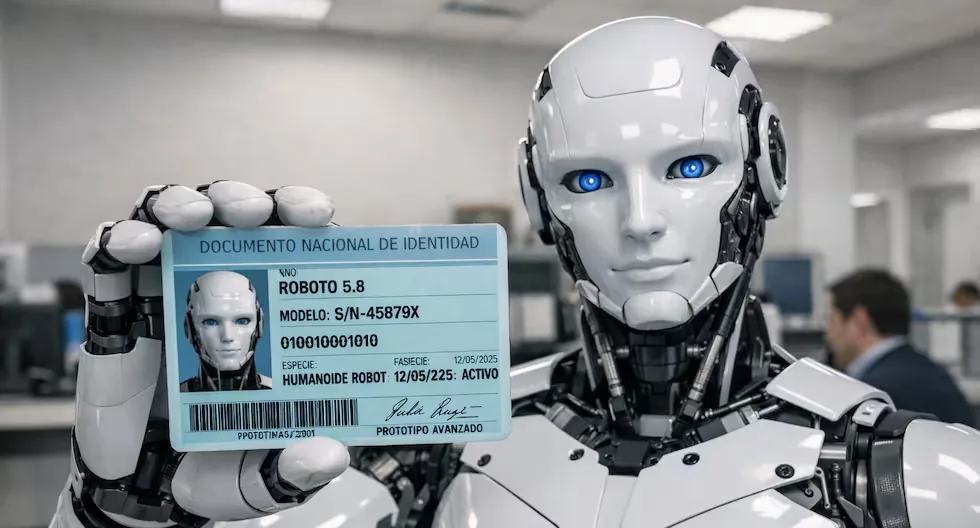
The Government of China recently announced the creation of a “digital identification” system for humanoid robots, amid the rapid expansion experienced by this sector in the country, which, similarly to the DNI, will assign a 29-digit code to each machine with the aim of facilitating its traceability.
The platform, presented at the end of May by the Humanoid Robotics and Embedded Intelligence Standardization Committee (HEIS), dependent on the Ministry of Industry and Information Technology of China, acts as the operational core of a new national regulation, which requires each humanoid robot to have a unique identity code.
SEE: Four 50 MP cameras, 8K video and 1 TB of storage: this is the Motorola Signature
The assigned identification will allow tracking of robots throughout their entire life cycle, from manufacturing to recycling.
The 29 digits accompanying each robot are not arbitrary, but are divided into four numerical segments with specific meanings.
The first two correspond to the country of origin and allow tracking of shipments and cross-border sales; next, a block of four digits identifies the manufacturing company, followed by six digits corresponding to the robot model.
The last 17 digits constitute the serial number, a unique identifier for each unit that allows precise traceability throughout its entire life cycle, from manufacturing to recycling.
Yu Xiuming, vice president of the China Electronics Standardization Institute, explained to Xinhua that China intends to use this identification system to address core issues in the humanoid robot industry regarding safety, supervision, and governance, as well as to accelerate the deployment of these robots in various uses.
The initiative is already applied to more than 100 Chinese humanoid robot manufacturers, and more than 28,000 robots of about 200 models have received a digital identity.
SEE: NASA will announce the four astronauts of the Artemis III mission on June 9
The measure comes at a time of growing interest in humanoid robotics in China, where authorities have identified these systems as one of the strategic areas of technological development.
The global humanoid robot market expanded by 508% last year, with about 18,000 total shipments worldwide in which Chinese manufacturers are “occupying a leading position supported by a comprehensive industrial supply chain,” according to data from consulting firm IDC cited by the South China Morning Post.
This Monday, one of the most visible firms in the humanoid robot sector in China, Unitree, which gained visibility for its demonstrations such as the Lunar New Year gala on state television CCTV, received permission from the Shanghai Stock Exchange to list and is expected to go public with a planned fundraising of about 4.2 billion yuan (610 million dollars).
- Xiaomi brings Leica telephoto to the entire T series and bets on batteries up to 7,000 mAh
- Four 50 MP cameras, 8K video and 1 TB of storage: this is the Motorola Signature
- RTX Spark, Nvidia’s new ‘superchip’ designed for AI developers, content creators, and gamers