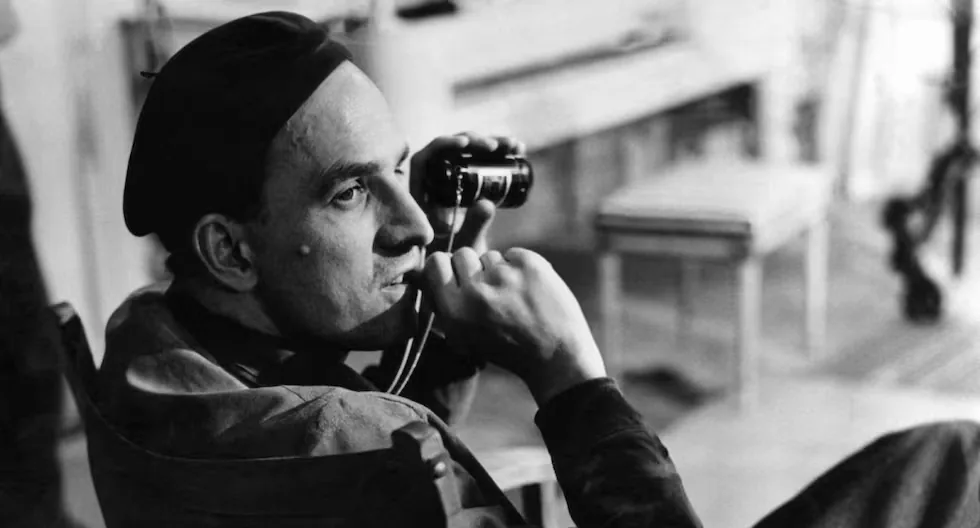
On July 30, 2007, in what could be defined as a coincidence as curious as it was fatal, two European filmmakers of great notoriety in the late 1950s and early next decade died: Michelangelo Antonioni and Ingmar Bergman; one in Rome, and the other at his residence on the island of Fårö, in Sweden. As critic Isaac León Frías points out, these were two key figures for a cinema rooted in postwar modernity, filmed with a more reflective attitude through procedures that broke with traditional dramatic forms — distancing, contemplation, longer shots — to explore human nature.
If we focus on the Swedish director, we could say that any panegyric usually written about Bergman will highlight him as an intellectual figure of European culture and a reference of its humanist tradition. And while this statement is not an exaggeration, critic Isaac León does not want to worship him like a marble statue. He and his troop of critics gathered for the book “Ingmar Bergman: a cinema with an open heart” seek, beyond his unquestionable intellectual dimension, to offer us aspects of a much closer and, literally, carnal artist. Isaac León likes to quote a phrase from the author of Persona in which he stated that he basically conceived most of his films “in the guts.”
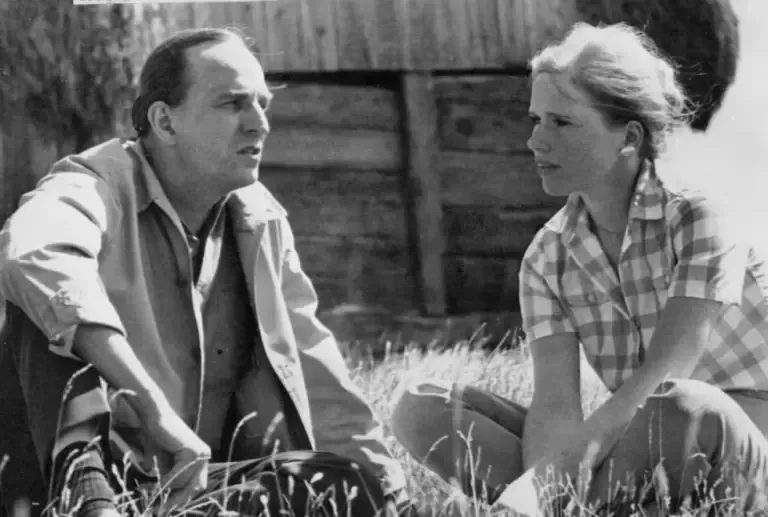
Ingmar Bergman and Liv Ullmann portrayed in 1968. (Photo: AFP/ Agencies)
For the critic, this statement is very revealing to define an intellectual creator, but whose cinema passes through the body: “For Bergman, the sensory, the physical, have a capital importance,” he warns. Not for nothing, León adds, Bergman was, before being a filmmaker, a man of theater. This explains why in his cinema, the physical and body expression are at the forefront of the image: from the voice and facial gestures in close-up to the sensuality of encounters.
“Bergman said that he made his films with his guts, from his very entrails. We are talking about an intellectual director, but whose cinema passes through the body.”
Isaac León Frías | Film critic
Therefore, more than worshiping him, the collected essays propose new approaches and perspectives: from the treatment of couple problems — in which Bergman was a pioneer by addressing the most conflicted and stormy relationships, as happens in Scenes from a Marriage (1973) —, through his interest in eroticism (Summer with Monika, 1953), relationships between women (in films like The Silence, 1963, or Persona, 1966), to his obsessions linked to physical deterioration, pain, and illness (Cries and Whispers, 1973).
Thus, avoiding the stereotypes erected about Bergman, León even points out how the filmmaker handles humor in his films, not from overflowing comedy, but from comedy linked to theatrical tradition, based on situations and dialogues, as happens in Smiles of a Summer Night (1955). “But even in Bergman’s dramatic films, there are moments that lend themselves to irony, sarcasm, and almost to joking,” he explains.
Another dimension that few notice in his filmography is his facet as a horror filmmaker. “Bergman was a filmmaker who anticipated the genre now called ‘Body horror.’ There is a line of contemporary cinema, represented by David Lynch or David Cronenberg, focused on bodily horror, which has a direct link to Bergman in the idea that the body has these other dimensions like illness.
The Swedish filmmaker on the set of the film “Summer Games” (1951). (Photo: Agencies)
/ Sjöberg Bildbyrå
Present influences
Although Bergman’s death at 89 — almost two decades ago — symbolically closed a stage in cinema, for Isaac León the legacy of the Swedish master has remained present. “Certainly, Woody Allen is one of the most declared heirs, especially in films like ‘Interiors,’ ‘Husbands and Wives,’ ‘The Other Woman,’ or ‘Hannah and Her Sisters.’ Even in one of the most recent ones, ‘Blue Jasmine,’ the film for which Cate Blanchett won the Oscar, Bergman’s mark is very clear.”
Likewise, León notes his influence on David Lynch — where the imprint of Persona is evident in his iconic Mulholland Drive — as well as on independent filmmakers like Noah Baumbach and Europeans like Michael Haneke, who even radicalizes Bergman’s proposal by portraying current and more desolate couple relationships.