




![Alberto Beingolea: “If they insist on not giving [the powers], they are complicating life for Peru”](https://insightermedia.com/wp-content/uploads/2026/09/bb3fa9e11304ea13fe2cd333955007bc-150x150.webp "Alberto Beingolea: “If they insist on not giving [the powers], they are complicating life for Peru”")


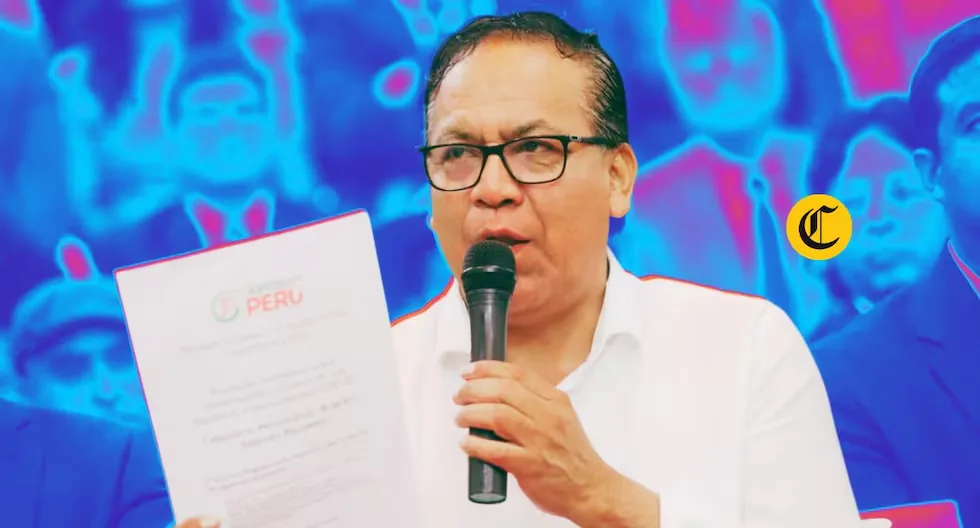
Just six days before the second round of elections and after the presidential debate, the candidate of Juntos por el Perú, Roberto Sánchez, presented a new government plan of more than one hundred pages, with which he tries to soften his original program.
Read more Where to vote? Check your polling place for the second round of the 2026 Elections at LINK
Also read | Hania Pérez de Cuéllar rules out spoiled vote in second round: “I am reflecting on that vote”
The document, called “Second Round Government Program of Juntos por el Perú: Strategic Priorities for Governance and Development with Equity of the Peruvian Nation 2026-2031,” has 114 pages, 22 more than the original proposal, presented to the National Jury of Elections.
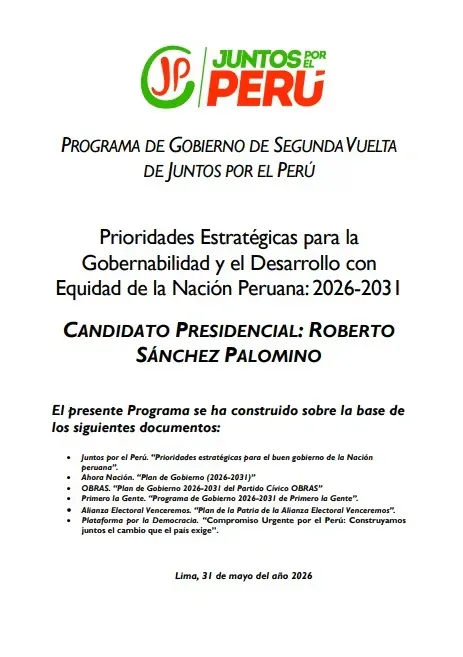
Sánchez has defined it as a “consensus” program that incorporates proposals from Ahora Nación, Primero la Gente, Obras, Venceremos, and other groups that support his candidacy in the second round.
In a press conference, when asked what would guarantee that he would not change the program again if he reached the Government Palace, the candidate did not answer directly and said that “this is the offer, the consensus program,” “the plan with which we will govern.”
Throughout the new plan, attempts can be seen to moderate some aspects of the radical discourse with which he advanced to the runoff. However, it maintains central proposals related to constitutional reform, the economic model, and mining formalization.
In economic matters, the new document states that it will respect the constitutional autonomy of the Central Reserve Bank of Peru (BCR) and will guarantee technical continuity and compliance with fiscal rules.
“The BCR has been and will be a key player in monetary stability, which complements fiscal stability. Therefore, under the government of Juntos por el Perú, we will safeguard the autonomy and independence that the BCRP has had for more than 30 years,” the document states.
Likewise, Juntos por el Perú now states that it commits to respecting Free Trade Agreements (FTAs) and promoting “investment-friendly regulations for both domestic and foreign investment.”
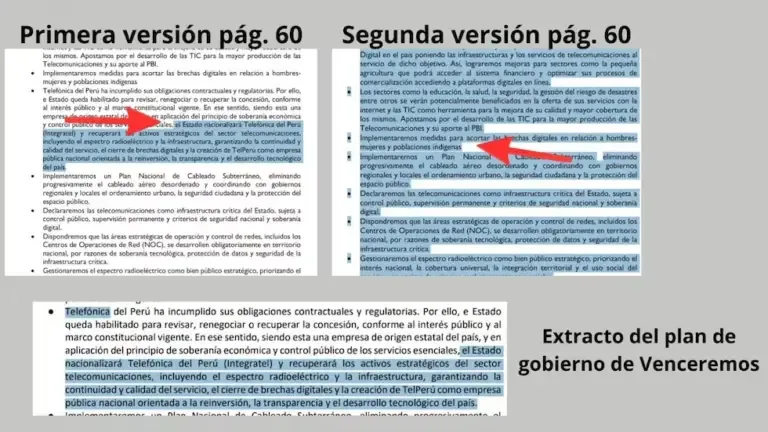
Even in a first version of the document – distributed in the morning – the nationalization of the company Telefónica del Perú (Integratel) was proposed, but the initiative was withdrawn from the text resent in the afternoon.
And reviewing the Venceremos Government plan, it also states that the State “will nationalize Telefónica del Perú and recover the assets.”
On his social media, former Minister of Economy David Tuesta wrote: “Juntos por el Perú seems to be bringing us several “new” government plans this week. They call it plurality and democracy: I call it improvisation”.
The plan in detail
The new plan maintains the proposal to review the current economic regime. Among its proposals is: “Return to the State an active role as a strategic planner of development, guarantor of sovereignty over natural resources and universal services, reviewing the economic regime of the Constitution so that development benefits the whole society and not just a few.”
In its original proposal, the position was more explicit regarding the state’s role in the economy. The document stated that “natural resources extracted from the subsoil will belong to the State. Therefore, any private individual who exploits them must pay for their extraction. Natural resources will be in the hands of the State and, although it will not be prevented from investing in their exploitation, their use will be promoted through public-private partnerships.”
Also read | Fact-checking the presidential debate: Keiko Fujimori vs. Roberto Sánchez
It also proposed direct State management of energy, productive, and strategic resources for the viability of the Peruvian nation: gas, oil, water, forests, energy, seas, airspace, ports.
“Concessions that grant special advantages to foreign investors, that jeopardize territorial sovereignty and our energy matrix, that put national entrepreneurs at a disadvantage, or that go against the public interest will be prohibited,” said the original plan.
Another topic in which the discourse has been toned down is constitutional change. The original plan established that: “The people will decide in due course the most appropriate way to reform the Constitution. It can be a partial reform or a total reform according to the political and social consensus achieved.”
It also stated: “It can be done based on the current text, or as a sign of respect for the value of a Constitution, resume the path set by the 1979 Constitution. What must be avoided at all times is that the modification of the Constitution is done by an ordinary Congress, where legislative interests are confused with constitutional objectives and changes are made for opportunistic purposes, as has been seen to the extreme in the current Congress. Therefore, the constitutional reform must be done by a Constituent Assembly convened for that express purpose, following the reform path approved by the assembly itself.”
Now, the new document proposes a “Consensus Constitution.” In this sense, it states: “As Juntos por el Perú, a consensus Constitution will be promoted through national dialogue, involving all sectors and society as a whole, following the democratic paths contemplated by the Political Charter and the law.”
It also proposes: “To lead a democratic and participatory process of constitutional change that, through national dialogue and citizen consultation, defines the path — comprehensive reform through article 206 or the convening of a constituent assembly — to provide the country with a consensus Constitution.”
Also read | Roberto Sánchez and Keiko Fujimori: referendum, public works, and human rights focused the block on the State
Regarding mining, the proposal maintains as a focus the formalization of small-scale and artisanal mining. The new plan states: “We will promote a new MAPE Law to seriously formalize small-scale and artisanal mining, incorporating thousands of producers into the formal economy with clear rules, legal certainty, and environmental responsibility.”
Mining formalization continues to be one of the common points between both documents, although presented under new regulatory mechanisms.
Changes are also observed in the chapter related to freedom of expression and the media. The new plan guarantees the free exercise of the press, media, and citizens who disagree, as well as stating that social protest will not be criminalized.
However, the original plan proposed that “traditional media assume, from their free and independent exercise, the commitment to the development and quality of life of the population.”
It also stated, “in this line, the State will promote the creation of educational, cultural, and informational community media at the national, regional, and local levels, granting licenses for the use of the radio spectrum equitably among the private sector, the state sector, and the community sector.”
It also proposed the creation of “citizen oversight bodies over the media, whose main function will be to issue alerts about content aimed at generating information blockages to the detriment of citizens or others that promote violence and discrimination.”
It is worth noting that, in its original proposal, Juntos por el Perú stated that Free Trade Agreements and other trade agreements would be renegotiated.
Recycled team
On Monday, June 1, Roberto Sánchez presented – in a press conference – his technical team, which is made up of questioned former ministers from the Castillo regime such as Rosendo Serna, Dimitri Senmache, Walter Ayala, and Andrés Alencastre.
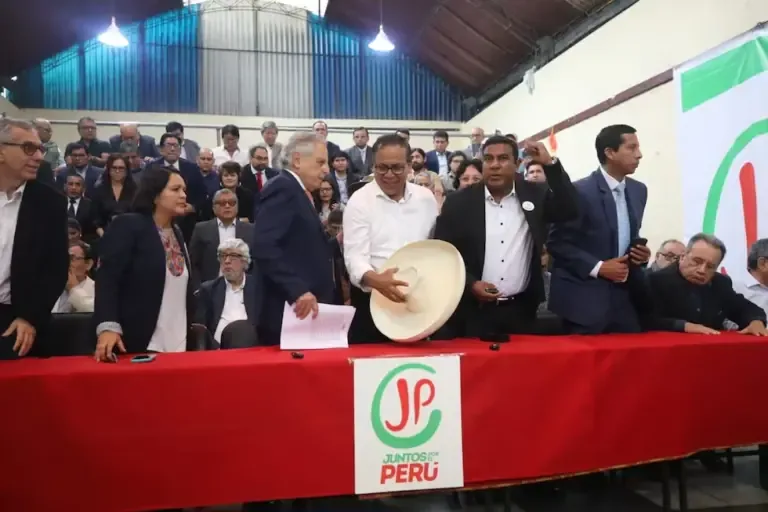
Serna, who served as Minister of Education, was questioned for allegedly having plagiarized 70% of his doctoral thesis, according to “Cuarto Poder.”
Senmache was censured as head of the Ministry of the Interior due to the escape of former Minister of Transport Juan Silva. Meanwhile, Ayala – who was Minister of Defense – is under investigation for the Irregular Promotions Case in the PNP and the Armed Forces. Alencastre, for his part, resigned from the Ministry of Agrarian Development and Irrigation after the urea crisis, which caused the rise in food costs.
They joined former ministers Pedro Francke, Anahí Durand, and Hernando Cevallos and former Deputy Minister of Finance Gustavo Guerra García, as well as former judge Duberlí Rodríguez and former prosecutor José Domingo Pérez, among others.
The presence of these figures in Roberto Sánchez’s circle is reflected in the shift his discourse has experienced ahead of the runoff.
Fuerza Popular also had additions to its team such as Carlos Neuhaus and Rafael Belaunde Llosa, although this did not imply changes in the proposals contained in its original government plan.
Analysis
In an interview with El Comercio, political analysts José Carlos Requena and Enrique Castillo described the document as extensive and warned that Sánchez’s most radical proposals remain. Meanwhile, environmental specialist César Ipenza considered that the new plan continues to seek to favor illegal mining.
Requena considered that the document presented by Sánchez seeks “to give a technical veneer to a proposal similar to the initial one,” but the most radical proposals are still maintained.
“They believe that with more reasonable language or explanation, it is a document of more than 100 pages, they can give it some feasibility […] They opt for a more emotional, more symbolic element that can assure them victory,” he said.
The specialist pointed out that the technical team presented by the JP candidate seeks “to give a cast to these proposals” and vindicate Pedro Castillo’s government.
For Requena, “there are no guarantees” that Sánchez will not change his discourse again. “As long as changing his proposals may be useful, [Sánchez] can update them in the not-too-distant future. In that sense, it is complicated to project guarantees,” he said.
Also read | Presidential debate: Keiko Fujimori reminds Roberto Sánchez of his closeness to “Antauro” and he points to her for “pro-crime laws”
For his part, Castillo described the new government plan as a “development document,” extensive, inconsistent, incoherent, and contradictory. “In practice, it is a very difficult document to carry out. I don’t think he can apply it,” he said.
He also opined that this plan “seeks to please the organizations that have given or want to give their support” to Sánchez.
“More than a government plan, it is a catalog of, apparently, all the proposals that existed in all the parties and organizations that have joined the JP candidacy,” he emphasized.
From Castillo’s perspective, the proposal “lacks logic, coherence, and consistency” and is “contradictory.”
“In economic terms, in order not to scare, they practically establish measures that do not differ much from the proposals of other centrist groups. However, it proposes strong State participation in a number of sectors. So, while on one hand it says it will respect macroeconomic fundamentals and the independence of the BCR and respect contracts, on the other hand it proposes an almost interventionist State,” he stressed.
According to the political analyst, Sánchez “has had to yield to pressures” and recalled that the candidate said he would not sign any roadmap. “However, he needs to show a new face that does not scare and after the debate he needs a boost to his candidacy,” he concluded.
Also read | Presidential debate: Keiko Fujimori indicates she will request powers to strengthen the PNP and Roberto Sánchez assures he will “clean” the institution of “bad elements”
On the other hand, Ipenza warned that there is “an insistence on continuing to favor informal miners, with various measures, but especially with disguised words.”
“They insist on reducing concession terms to be able to take them from some and give them to others. This means greater impunity. Miners are already insisting on repealing the legal framework and measures to facilitate their path,” he concluded.