




![Alberto Beingolea: “If they insist on not giving [the powers], they are complicating life for Peru”](https://insightermedia.com/wp-content/uploads/2026/09/bb3fa9e11304ea13fe2cd333955007bc-150x150.webp "Alberto Beingolea: “If they insist on not giving [the powers], they are complicating life for Peru”")



Earthquake in Colombia via the Geological Service
The SGC has a total of 339 seismic stations, located throughout the Colombian territory and in specific areas such as active volcanoes. 206 seismic stations are located covering the entire territory corresponding to the National Seismic Network and 133 seismic stations installed on the active Colombian volcanoes that are permanently monitored in three volcanological and seismological observatories.
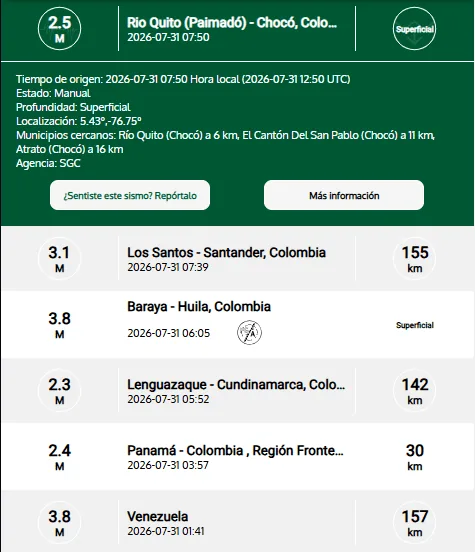
Find out here about the earthquakes that occurred in Colombian territory, reported by the Geological Service. Here we tell you which were the latest.
- HOW LONG SHOULD THE EMERGENCY KIT LAST?
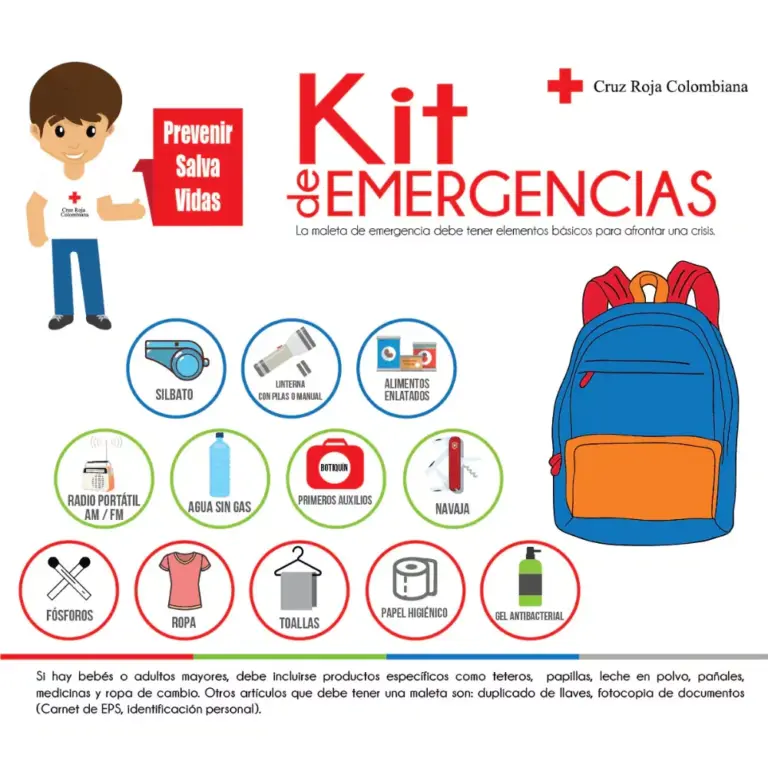
The emergency kit should be prepared thinking about the person or family group and it should be useful for 72 hours in case of emergency.
- CHECK WHAT AN EMERGENCY BACKPACK FOR THE HOME SHOULD CONTAIN.
- Updated earthquake reports:
- WHAT IS A SEISMIC SWARM?
- A seismic swarm is a group of earthquakes that occur in the same area over a short period of time. Unlike a single strong earthquake, seismic swarms usually consist of numerous minor tremors. Often, there is no main earthquake triggering the swarm, but the seismic events occur more or less continuously and are related to tectonic processes.
- HOW TO ACT DURING AN EARTHQUAKE?
- • Go to the already established safety zones.
- • Stay away from glass or objects that could fall.
- • If possible, avoid panic and try to stay calm.
- • Do not run in vehicle passage areas.
- • If you are driving, stop your vehicle.
- • If you are in a building, do not use the elevator, always use the stairs.
- • Be attentive to minors, disabled people, and the elderly.
- HOW TO DIFFERENTIATE A TREMOR FROM AN EARTHQUAKE?
- The terms “tremor” and “earthquake” are often used interchangeably, but generally, the difference lies in their magnitude, perceived intensity, and reach.
- • Tremor: Refers to seismic movements of lesser intensity. Usually, it is used to describe low-magnitude earth tremors that do not cause significant damage to structures or people. They are perceptible, but their impact is mild.
- • Earthquake: Refers to a seismic event of greater magnitude. Earthquakes are significant seismic tremors that can cause severe damage to buildings, infrastructure, and, in the most severe cases, cause personal injuries and even loss of life. They have considerable magnitude and are often accompanied by aftershocks.
- WHAT IS THE PACIFIC RING OF FIRE?
- The Pacific Ring of Fire is a geologically active region that surrounds the Pacific Ocean and the continents that border its waters. It is characterized by a high frequency of earthquakes and volcanic activity. It extends approximately 40,000 kilometers, including subduction zones where tectonic plates collide (such as the Nazca plate), generating frequent volcanoes and earthquakes.
- WHAT IS AN EARTHQUAKE?
- An earthquake is a sudden rupture of rocks inside the Earth. This sudden release of energy propagates in the form of waves that cause ground movement.
- Earthquake in Los Santos – Santander, Colombia
- Magnitude: 2.5
- Depth: 150km
- Local time: 2026-07-30 23:28
- Latitude: 6.87°
- Longitude: -73.07°
- Earthquake in Lloró – Chocó, Colombia
- Magnitude: 2.7
- Depth: 46km
- Local time: 2026-07-30 18:14
- Latitude: 5.54°
- Longitude: -76.50°
- WHY SHOULD YOU NEVER USE AN ELEVATOR DURING AN EARTHQUAKE?
- Experts recommend never using the elevator during an earthquake because it could detach from its structure and fall from a great height with people inside.
- WHAT TO DO IN CASE OF A TSUNAMI?
- If you receive official tsunami alert or alarm information or see the sea receding, evacuate to higher areas. Move to a flood-free zone and head to the nearest meeting point. If you cannot reach a high area, go to an upper floor or the roof of a solid building.
- Earthquake in Curumaní – Cesar, Colombia
- Magnitude: 2.4
- Depth: Shallow
- Local time: 2026-07-30 16:23
- Latitude: 9.35°
- Longitude: -73.48°
- CHECK AND NOTE THE EMERGENCY ASSISTANCE NUMBER.

- CHECK WHAT AN EMERGENCY BACKPACK FOR THE HOME SHOULD CONTAIN.
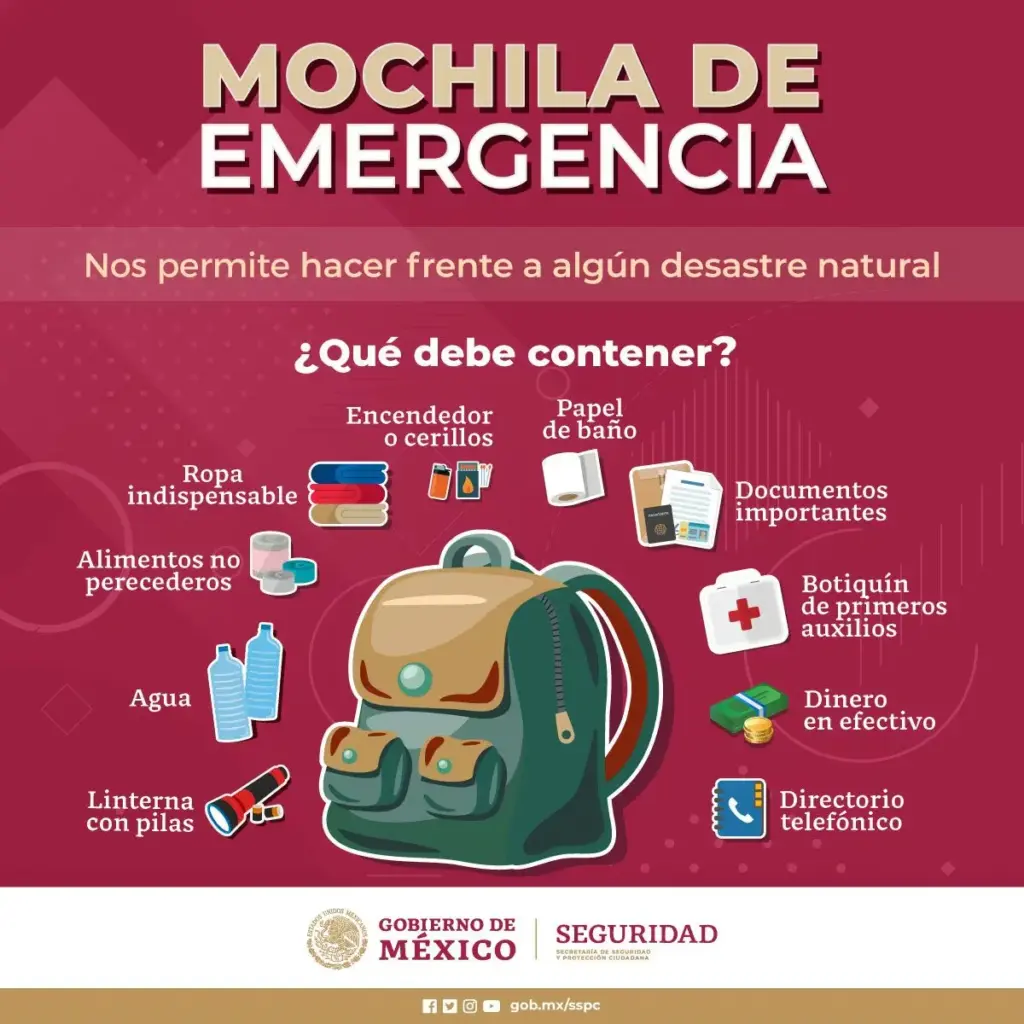
- WHAT SHOULD MY EMERGENCY BACKPACK CONTAIN?
- • Essential hygiene items
- • First aid kit (bandages, gauze, alcohol, pills, hydrogen peroxide, etc.)
- • Warm clothing
- • Non-perishable food (tuna cans, cereal bars, chocolates, nuts, etc.) and money
- • Communication items
- • Specific items for babies and infants, feminine use, the elderly, and other basic needs.
- CHECK WHAT AN EMERGENCY BACKPACK FOR THE HOME SHOULD CONTAIN.
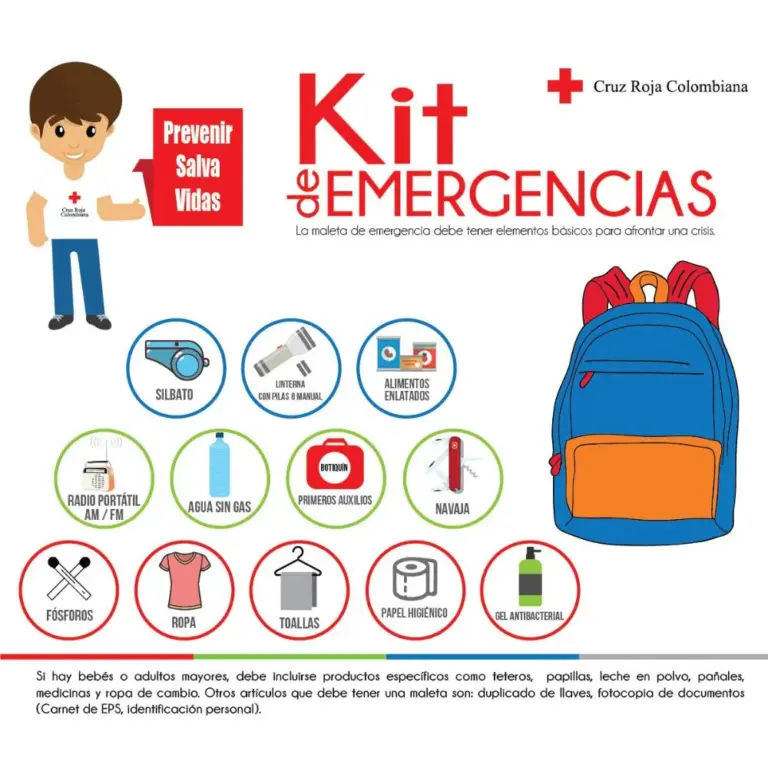
- WHY ARE THERE SO MANY EARTHQUAKES IN COLOMBIA?
- Colombia is located in the northwestern corner of South America, where the South American, Nazca, and Caribbean tectonic plates converge; a characteristic that explains the high level of seismicity in the country.
- EMERGENCY PHONE NUMBERS – COLOMBIA
- • Emergency line: 123
- (It is the single national emergency line, allowing Colombians to access all emergency and security services offered by the State through one number)
- • National Police: 112
- • Traffic Police: 127
- • Civil Defense: 144
- • Firefighters: 119
- • Red Cross: 132
- • Ambulance Service: 125
- • Gaula – Anti-kidnapping: 165
- • Disaster Attention: 111
- CAN EARTHQUAKES BE PREDICTED?
- So far, there is no reliable technique anywhere in the world for earthquake forecasting, and we are still far from achieving it.
- However, although earthquakes cannot be predicted in time, they can be predicted in space, meaning in certain areas it can be said that an earthquake will occur, but when it will happen is unknown.
Earthquake in San José del Palmar – Chocó, Colombia
Magnitude: 3.4
Depth: 81 km
Local time: 2026-07-30 13:38:18
UTC time: 2026-07-30 18:38:18
Latitude: 5.08°
Longitude: -76.08°
Earthquake in Los Santos – Santander, Colombia
Magnitude: 2.6
Depth: 139 km
Local time: 2026-07-30 04:35:48
UTC time: 2026-07-30 09:35:48
Latitude: 6.80°
Longitude: -73.18°
Earthquake in Los Santos – Santander, Colombia
Magnitude: 2
Depth: 139 km
Local time: 2026-07-30 04:01:11
UTC time: 2026-07-30 09:01:11
Latitude: 6.79°
Longitude: -73.12°
What to do if I am on the street when an earthquake starts?
Look for an open place away from poles, trees, or buildings. Beware of electrical wires. If you are driving, stop carefully in a safe place.
Why does the Earth shake?
Because tectonic plates move and accumulate energy. When this energy is suddenly released, an earthquake occurs.
What to do after an earthquake?
Check for injuries, turn off gas and electricity leaks, avoid using the elevator, and stay away from damaged structures. If you are in a coastal area, check for tsunami alerts.
What is the difference between earthquake, tremor, seismic event, and telluric movement?
They are synonyms, but in some countries “earthquake” is used for the most destructive seismic events.
How to know if an earthquake is strong?
There are two ways:
– Magnitude, measured on the Richter scale, indicates the energy released.
– Intensity, measured on the Mercalli scale, measures the impact on people and structures.
What should my emergency backpack have?
It should contain the essentials to survive the first hours after an earthquake:
– Hygiene items
– First aid kit with bandages, alcohol, gauze, pills, among others
– Warm clothing
– Non-perishable food such as tuna, energy bars, chocolates, and nuts, as well as cash
– Radio or flashlight with batteries
– Specific items according to needs, such as products for babies, elderly, or pets
Read more Dollar price in Peru: how much the exchange rate opened TODAY, Friday, July 31
What to do before an earthquake
• Have your emergency backpack ready.
• Identify safe zones at home, work, and on the street.
• Participate in drills.
What to do during an earthquake
• Stay calm.
• Protect yourself under a sturdy table or in the triangle of life.
• Stay away from windows and objects that may fall.
What to do after an earthquake
• Assess damage and check for injuries.
• Use text messages to communicate and avoid overloading phone lines.
• Stay away from damaged buildings and follow authorities’ instructions.
- Earthquake in Medina – Cundinamarca, Colombia
Magnitude: 2
Depth: Shallow (Less than 30 km)
Local time: 2026-07-29 20:24:11
UTC time: 2026-07-30 01:24:11
Latitude: 4.64°
Longitude: -73.42°
- Where should the emergency backpack be stored?
It should be located in a visible, dry, and easily accessible place, preferably near the main exit door of the home.
- How often should the survival kit be checked?
It is recommended to check the backpack every 6 months to verify the expiration date of food, water, and medicines, as well as the condition of batteries.
- How much should the survival backpack weigh?
The ideal weight should not exceed 25% of the body weight of the person who will carry it, ensuring a quick and agile evacuation.
- Can an earthquake be predicted?
Currently, it is impossible to determine, since the Earth itself has a wide dynamic regarding its movements, considering that it is not only about predicting when it will shake, but also determining the intensity, magnitude, depth, and other important factors.
- WHAT IS SEISMIC SILENCE?
- Seismic silence is a prolonged period without significant or intense seismic activity in a region, which may indicate the accumulation of tectonic stresses and an increased risk of a future earthquake.
- Earthquake in Los Santos – Santander, Colombia
Magnitude: 2.3
Depth: 144 km
Local time: 2026-07-29 16:49:35
UTC time: 2026-07-29 21:49:35
Latitude: 6.76°
Longitude: -73.12°
- EMERGENCY PHONE NUMBERS – COLOMBIA
- • Emergency line: 123
- (It is the single national emergency line, allowing Colombians to access all emergency and security services offered by the State through one number)
- • National Police: 112
- • Traffic Police: 127
- • Civil Defense: 144
- • Firefighters: 119
- • Red Cross: 132
- • Ambulance Service: 125
- • Gaula – Anti-kidnapping: 165
- • Disaster Attention: 111
- Earthquake in La Jagua de Ibirico – Cesar, Colombia
Magnitude: 2.3
Depth: 116 km
Local time: 2026-07-29 14:57:42
UTC time: 2026-07-29 19:57:42
Latitude: 9.53°
Longitude: -73.39°
- Earthquake in Cumbal – Nariño, Colombia
Magnitude: 4.2
Depth: Shallow (Less than 30 km)
Local time: 2026-07-29 10:27:04
UTC time: 2026-07-29 15:27:04
Latitude: 0.83°
Longitude: -77.87°
- CHECK AND NOTE THE EMERGENCY ASSISTANCE NUMBER.

- Earthquake in La Jagua de Ibirico – Cesar, Colombia
- Magnitude: 2.3
- Depth: 116 km
- Local time: 2026-07-29 14:57:42
- UTC time: 2026-07-29 19:57:42
- Latitude: 9.53°
- Longitude:-73.39°
- Why does it shake so much in Colombia?
The Colombian Geological Service, the entity responsible for monitoring earthquakes in the country and reporting them, shared a series of data about why seismicity occurs in Colombia, which can help us prepare for any earthquake.
- Colombia is a seismically very active country, as there are different tectonic plates in contact, causing earthquakes in most of the territory.
- The most seismically active places in the country are the coasts and around our mountain ranges.
- There is a place where earthquakes occur almost every day and represents 60% of the seismicity in Colombia: the Bucaramanga Seismic Nest, located in the department of Santander, near the municipality of Los Santos.
- On average, there are 2,500 earthquakes per month in the country, but most are not of significant magnitude or intensity. Many of them we don’t even feel!
- In the 30 years that the National Seismic Network has been monitoring seismic activity in the country, almost 300,000 such events have been recorded.
- Where a large magnitude earthquake has already occurred, it is very likely that another will occur in the future. That is why it is so important to keep in mind the seismic history of our country and regions.
- Aftershocks (seismic movements following an earthquake, of lesser magnitude and occurring in the same region) generally occur in shallow earthquakes, which happen less than 30 km from the surface.
- The effects an earthquake can have on a place’s infrastructure and, therefore, on people, depend, among other things, on the relationship between its magnitude and depth. The greater the magnitude and the shallower the depth, the greater the impact.
- The deeper an earthquake is, the more its energy can spread across the territory.
- There is still no scientifically proven method to predict earthquakes. Therefore, we must prepare to minimize their impacts, and having earthquake-resistant constructions is the best way to do so.
- WHAT SHOULD MY EMERGENCY BACKPACK CONTAIN?
• Essential hygiene items
• First aid kit (bandages, gauze, alcohol, pills, hydrogen peroxide, etc.)
• Warm clothing
• Non-perishable food (tuna cans, cereal bars, chocolates, nuts, etc.) and money
• Communication items
• Specific items for babies and infants, feminine use, the elderly, and other basic needs.
- CHECK WHAT AN EMERGENCY BACKPACK FOR THE HOME SHOULD CONTAIN.
- A new tremor was recorded on the morning of Wednesday, July 29, 2026, on the border between Ecuador and Colombia. The epicenter of the earthquake was 9.46 kilometers from Cumbal, Nariño, according to the Ecuadorian Geophysical Institute.
- Considered a high seismic risk country, Colombia is a country located in the Pacific Ring of Fire , a zone that concentrates 75% of the volcanoes in the world and where approximately 80% of the strongest tremors worldwide occur.
- What are “earthquake lights” and why do they occur?
Earthquake lights are an unusual luminous phenomenon that some people report seeing in the sky during or before an earthquake. Although rare, scientists suggest they could be caused by electrical charges released due to friction and stress in certain types of rocks in the Earth’s crust during seismic rupture.
- Earthquake in Tufiño – Carchi, Ecuador, Colombia
- Magnitude: 4.2
- Depth: Shallow (Less than 30 km)
- Local time: 2026-07-29 10:27:04
- UTC time: 2026-07-29 15:27:04
- Latitude: 0.83°
- Longitude:-77.87°
- WHY ARE THERE SO MANY EARTHQUAKES IN COLOMBIA?
Colombia is located in the northwestern corner of South America, where the South American, Nazca, and Caribbean tectonic plates converge; a characteristic that explains the high level of seismicity in the country.
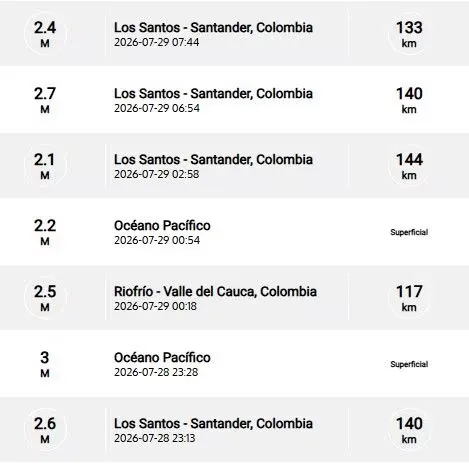
Recent earthquakes reported by the SGC.
- WHAT IS THE LARGEST MAGNITUDE EARTHQUAKE RECORDED IN COLOMBIA?
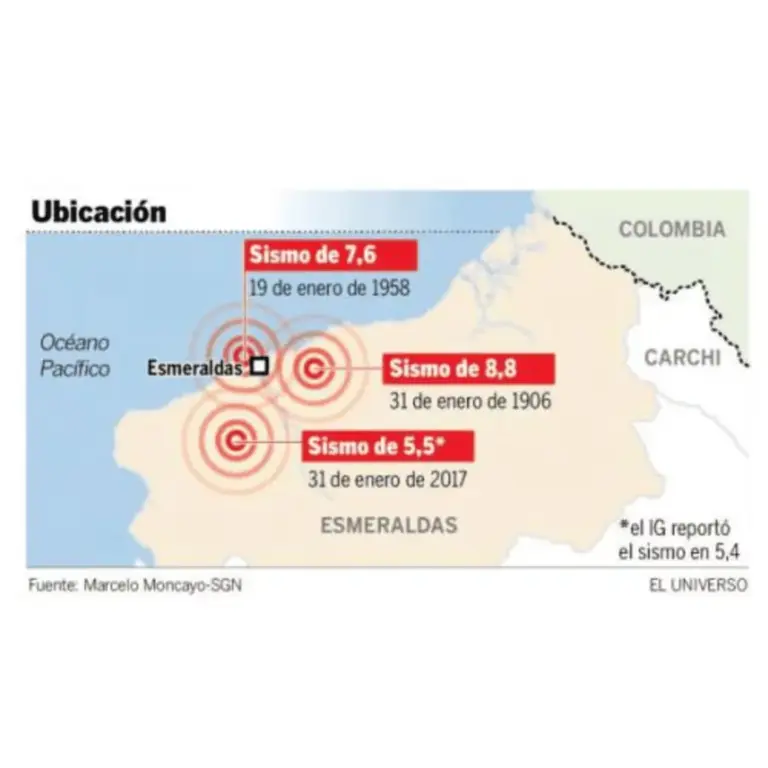
- The earthquake on January 31, 1906, located in the Pacific Ocean off the coasts of Esmeraldas (Ecuador) and Tumaco (Colombia) with an estimated moment magnitude of 8.8 is the strongest earthquake recorded in the country.
- WHAT IS AN EARTHQUAKE?
- An earthquake is a sudden rupture of rocks inside the Earth. This sudden release of energy propagates in the form of waves that cause ground movement.
- WHAT IS SEISMIC SILENCE?
- Seismic silence is a prolonged period without significant or intense seismic activity in a region, which may indicate the accumulation of tectonic stresses and an increased risk of a future earthquake.
- WHAT IS THE DIFFERENCE BETWEEN EARTHQUAKE, TREMOR, SEISMIC EVENT, AND TELLURIC MOVEMENT?
- In reality, the four terms are synonyms, but in Latin America special emphasis has been given to the term earthquake to refer to destructive seismic events or those that have caused victims.
- HOW MANY SEISMOGRAPHS ARE THERE?
- NATIONAL SEISMIC NETWORK OF COLOMBIA-RSNC
- The SGC has a total of 339 seismic stations, located throughout Colombian territory and in specific areas such as active volcanoes. 206 seismic stations are located covering the entire territory corresponding to the National Seismic Network.
- There are 133 seismic stations installed on the active Colombian volcanoes that are permanently monitored in three volcanological and seismological observatories.
- WHAT IS THE COLOMBIAN GEOLOGICAL SERVICE?
- The Colombian Geological Service (SGC) is a century-old science and technology entity attached to the Ministry of Mines and Energy, whose objective is to contribute to the country’s economic and social development through research in basic and applied geosciences of the subsurface, the potential of its resources, the evaluation and monitoring of geological hazards, comprehensive management of geoscientific knowledge, research and nuclear and radioactive control, attending to the priorities of the National Government’s policies.
What was the magnitude and where was the last tremor? See here the reports from the Colombian Geological Service (SGC) about the latest earthquakes in the country.