



![Alberto Beingolea: “If they insist on not giving [the powers], they are complicating life for Peru”](https://insightermedia.com/wp-content/uploads/2026/09/bb3fa9e11304ea13fe2cd333955007bc-150x150.webp "Alberto Beingolea: “If they insist on not giving [the powers], they are complicating life for Peru”")


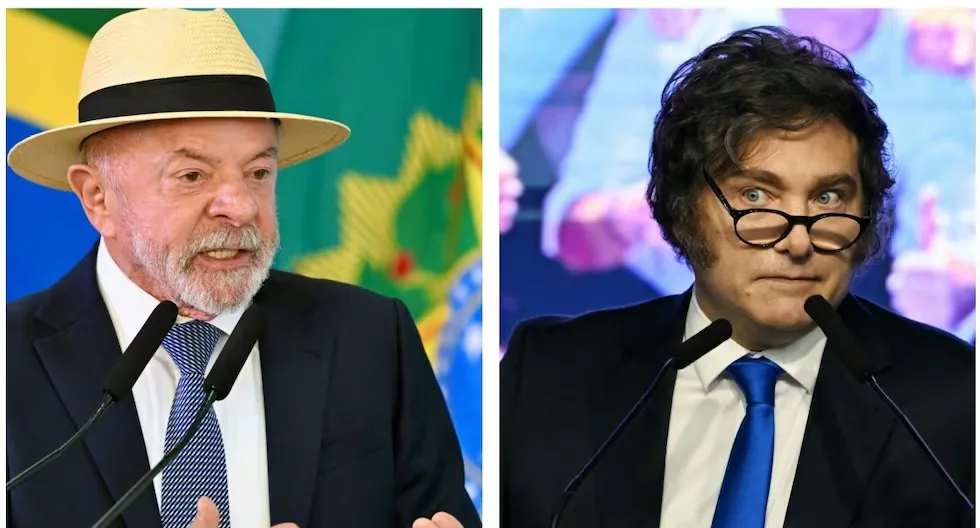
The crisis unfolded in several stages. On July 24, Milei traveled to Sao Paulo to support the launch of Flávio Bolsonaro’s presidential campaign, son of former president Jair Bolsonaro, Lula’s main rival. During the visit, the Argentine avoided any contact with the Brazilian Government and participated in events organized by the opposition.
Read more Earthquake in Mexico today: where was the epicenter of the latest quake on August 5?
SEE HERE: From economy to security: what does Gustavo Petro leave Colombia to Abelardo de la Espriella?
While in Brazil, Milei attacked Lula and also questioned Supreme Federal Court judge Alexandre de Moraes, who leads judicial processes against Bolsonaro and his allies for the attempted coup against Lula in January 2023.
In his speech in Sao Paulo, Milei referred to Lula as a “prisoner” and “thief” and accused him of “squandering” Brazil’s public money.
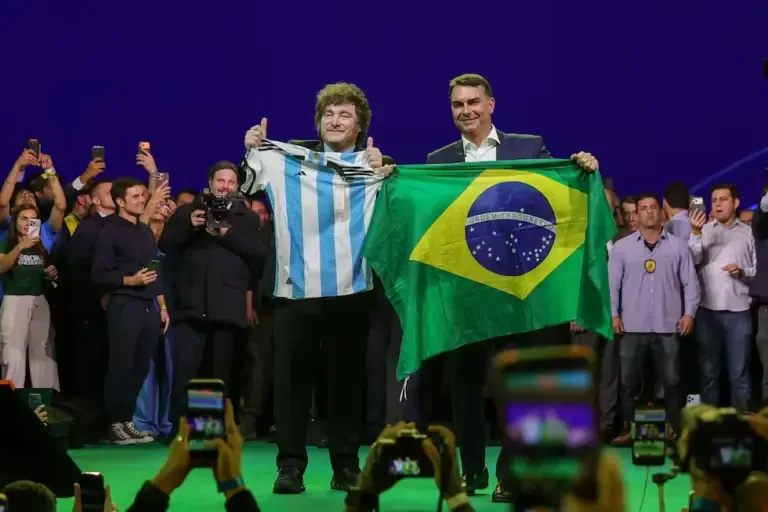
Milei also said that Flávio Bolsonaro is the only candidate capable of “stopping the socialist trash” at the polls.
As a reaction, on July 26 Brazil recalled its ambassador in Buenos Aires, Julio Bitelli. Meanwhile, Foreign Minister Mauro Vieira also summoned the Argentine ambassador to convey the Brazilian Government’s rejection.
General elections in Brazil will be held on Sunday, October 4. If none of the presidential candidates obtains more than 50% of the valid votes, the second round is scheduled for Sunday, October 25.
After returning to Argentina, Milei did not moderate his tone and in two interviews insulted Lula again.
“He is a thief, he is corrupt, he was convicted for being a thief and corrupt, he was imprisoned, so it is also true that he is a prisoner,” Milei said about Lula to LN+.
“Not only that: he was released due to a procedural error, not because he was innocent. Therefore, he is a thief and corrupt,” he added.
Finally, on Tuesday Brazil announced it was downgrading its diplomatic relations with Argentina to chargé d’affaires level. It also informed that its ambassador would not return to Buenos Aires.
Additionally, it said it is up to Argentina to decide whether to keep its ambassador in Brasilia or withdraw him, although it specified it will not deal directly with him while the crisis remains open.
For its part, the Argentine Foreign Ministry regretted the decision of Lula’s Government. “The Argentine Republic takes note of the decision unilaterally adopted by the Government of the Federative Republic of Brazil, and regrets its decision to continue isolating itself from the rest of the region for purely ideological reasons,” it said in a statement.
According to the latest survey by the Genial/Quaest center, in the first round of elections Lula would obtain 39% of the votes and Flávio Bolsonaro 30%. While in the second round the leftist would get 44% against 39% of the right-wing candidate.
Milei seeks to consolidate himself as a leader of the regional right
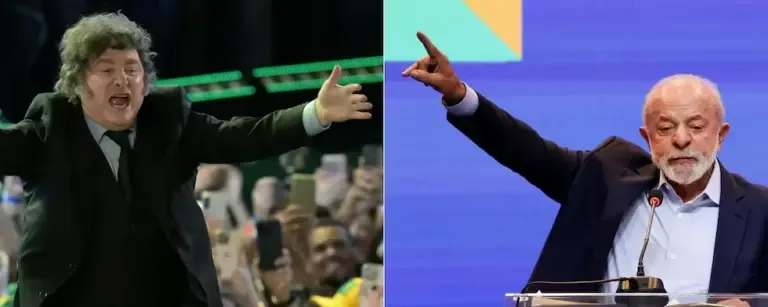
For international relations expert Francesco Tucci, director of the Communication and Journalism program at the Peruvian University of Applied Sciences (UPC), the confrontation with Lula responds to a political strategy of Milei that goes far beyond ideological differences and lists three objectives.
The first, Tucci tells El Comercio, is to reinforce his narrative of the so-called “culture war” against socialism and communism in Latin America, presenting himself as one of the main references of the right in the region.
The second is a domestic political objective. According to Tucci, the dispute with Lula also allows Milei to divert attention from domestic problems, such as economic adjustment, tensions with Congress, and the wear and tear of governance itself. “External tensions work as a distraction mechanism that allows mobilizing ideological passions and reactivating the support of his base,” he states.
And the third, Tucci adds, fits with Milei’s critical stance towards Mercosur. “By straining the relationship with Brazil, its main trading partner, he probably seeks to weaken the bloc’s cohesion and open space for more flexible bilateral negotiations,” he points out.
Read more La Tinka live: result of Wednesday, August 5 and millionaire jackpot of S/ 22.5 million
Regarding the Brazilian Government’s reaction, the analyst considers that Milei’s support for bolsonarism was the factor that finally broke Brasilia’s patience.
“Milei’s participation in the Brazilian presidential campaign was not a conventional diplomatic gesture: it was direct interference in Brazil’s internal politics in an election year,” he asserts. He also recalls that the attacks against Lula did not start this year, but date back to the 2023 Argentine presidential campaign, when the Brazilian president had already demanded apologies for the slanders.
For Tucci, the fact that Milei traveled to Sao Paulo to back Flávio Bolsonaro and called Lula a “prisoner,” “thief,” and “corrupt” ended up triggering an unprecedented response. “In an electoral context as polarized as Brazil’s, any gesture that can be interpreted as support for the opposition is received with extreme sensitivity,”, he explains.
“This is the worst crisis between Argentina and Brazil since the return of democracy,” he states. Tucci indicates that the crisis already transcends the bilateral level. “What began as a gesture of ideological solidarity with bolsonarism has become a crisis that threatens to reshape the map of South America and the solidity of Mercosur. The key question is whether there will be regional actors (including organizations like the OAS) capable of mediating before the damage becomes even more severe.”
“I don’t think there will be normalization before the elections in Brazil”
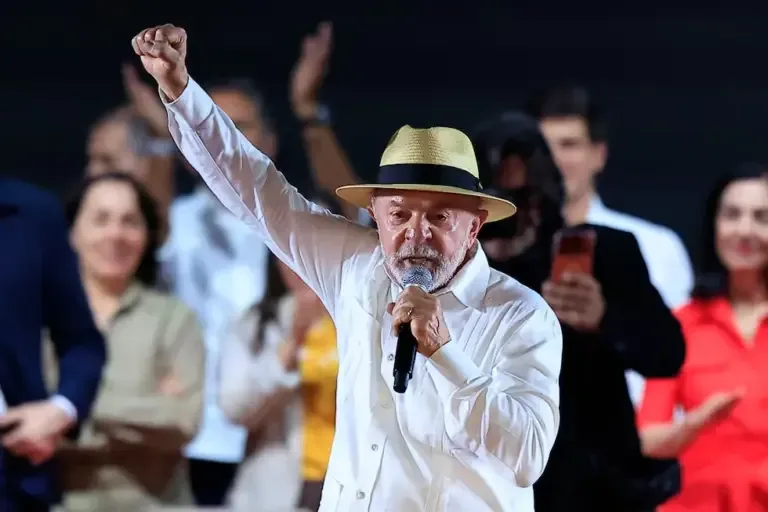
Ambassador Juan Álvarez Vita tells El Comercio that the crisis cannot be understood solely from the ideological differences between Milei and Lula. He says the conflict is also marked by the Argentine leader’s personal style and the growing tension accumulated between both governments.
“When a person holds the office of head of state, they must consider that their words are no longer just personal but represent an entire country,” he says. He recalls that Milei had already had strong verbal confrontations with Pope Francis, whom he called “representative of the evil,” and maintains that this same style has ended up transferring to the relationship with Brazil.
Álvarez Vita points out that the differences between a president identified with the most radical right and another from the left have deepened the bilateral deterioration, but considers that the breaking point was Milei’s open support for bolsonarism. “His trip to Brazil to participate in the launch of Flávio Bolsonaro’s campaign added fuel to the fire in a relationship that was already accumulating frictions,” he emphasizes.
The ambassador considers that the conflict has a strong personal component. “The tensions have become more evident at the leaders’ level than at the state level. This problem originates largely in personal matters,” he explains.
Álvarez Vita states that a prompt reconciliation will be difficult. “I don’t think there can be normalization of relations before the presidential elections in Brazil in October,”.
However, he downplays the practical impact of the diplomatic downgrade decided by Brazil. He even questions the effectiveness of ambassador withdrawals as a pressure tool.
“Withdrawing an ambassador can become a kind of self-sanction, because you are withdrawing precisely the person with the most experience to manage the relationship with that country,” he argues.
He recalls that even among rival powers, the current practice is to keep diplomatic channels open. He mentions as examples the relations between the United States and Russia or between Washington and Beijing, where despite deep political differences, ambassadors remain in their posts.
Likewise, he considers that the Brazilian government’s decision also has an internal political component. “Lula is campaigning for re-election and this type of measure can give him electoral gains, because in such situations citizens tend to rally behind their president,” he points out.
Despite the political gravity of the crisis, Álvarez Vita estimates that the economic impact will be limited. “Trade and economic relations between Argentina and Brazil will continue. There is more noise than nuts,”.