




![Alberto Beingolea: “If they insist on not giving [the powers], they are complicating life for Peru”](https://insightermedia.com/wp-content/uploads/2026/09/bb3fa9e11304ea13fe2cd333955007bc-150x150.webp "Alberto Beingolea: “If they insist on not giving [the powers], they are complicating life for Peru”")



An earth tremor can turn an everyday journey into an emergency situation in a matter of seconds. Amid the confusion, running towards an exit, forcing a door, or trying to leave a vehicle without authorization can increase the danger. Therefore, the Urban Transport Authority for Lima and Callao (ATU) reminded the protocols that passengers must follow if an earthquake surprises them while using public transportation. The provisions cover the main mobility systems of the capital, including the Metropolitano, the complementary corridors, the Aerodirecto service, and lines 1 and 2 of the Lima Metro. The premise is clear: in an emergency, users must remain calm, stay alert, and follow the instructions of the personnel responsible for safety. The response during the first seconds is crucial. Workers of each service have established protocols to identify safe spaces, control passenger movement, and, if the situation requires, coordinate an evacuation. Therefore, acting on one’s own can end up complicating an operation designed precisely to reduce risks.
Read more Payment schedule for August 2026: when will BANCO DE LA NACIÓN VIA deposit to public workers?
If the earthquake surprises you inside a bus
Those traveling on the Metropolitano, the complementary corridors, or the Aerodirecto should not try to get off while the vehicle is still moving. The recommendation is to wait for the driver to slow down and stop the vehicle in a place that offers suitable conditions for a safe exit.
The doors will not open while there is a risk to passengers. In that scenario, trying to force them open or leaving the bus hastily can expose people to accidents and other dangers derived from the emergency.
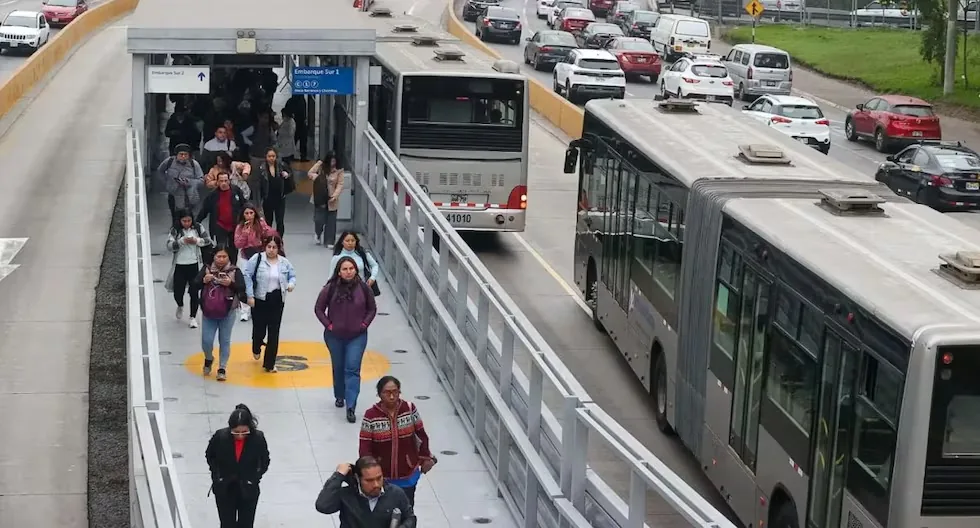
Specifically, in the case of the Metropolitano, buses will be directed to the nearest station, where the disembarkation of users can be organized. If the movement occurs when the passenger is in a boarding area, they must remain within the spaces previously identified as safe and wait for the corresponding instructions before moving.
What happens if the tremor occurs in a station?
Not all situations require immediate evacuation. If the passenger is in a boarding area when the movement begins, the most important thing is to identify the marked zones and stay there while the emergency lasts.
The instinctive reaction to quickly look for an exit can cause crowding and hinder the work of the personnel in charge of controlling the situation. Instead, waiting for instructions allows movement to be carried out in an orderly manner and only when conditions exist to do so.
The ATU seeks for users to understand that the protocols not only indicate what to do but also what actions should be avoided. In an emergency, a hasty decision can turn a controlled situation into a higher-risk scenario.
On the Metro, going down to the tracks is prohibited
The procedure changes when the earthquake occurs while a person is aboard a train on lines 1 or 2 of the Lima Metro. In this case, the main rule is strict: passengers must not go down to the tracks under any circumstances.
If the train is stopped between two stations, users must remain inside the cars and keep the doors closed. The fact that the train is immobilized does not mean there is authorization to exit; any evacuation must be determined by the responsible personnel.
When the train is in a platform area, conditions may be different and the doors could remain open. Even so, passengers must stay inside the car until they receive an official indication determining the next step.
The final decision rests with specialized personnel
After an earthquake, the priority is to assess whether the infrastructure and operating conditions allow the service to continue or if it is necessary to activate an evacuation. That assessment corresponds to the security personnel and those responsible for each transport system.
Therefore, users must avoid individual movements, opening doors without authorization, or trying to leave trains and buses on their own. Coordination is an essential part of the response to an emergency.
In situations like this, knowing how to react can make a difference. Staying calm, remaining in safe areas, and following official instructions helps reduce risks and facilitates the teams in charge of the emergency to act without obstacles.
Read more Holidays in Peru 2026: what are the upcoming days off until the end of the year?