





![Alberto Beingolea: “If they insist on not giving [the powers], they are complicating life for Peru”](https://insightermedia.com/wp-content/uploads/2026/09/bb3fa9e11304ea13fe2cd333955007bc-150x150.webp "Alberto Beingolea: “If they insist on not giving [the powers], they are complicating life for Peru”")




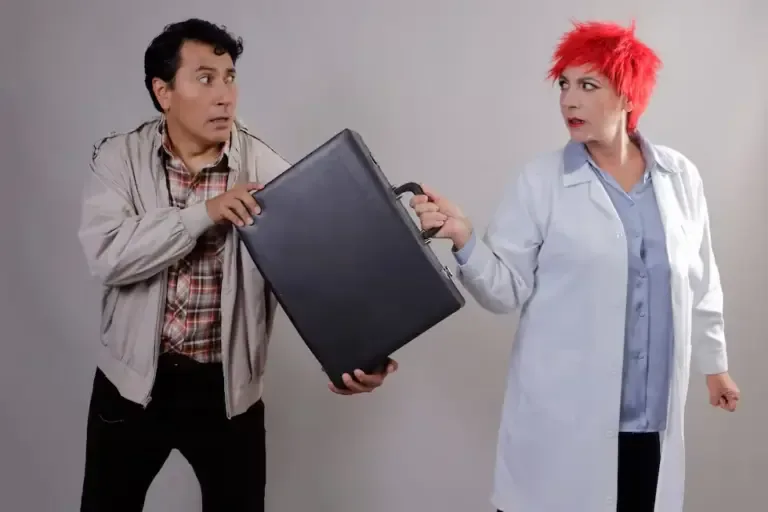
There is something unsettling about an apparently innocent question when the person asking it has the power to change the rules of the conversation. In I.D.I.O.T.A., a play directed by David Carrillo, Carlos Varela enters a room to take a test and soon discovers that it is far from a conventional exam. Each answer opens a new situation and turns the viewer into a witness of a game in which no one seems to have complete control.
Read more Earthquake in Colombia: Seismological report for Saturday, August 22 according to the SGC
The play, which is currently at the Teatro de Lucía until September 20, plays precisely with that uncertainty. What begins with the tone of a comedy ends up shifting towards suspense, drama, and increasingly uncomfortable situations. Carlos tries to understand what is happening while the conditions of the experiment change before him.

For David Carrillo —director of the first staging of I.D.I.O.T.A. in Lima— one of the main challenges was to build those changes without losing the audience along the way. Sandra Bernasconi and Armando Machuca sustain that confrontation on stage and must modify their characters’ registers as the situation stops seeming like a simple game.
But the title of the play also suggests a reading that goes beyond the experiment. “The idiot —explains Carrillo— was that citizen who, despite being part of the polis, ignored its public affairs to focus solely on his private life.” For the director, that idea remains relevant. “We are so immersed in our little miseries, in our little difficulties, that there is almost a sense of apoliticism. ‘I don’t get involved, I don’t care,’ one says until the problem knocks on your door,” he adds.
Think before accepting
Carlos’s economic situation is fundamental to understanding why he enters the experiment. He has tried to start a small business, took out a bank loan, and ended up facing debts and mortgages. His need is not a detail of the story but the condition that makes it possible for someone to accept something that, under different circumstances, they probably would have rejected.
For Carrillo, money can be one of the most obvious forms of pressure, though not the only one. “How many times, because of the speed of life and some pressure mechanism, do we not take time to see the consequences of that small act, of that little ‘I accept’?” he wonders.
Read more Earthquake in Japan of magnitude 5.9 shakes Tokyo and leaves dozens injured

That idea is also present in the way the director has worked on the staging. The director decided to focus on the spectator’s place and adjust the pace of each moment so that the genre changes do not become disorderly. Sandra Bernasconi and Armando Machuca must move from comedy to drama and from suspense to more physical situations without losing the tension of the confrontation. “Finding those bits of change that allow the audience to have a journey” has been, he explains, one of the greatest tasks of the direction.
More than offering a moral answer about what happens on stage, Carrillo seeks to transfer that discussion to those who watch it. His interest is that the audience asks themselves what they would have done in Carlos’s place or if they ever regret having done it. “The moral debate is in the audience, in what will happen later in their lives,” he states.
For the director, that ability to stop and think is related to a function he considers increasingly necessary in art: to stimulate critical thinking. In a life crossed by algorithms and systems designed to accelerate our decisions, Carrillo warns about the risk of becoming what is seen on stage. “Critical thinking is the only thing that allows you not to automate yourself, not to become a bot of life,” he concludes.
Season from August 20 to September 20 at the Teatro de Lucía. Performances are on Thursdays, Fridays, and Saturdays at 8 p.m., and on Sundays at 7 p.m. Tickets available at Joinnnus.
Read more ESPN Premium free: where can I watch Boca Juniors vs Racing for the 2026 Clausura Tournament