




![Alberto Beingolea: “If they insist on not giving [the powers], they are complicating life for Peru”](https://insightermedia.com/wp-content/uploads/2026/09/bb3fa9e11304ea13fe2cd333955007bc-150x150.webp "Alberto Beingolea: “If they insist on not giving [the powers], they are complicating life for Peru”")



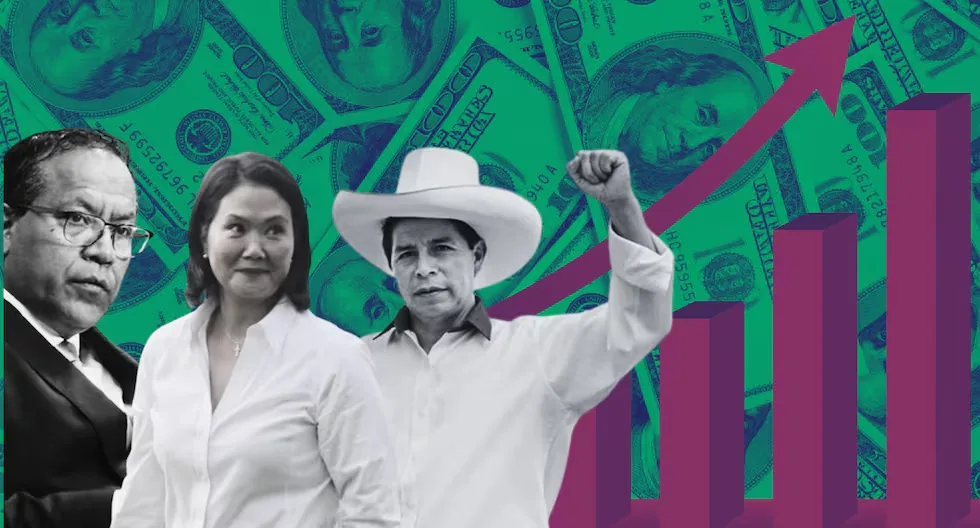
The big difference between how the markets faced both electoral processes lies in the magnitude of the depreciations recorded. In 2021, Pedro Castillo’s advance to the second round – whose proposal consisted of a change in the economic model – was perceived as an extreme risk in the market, which was already hit by the pandemic, and led to an unprecedented capital flight.
Read more Extra time, Argentina-Spain LIVE: Goal by Ferran Torres
According to the Central Reserve Bank (BCR), during that electoral process nearly US$15 billion left the economy – equivalent to 7.4% of GDP –; the largest capital flight in the country’s history. As a consequence, the sol depreciated against the dollar for more than 60 consecutive days. To avoid a collapse of high magnitude, the BCR intervened in the foreign exchange market and sold the historic figure of US$17.6 billion, which came from the country’s international reserves.
After the depreciation of the sol throughout 2021, the dollar began to stabilize as the nervousness and various economic risks dissipated. In recent years, the increase in copper exports and the weakening of the dollar worldwide have contributed to the strength of the sol against the US currency, and therefore, to an exchange rate lower than that perceived five years ago.
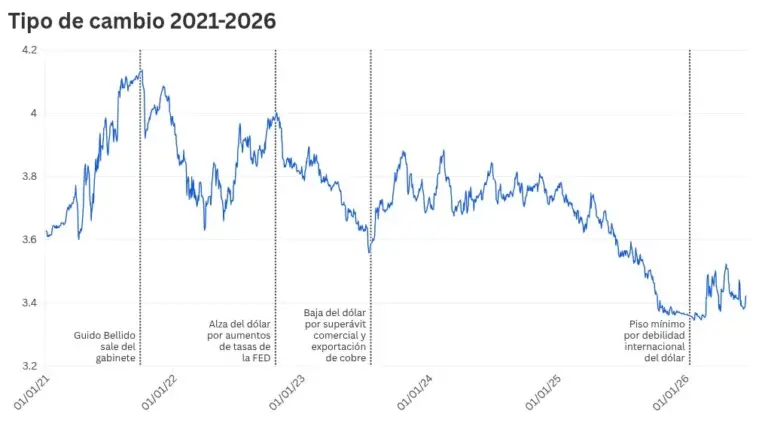
In contrast to 2021, the scenario of the 2026 second round has been much more moderate. In April, when it was confirmed that the left-wing candidate, Roberto Sánchez, would compete against Keiko Fujimori in the second round, the dollar rose from S/3.37 to reach a ceiling of S/3.53. However, the US currency remained stable in May, although still above the figures prior to the second round, until stabilizing around S/3.42, as polls showed a close race for the presidency.
The difference between the trends of the 2021 and 2026 electoral and post-electoral scenarios can be seen in the following charts.
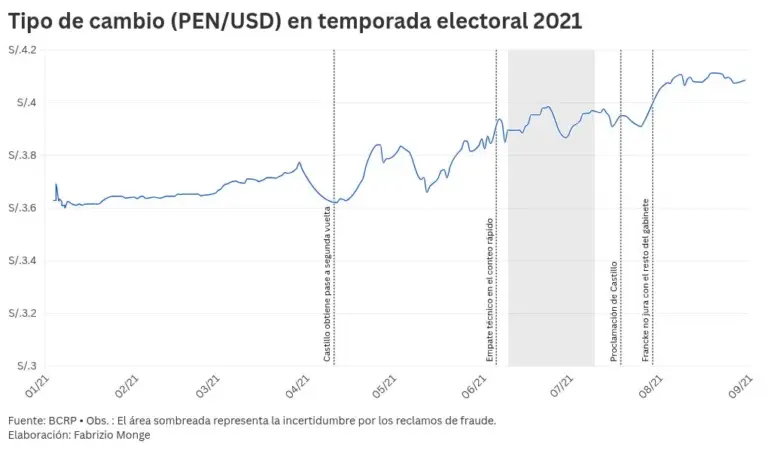
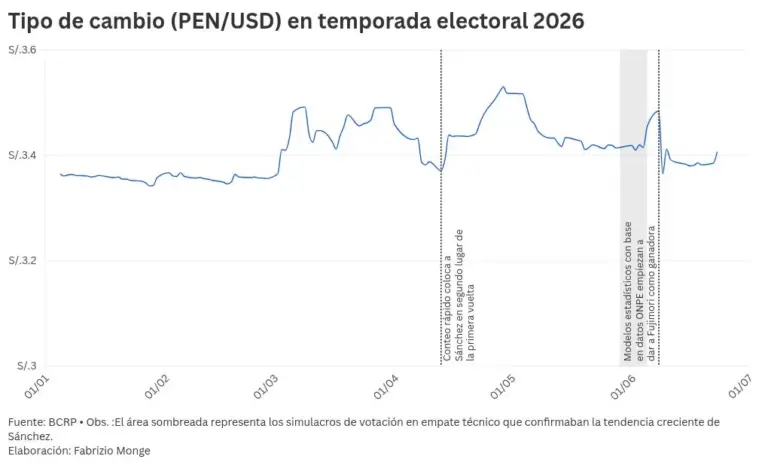
Why was the impact of the electoral situation on economic indicators different from what happened in 2021?
A report from the BCR published in March 2026 explains that electoral processes usually bring temporary storms: the dollar rises and falls quickly because companies buy foreign currency to protect themselves against uncertainty. However, the scare usually lasts little if the market does not anticipate a radical change in the economic rules of the game.
For economist Marco Ortiz from the Universidad del Pacífico, this time the exchange rate was not as affected as in the 2021 presidential elections because the “nervous money” had already left the country five years earlier.
“In economics, what matters for the price of financial assets is the unexpected, unanticipated part. When something is already anticipated, we say it is ‘priced in’. In some way, Castillo’s surprise in 2021 was much stronger than Sánchez’s surprise in 2026. […] In 2021, despite the country coming out of the pandemic, a good part of Peruvian assets was in the hands of non-residents. What happened between 2021 and 2026 was that many of those capitals left. When you have already left, you cannot ‘leave again’. The exposure was already lower; so, there was not much room to run,” Ortiz said in an interview with El Comercio.
Expectations in external markets
Data shows that, faced with Peruvian political risk, shares of Peruvian companies listed on the North American market react much more strongly and quickly than those traded on the local market.
In 2021, Pedro Castillo’s candidacy caused a 39.8% depreciation in the value of Credicorp’s stock between April and August, when it went from trading at US$153 to hitting a low of US$92.3 once Castillo’s government was installed.
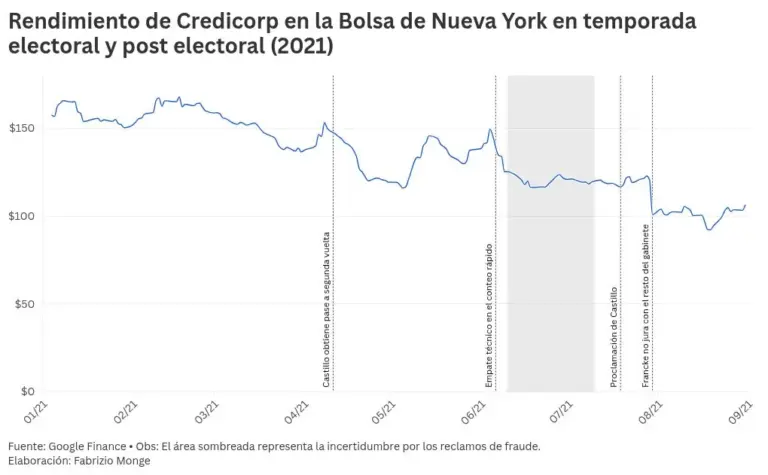
During the 2026 second round, however, the blow to Peruvian shares was more controlled and of shorter duration. After Roberto Sánchez’s advance was confirmed, Credicorp’s stock price experienced a 12.4% drop. However, the subsequent rebound was swift: on Monday, June 9, after the first official results favoring Keiko Fujimori were known, the stock surged 9.3% in a single session.
Also, a week later, the accumulated recovery exceeded 20.9%, leaving behind the losses recorded.
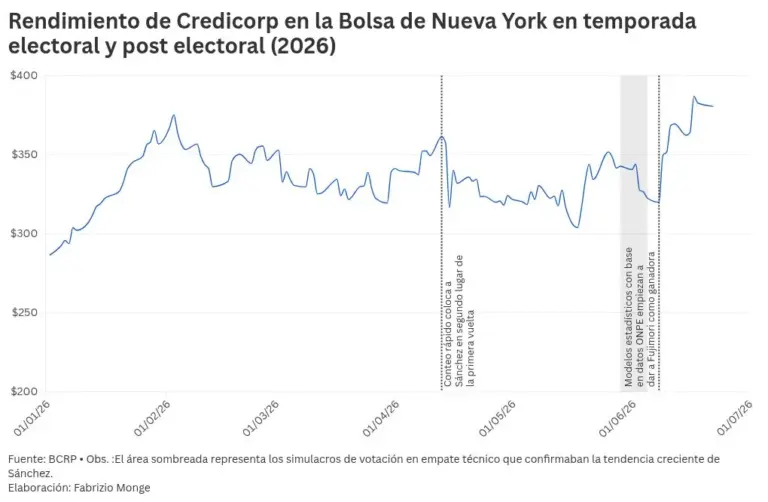
Other Peruvian companies showed the same pattern. In the 2021 electoral process, the electoral scenario caused a prolonged punishment on corporate quotes on Wall Street. Between the Friday before the second round and the end of July that year, Intercorp Financial Services accumulated a 33.6% drop in the US market.
This collapse extended to other economic sectors of the country, causing Compañía de Minas Buenaventura to also suffer a 32.7% setback and Cementos Pacasmayo to register a 22.8% contraction in the same period.
In contrast, the 2026 elections showed a much more moderate preventive setback and an aggressive stock market rebound in the days following the elections. After the runoff, Intercorp Financial Services’ stock consolidated a 21.6% jump in just two weeks.
Read more Will there be a long holiday in July? Check the next holiday in 2026 in Peru
This rapid liquidity injection also boosted Buenaventura’s recovery, with an 18.8% rise in just over a week and raised Cementos Pacasmayo’s stock value by 22.4%, reflecting a rapid movement of international flows towards local assets.
The mining shield of the BVL and political counterweights
Another indicator that serves as a thermometer of national economic expectations is the evolution of the BVL General Index.
In 2021, the Lima stock market suffered an immediate drop after the second round. On Monday, June 7, the first business day after the vote, amid uncertainty over the technical tie in the quick count between Pedro Castillo and Keiko Fujimori, the general index plummeted 7.7%.
In just three days, the accumulated drop reached 11.5%, and by July 30, after Pedro Castillo’s swearing-in, the local market’s accumulated decline reached 20.5%.
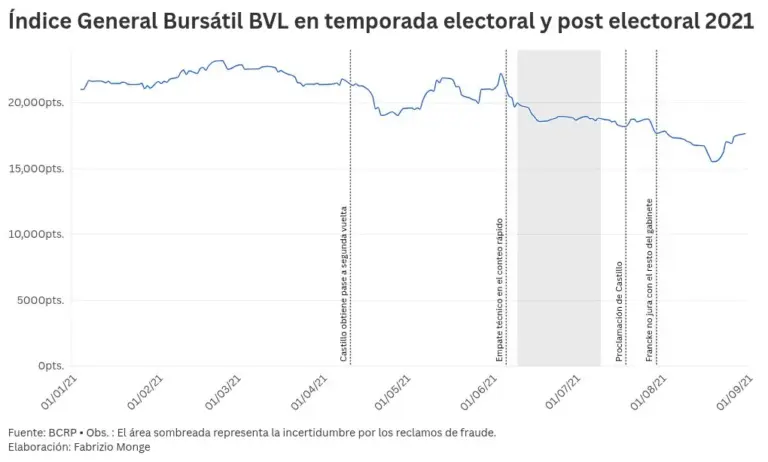
In contrast, the BVL’s behavior in 2026 was not subject to the same level of nervousness. The local index not only avoided deep losses during the campaign but has reached returns exceeding 25% so far this year.
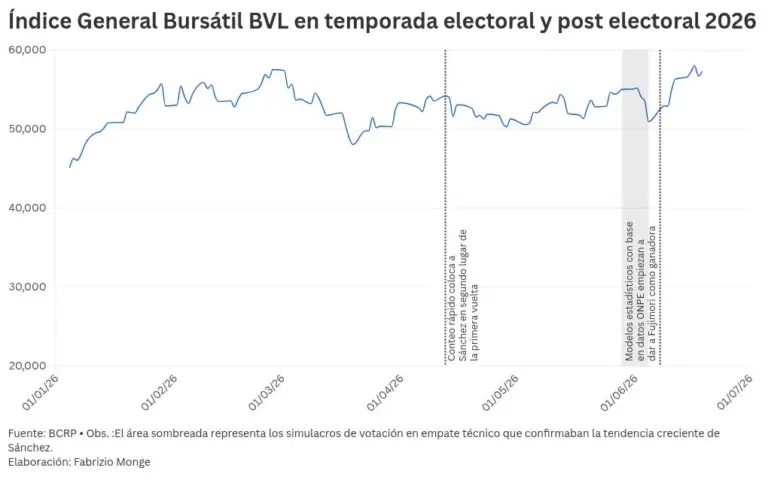
Enrique Castellanos, professor at Universidad del Pacífico, explains that the absence of a massive capital flight this year responds both to the metals price supercycle and to a pragmatic reading of the country’s political counterweights.
“The other reason why the stock market has performed well is that it is mainly a stock market with a heavy mining weighting that has been boosted by high prices of export minerals — copper, gold, silver, zinc —. That is why you have returns this year in the index of more than 25%. That is, there are more fundamentals in favor. But above all, there is confidence that if the system supported Castillo, it can also support Sánchez. I have not seen people closing businesses in Peru to leave, nor a massive exit from the country, as did occur with some sectors that decided to migrate during Castillo’s period” Castellanos said.
Post-electoral scenario and the unwinding of hedges
The most revealing milestone of the 2026 electoral process occurred on Monday, June 8, one day after the second round. During the week prior to the election, private voting simulations showed an upward trend for Sánchez. Then, fear of an electoral surprise pushed different economic agents to protect themselves by buying dollars as a precaution, which led the exchange rate back to S/3.47.
However, after the electoral flash and the release of the first official count data from ONPE, the exchange rate experienced a vertical plunge, falling sharply to S/3.39, while Credicorp’s (BAP) stock registered an aggressive rebound on Wall Street.
This sharp strengthening of the sol would have responded to the quick response of analysts from local and foreign banks. As soon as the first national count data entered, the analysis of voting trends would have made it evident that Keiko Fujimori showed a much better performance than she did in 2021 against Pedro Castillo.
As the risk of a Sánchez government dissipated, buying dollars ceased to be necessary for most economic agents, which generated an excess flow of the greenback in Lima’s foreign exchange market and, with it, a drop in the price of the US currency against the Peruvian sol.
Looking ahead to market behavior for the second half of this year, Castellanos projects an optimistic phase in the short term.
“I think we will have a kind of honeymoon. I do see good months for Peru: there is quite a bit of optimism that the Fuerza Popular government can do things better than the previous ones. The base is very low: we have had governments that basically have been carried by inertia. That is why I think that, at least in the next 12 months, the outlook is positive, unless we have some unpredictable external shock” he said.
- El Niño Phenomenon in Peru: six interactive charts show how much was not invested in prevention
- Remittances and elections: The crucial role of Peruvians abroad
- Earthquakes in Venezuela raise alerts: What were the strongest earthquakes in Peru and where did they occur?