









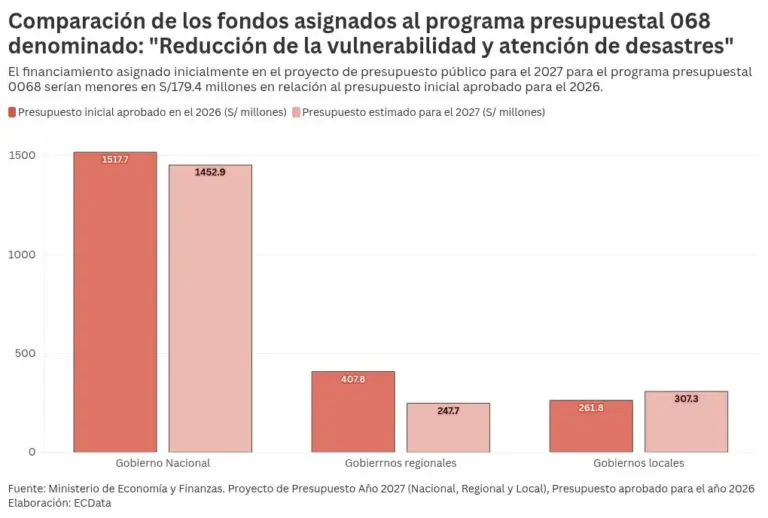
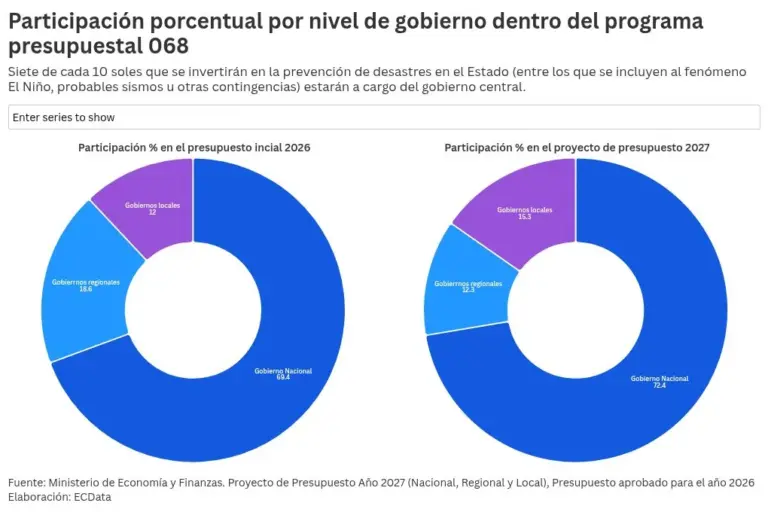
Although the national government would manage 72.4% of the total resources, the initial figure would be 4.2% below what was allocated in January 2026, while the share of local governments would increase by 17%, rising from S/261.8 million to S/307.3 million. In contrast, the allocation to regional governments would decrease by 39%, dropping from S/407.8 million to S/247.7 million in the same period [see charts].
Read more What happened to Al Qaeda after 9/11? This is how the terrorist group changed in 25 years
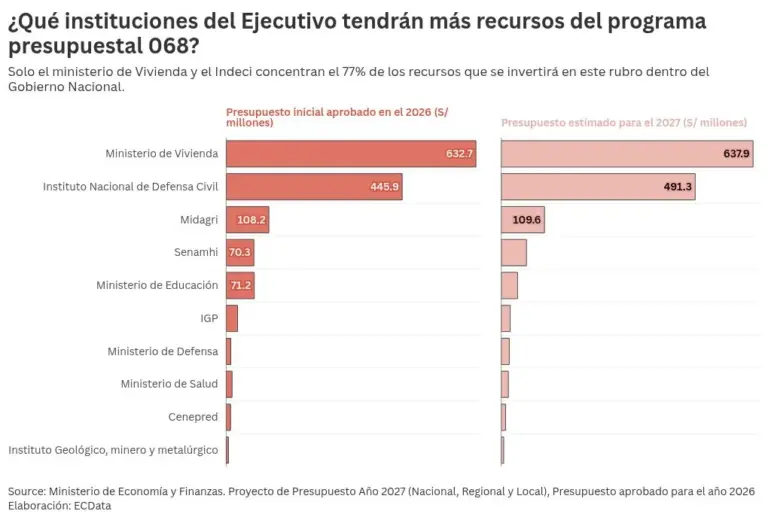
The Ministry of Housing and the National Institute of Civil Defense (Indeci) will be the institutions with the greatest prominence within the Executive branch to face the climatological events of the coming year. These two agencies alone concentrate 77% of the budget allocation within the national government and 56% of the total resources that the State will invest as a whole.
Indeci would have the largest year-on-year budget increase (+ S/45.3 million), which also represents a 10% increase compared to its initial budget this year. Meanwhile, institutions such as the Ministry of Education are among those that will experience the largest cuts (- S/29.7 million).
Subnational scenario
Regional governments, which along with municipalities will have new authorities from 2027, will receive differentiated funding. Tumbes, Piura, Lambayeque, La Libertad, Áncash, Lima Provinces, and Ica, regions highly vulnerable to El Niño would together receive 26% of what is planned for this level of government (S/64.6 million).
Although the regional government of Piura, one of the first areas to face the impact of rains and landslides, ranks second with S/23.9 million, it also records a 50% drop compared to the resources received at the beginning of this year (S/47.8 million).
Meanwhile, Ica shows the most notable reduction in this group, preliminarily receiving S/7.2 million at the start of 2027. At the beginning of this year, it was allocated S/116 million. [see map].
The scenario is also diverse at the local government level. For example, the 18 districts of Lima with “high” and “very high” risk of flooding diagnosed by Cenepred will have a joint budget of S/29.1 million, 20% more than this year. Lurigancho-Chosica, an area with a high incidence of mudslides and 21 active ravines, would be the district with the largest budget increase. The municipality would manage S/6.8 million for prevention and response efforts, a little more than triple what it received this year (S/2.1 million).
Read more AfD makes history in Germany: what explains its dizzying rise and what comes next?
Preliminary figures
Could the allocated resources increase as the year progresses? Carlos Casas, former Deputy Minister of Economy, professor and researcher at the University of the Pacific, told ECData that the apparent budget drop for PP068 would be relative, since there are always funds available to draw upon.
“There is the contingency reserve that can always transfer resources for that, adjustments that can be made, that [the 2027 budget for this item] is more or less at the same level could sound worrying; but there are many fiscal tools we can use to obtain more resources. The contingent lines for disasters are about US$2.5 billion, which are for earthquakes, for the El Niño phenomenon, etc. It will depend on the State whether it activates it or not,” he explains.
How will the election of new authorities impact the speed of response? For Casas, based on the analysis of the figures, the central government would prefer to centralize resources to guarantee a much faster response to eventualities. “It could be a healthy strategy and later those resources could easily be transferred to local or regional governments,” he notes.
This trend is also reflected in the budget for activities focused solely on facing El Niño. In the justification of the public budget bill for fiscal year 2027, the Minister of Economy, Elmer Cuba, announced that the central government would receive S/2,023 million of the S/2,489 million (81%). The most favored entity would be the National Infrastructure Authority, with S/1,047 million in charge.
Mary Mollo, a Disaster Risk Management specialist at ESAN, agrees that the Institutional Opening Budget (PIA) can be significantly modified within the year. “The PIA 2026 [for PP068] that started at S/2,187 million has almost doubled now. I see a process of recentralization in the budget volume (…). That also goes against what we would like to understand that the regions want, such as attention to the provinces and regions and districts farthest from the country, where the population has structural vulnerability,” she said.
Mollo adds that currently there is an observation from the MEF that local governments do not have the capacity to execute in the face of the proximity of a phenomenon that will be the most terrible since 1950. “The country rather needs to understand a new decentralization, where there is not only this process of transferring functions and generating autonomy. It is necessary to rethink how municipalities should be managed, develop a process of accompaniment from the Executive, and align budget distribution with the vulnerability map that the country currently has,” she said,
Read more The Kabbalah of Thursday, September 10: how to play, what time, and results