








In that first period (1956-1962), women represented only 4% of the entire Congress: 9 out of 235 parliamentarians. Seven decades later, the scenario is different. In the last general elections for the 2026-2031 period, Peruvians chose 70 female parliamentarians, equivalent to 37% of the new bicameral Congress.
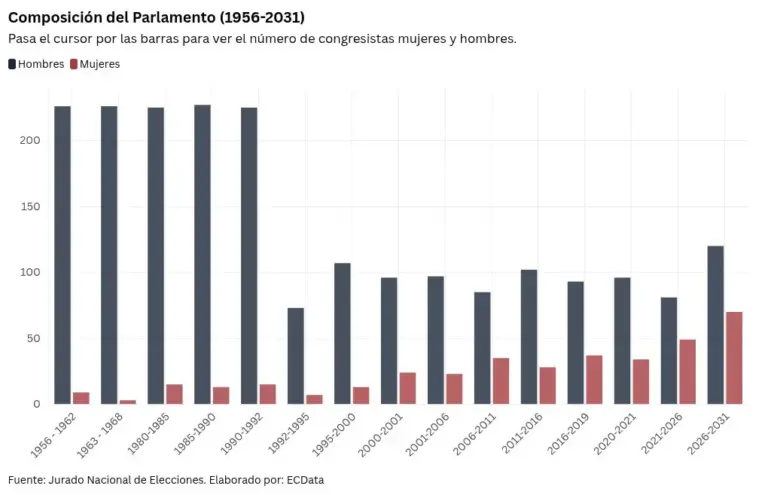
The figure of 70 congresswomen marks a historic record. There have never been so many women in Congress before. However, the return of bicameralism also shows that the path to parity remains incomplete: women represent 42% of the Chamber of Deputies, but only 27% of the Senate.
The difference in female participation between the two chambers is 15 percentage points.
By parliamentary group
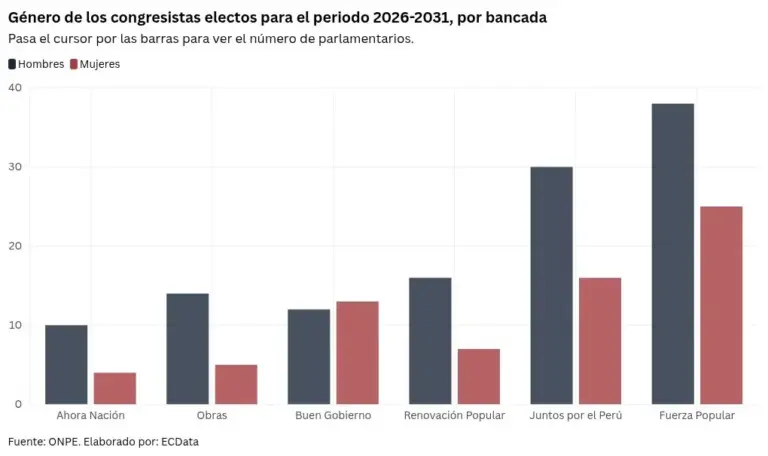
The representation of women is also not equally distributed within the parliamentary groups elected for the next period. Among all the political groups present in the new bicameral Congress, the Good Government Party is the only one with more women elected than men: 13 female parliamentarians versus 12 male parliamentarians, combining senators and deputies.
Next is Fuerza Popular, with around 40% female congress members (25 out of 63). The parties Obras and Ahora Nación have the lowest proportion of women among their congress members.
In the Senate, male presence is greater in almost all parliamentary groups. Fuerza Popular has 17 men and five women, while Juntos por el Perú shows the most pronounced gap, with 13 senators versus only one senator. This is Silvana Robles, suspended from her group after being accused of betrayal to the opposition bloc during the election of the Senate Board of Directors.
The distribution is more balanced in the Chamber of Deputies, although differences will also vary according to each group. Only the Good Government Party group has more female deputies than men.
Power within Congress
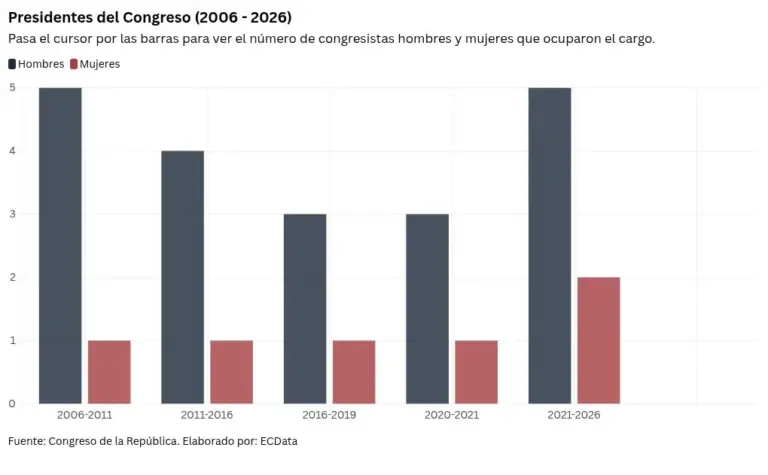
The gap is even larger in positions of power within Congress. The first woman to preside over Congress was Martha Chávez, in 1995. That historic event occurred almost four decades after the election of the first female parliamentarians in 1956. Since then, other women have reached the presidency of Parliament, but they remain a minority.
From 2006 until the outgoing Parliament ended its functions on July 28, there were 26 presidents of Congress. Of these, only six – 23% – have been women.
In the new bicameral Congress, the elected presidents for both chambers are men: Óscar Reto (Good Government) in deputies and Miguel Torres (Fuerza Popular) in the Senate. The right-wing bloc alliance was the only one that presented a formula with a woman as a candidate for the presidency: Norma Yarrow (Popular Renewal), for the Chamber of Deputies.
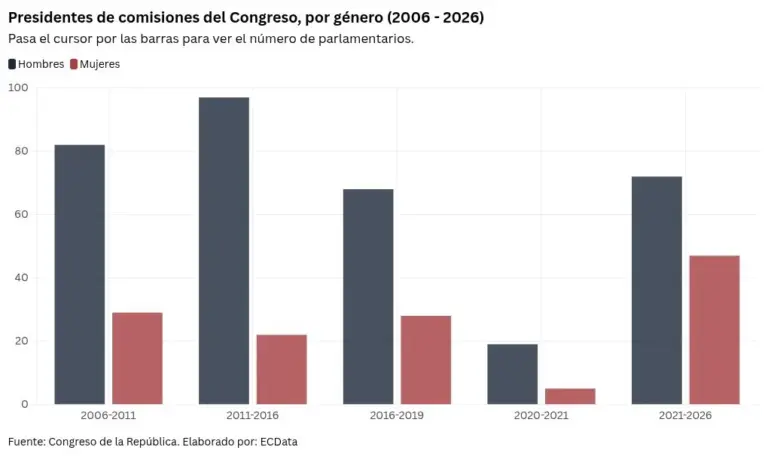
Differences also appear in the presidencies of the Parliament’s standing committees. Of the total 469 presidencies that existed between 2006 and 2026, only 131 were held by women, a figure equivalent to 28%.
The period with the highest female presence in committee presidencies was 2021-2026, when women held 47 of 119 presidencies, nearly 40%.
A new gap
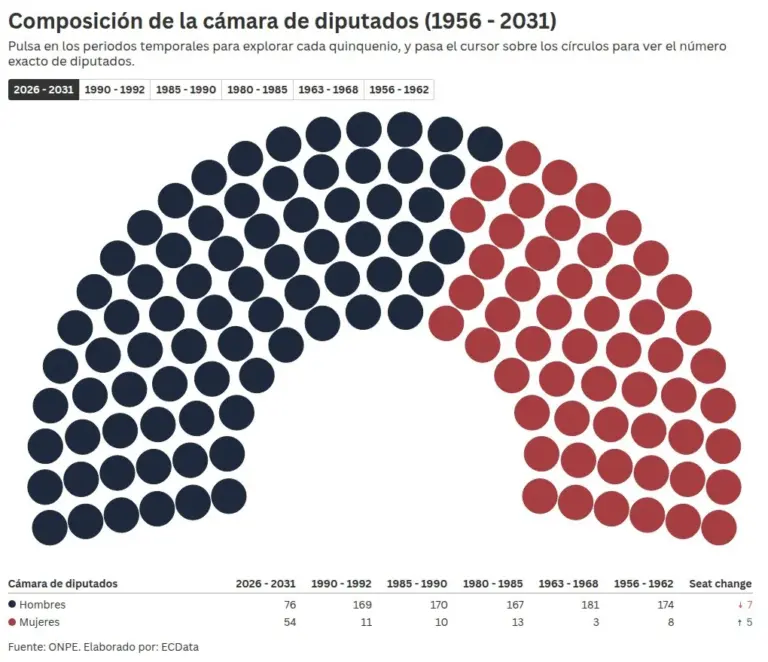
In the first year of female participation in power, Irene Silva de Santolalla was the only female senator. Meanwhile, the Chamber of Deputies had the participation of eight women, compared to 174 men.
For more than three decades, with the arrival of the unicameral Congress approved in 1993, this comparison ceased to exist. Women’s presence was measured in a single plenary of 120 or 130 congress members. In that period, growth was progressive: women went from representing only 6% at the beginning of the 90s to 38% during the 2021-2026 period.
The return of bicameralism has reopened that historic difference between chambers, but now with a much more marked gap. For the 2026-2031 period, women represent 42% of the Chamber of Deputies, but only 27% of the Senate.
Read more The public race returns to the Palace
For the Doctor in government and public administration and gender issues specialist, Beatriz Llanos, the results of the new bicameral Congress show that “there are different dynamics” in the election of both chambers.
“We have to look at the Chamber of Deputies, where the good news is that representation has continued to increase, and that is very important. But we have to carefully observe what is happening in the Senate, because it tells us that the rules and the ways in which the election of the chamber is designed also influence the result, and that is why we have different results in both chambers,” she points out.
In total, 11 female senators were elected by a single district. At the multiple electoral district level, they had less luck: only five were elected.
“There has been a Senate elected in a larger electoral district, which is the national electoral district, where women have better results. But there are also seats elected in electoral districts in regions, and that is where there is less representation of women,” Llanos notes.
Progress
For the representative of the United Nations Development Programme (UNDP) in Peru, Alissar Chaker, advances in female representation are not accidental, but the result of sustained work by movements that pushed for changes over decades.
“Before the Parity and Alternation Law, it was common for women to be relegated to the bottom of the lists to fulfill the quota, limiting their real chances of election. The combination of parity and alternation corrected this distortion and had an immediate and significant impact on the number of women elected,” she says.
Beatriz Llanos agrees: “A first message is that, when there are no rules that establish it obligatorily, political parties did not present a balanced offer of men and women.”
Although Law 31030 requires parties to present candidacies to Congress under parity and alternation criteria – one woman, one man; or one man, one woman – equity does not necessarily translate into results, mainly due to preferential voting.
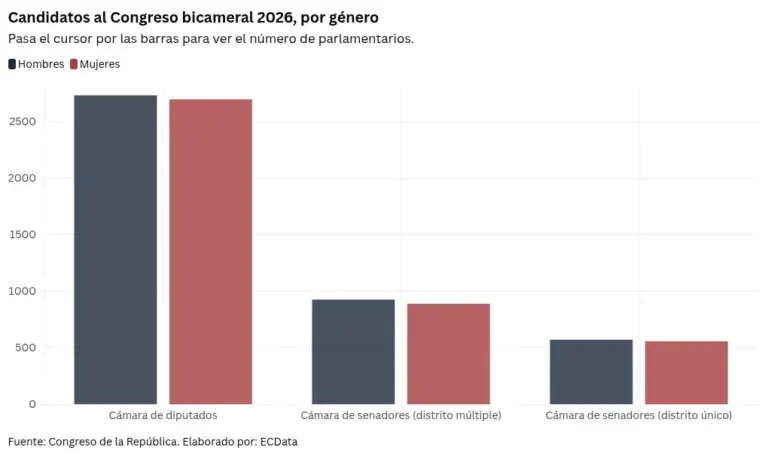
For the single-district Senate, 572 men and 559 women ran; in the multiple-district Senate, 927 men and 890 women; and in the Chamber of Deputies, 2,734 men versus 2,699 women. That is, although 50% of candidates were women, the results favored male candidates in both chambers.
Staying is also a barrier
The challenge does not end with the election. For women, reaching Congress may be just the first filter. Staying in politics, building a legislative career, and holding positions of power are different challenges.
Beatriz Llanos explains that women face particular barriers when aspiring to positions of power, such as the additional burden they face in household care.
“There are a series of disadvantages that women face that could condition their electoral outcome. One of them, for example, is the care burden. Women have greater responsibilities in family care duties for minors and the elderly. That structurally takes away time for them to participate in politics and carry out a series of activities,” she explains.
Added to this is political and digital violence, as well as greater difficulty in obtaining campaign financing.
“In different countries in the region, not only in Peru, it is observed that women have less access to financing for their campaigns. The costs of a campaign involve a series of economic resources that women do not necessarily have. Women do not access financiers or support in the same way as men,” she states.
Read more El Niño Phenomenon: How will State investment be distributed to face disasters during 2027?