




![Alberto Beingolea: “If they insist on not giving [the powers], they are complicating life for Peru”](https://insightermedia.com/wp-content/uploads/2026/09/bb3fa9e11304ea13fe2cd333955007bc-150x150.webp "Alberto Beingolea: “If they insist on not giving [the powers], they are complicating life for Peru”")



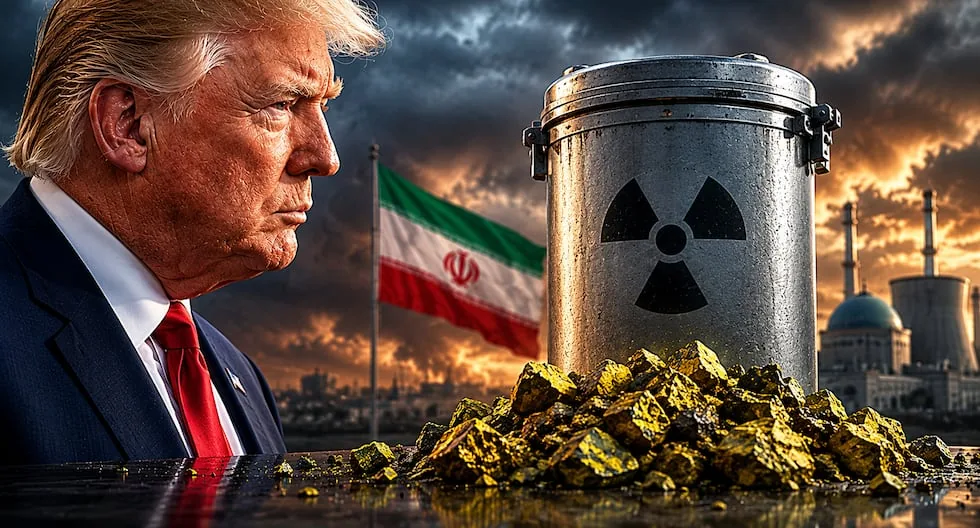
While the United States and Iran try to keep negotiations open to sign an agreement that leads to the end of the war, the main obstacle seems to focus on one question: what will happen to the enriched uranium that Tehran already possesses? President Donald Trump stated on Monday that the Iranian reserves should be handed over to the United States for destruction or, preferably, eliminated under international supervision, while Tehran maintains a different position: it insists that its nuclear program has civilian purposes and refuses to give up one of the most sensitive assets of its strategic capacity.
Read more Quini 6 LIVE: see here the results and draw 3377 of today, Wednesday, May 27
“The enriched uranium (nuclear dust!) will be immediately handed over to the United States to be repatriated and destroyed or, preferably — together and in coordination with the Islamic Republic of Iran — destroyed in situ or at another acceptable location”, said Trump on his Truth Social account.
He added that this process must be accompanied by the Atomic Energy Commission (he probably meant the International Atomic Energy Agency, a UN agency), which will act “as a witness” to this process.
According to the UN, Iran has 440 kilos of uranium enriched to 60%. It is very close to the 90% enrichment threshold that allows the manufacture of the atomic bomb.
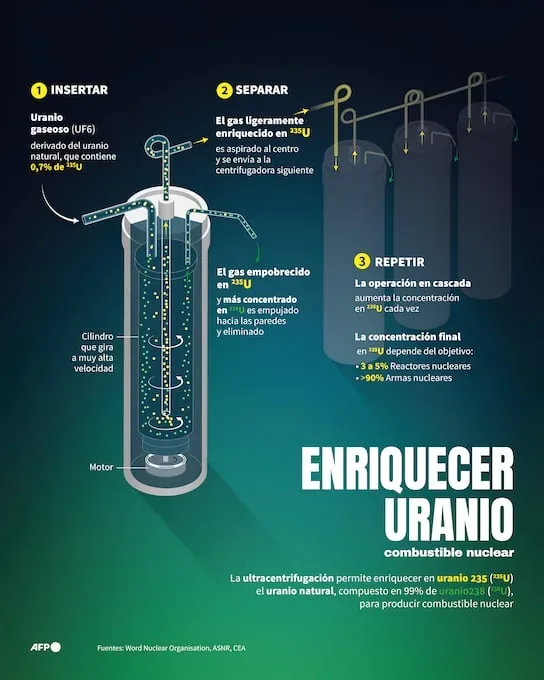
Trump’s demand goes beyond limiting future enrichment: it aims to eliminate the material that Iran already possesses, one of the most sensitive points of the negotiations.
At this point, it should be noted that the latest draft of the memorandum of understanding between Washington and Tehran proposes a 60-day extension of the ceasefire, the reopening of the Strait of Hormuz for commercial transit, the gradual lifting of some economic restrictions, and negotiations on sanctions and frozen Iranian assets.
However, the nuclear issue would not be completely resolved in that first stage: the scheme contemplates that Iran reaffirms that it will not develop nuclear weapons and agrees to later discuss limits on uranium enrichment and the fate of its enriched uranium reserves. That is, the draft seeks to first close the immediate military crisis and leave the most complex and delicate aspect of the agreement, the future of the Iranian nuclear program, for a second phase.
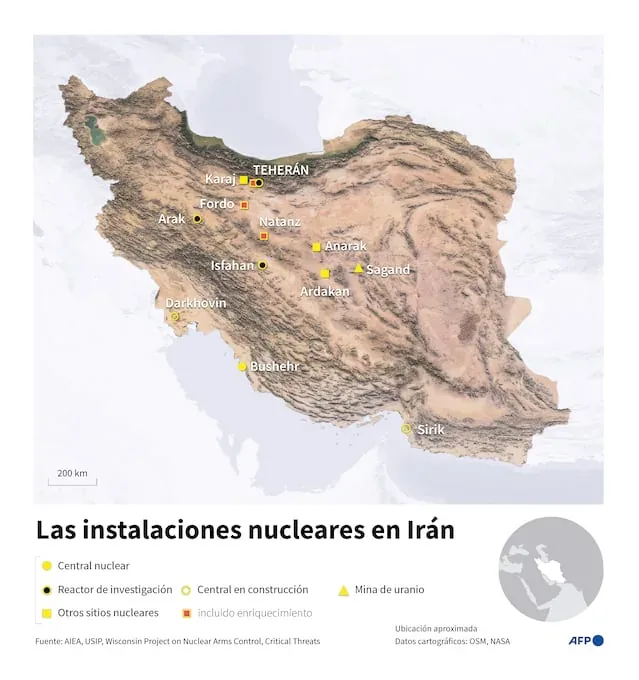
Iran has repeatedly rejected the demand to completely give up uranium enrichment. In April, the head of the Iranian nuclear agency stated that the demands from the US and Israel to limit enrichment “will not happen.”
Iran has proposed intermediate formulas: accepting temporary limits or reducing enrichment levels in exchange for economic relief and broader international supervision.
Iran’s dilemma: give up or accelerate the nuclear path?
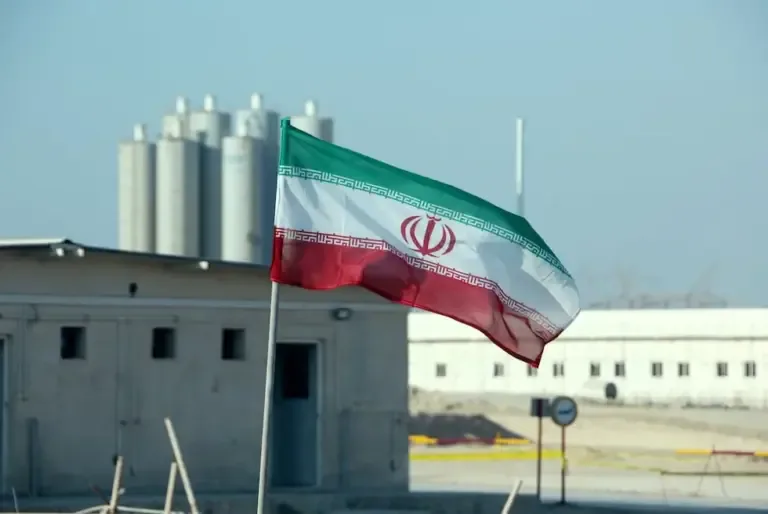
International analyst Francisco Belaunde Matossian considered that the war launched by the United States and Israel could have strengthened in some sectors of Iranian power the idea of keeping the nuclear option open as a future security mechanism, although he warned that the debate would still be far from closed within Tehran’s leadership.
“It is possible that some of the more radical sectors are seeing that possibility. Giving up the idea of having an atomic bomb, seeing what has happened, may not be the best,” he said.
He explained that for certain groups within Iranian power, the perception could arise that a nuclear capability would function as a guarantee against future aggressions.
“It seems logical to think about having an atomic bomb as insurance against any attack”, he insisted.
However, he indicated that within Iran there would also be different positions regarding that strategy. Some sectors would consider that the country already has other geopolitical pressure tools that could reduce the need to cross the nuclear threshold.
“There are those who argue that the fact that Iran can play with the Strait of Hormuz issue would make having an atomic bomb less necessary, because it would have a way to pressure to avoid being attacked”, he explained.
Belaunde pointed out that this would have opened an internal discussion in the Iranian government about which path to follow.
For security and intelligence specialist Andrés Gómez de la Torre, the war could modify Tehran’s strategic calculations, although he considered it premature to say that Iran has definitively decided to advance towards a military nuclear capability.
“It is very difficult to predict what Iran’s attitude might be at this moment,” he told El Comercio. He explained that the current international scenario is going through a period of increasing deterioration of the nuclear control system.
“The director of the International Atomic Energy Agency, Rafael Grossi, has spoken of a deterioration of the international nuclear order. Many countries are thinking that nuclear weapons are insurance. There is the case of North Korea”, he said.
Under that logic, he warned that a possible Iranian renunciation of its nuclear project would imply losing a key element of strategic pressure.
“By giving up its nuclear project, Iran would obviously be losing its last deterrence card”, he stated.
Trump’s pressure over enriched uranium
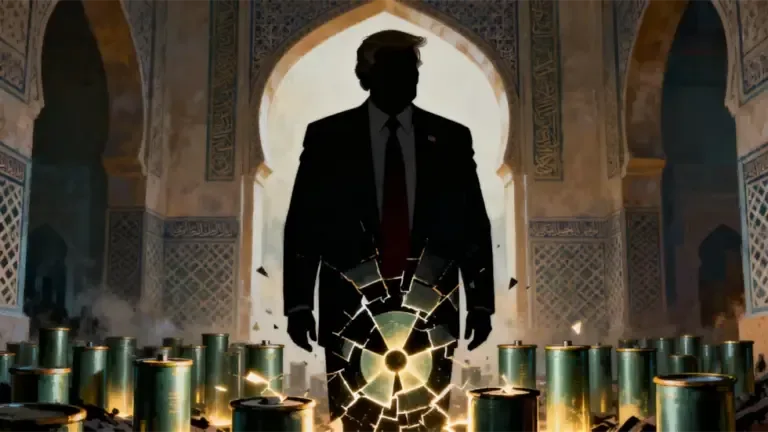
Regarding Trump’s demands, Gómez de la Torre explained that Washington seeks to make the fate of the enriched uranium reserves a precondition for any final understanding with Tehran.
However, he emphasized that the alternatives put forward by Trump present technical and political difficulties.
Read more National Lottery Thursday, May 28: how to play, prizes, and check the results
“This raises a series of complexities, because any bilateral negotiation should force the entry of a third party, which is the International Atomic Energy Agency, as verifier of what will happen with the uranium reserves,” he explained.
He added that the difficulties are not only diplomatic but also operational.
“The possible transfer of uranium or the handling proposed by the United States is very complicated. It has a series of technical problems, whether transferring it or destroying it on site,” he said.
For Gómez de la Torre, Washington’s firmness responds to a position that Trump has constantly repeated: to prevent Iran from reaching military nuclear capability.
“Everything points to the fact that Iran has stored enriched uranium reserves, and this is related to how emphatic Trump has been regarding that Iran should never have a nuclear weapon,” he said.
Meanwhile, he stated that Tehran continues to condition any substantive discussion about its atomic program to a military de-escalation.
“Iran continues to condition discussing the nuclear issue based on first obtaining a ceasefire, at least momentarily,” he said.
The analyst also stated that negotiations between Washington and Tehran take place in a broader context of weakening international nuclear control mechanisms.
He cited recent warnings from Rafael Grossi about the impact of the expiration of the New START treaty between the United States and Russia.
“We are in a context where the nuclear weapon has again become, as in the years of the Cold War, a key instrument of defense, foreign policy, and deterrence,” he said.
He also recalled that international estimates indicate that about twenty countries could develop nuclear capabilities in the future.
“The Non-Proliferation Treaty is being undermined and we are entering a much more complex stage of nuclear diplomacy,” he concluded.
For his part, Belaunde stated that the Iranian nuclear program is one of the most sensitive issues in the negotiations to end the war.
He indicated that the proposal promoted by Trump for a preliminary 60-day agreement and leaving the substantive discussions about the Iranian nuclear program for a later stage faces resistance both within the United States and Israel.
Belaunde said that in any case Trump needs to show political results.
“Trump also cannot appear to be yielding again to Israeli pressures,” he said.
He added that some of the formulas evaluated included economic benefits for Iran, such as sanction relief or the return of withheld funds, something that generated rejection among conservative US sectors.
“Some more radical sectors of the Republican Party considered that too many advantages were being given to Iran without any security that it would finally deliver that stock and completely give up the atomic bomb,” he explained.
Although enriched uranium appears as the main focus of discussion, Belaunde warned that it would not be the only pending point.
According to him, sensitive issues for Israel, such as Iran’s missile capability, have been sidelined in the draft of the latest negotiation.
“It seems that Trump is so desperate to reach an agreement because he realizes this war is affecting him, that he would be willing to set aside the issue of Iranian ballistic missiles,” he said.
For the analyst, that scenario could become a new source of friction with Israel.