





![Alberto Beingolea: “If they insist on not giving [the powers], they are complicating life for Peru”](https://insightermedia.com/wp-content/uploads/2026/09/bb3fa9e11304ea13fe2cd333955007bc-150x150.webp "Alberto Beingolea: “If they insist on not giving [the powers], they are complicating life for Peru”")



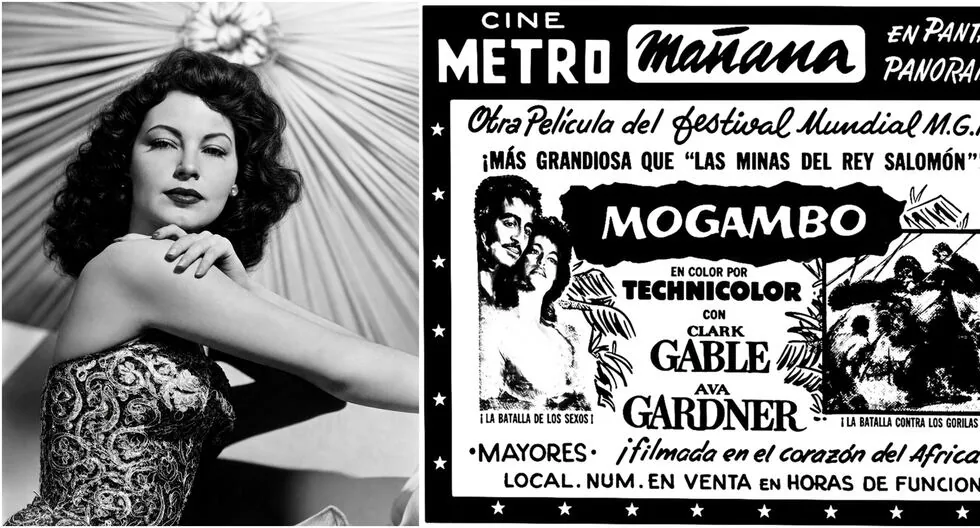
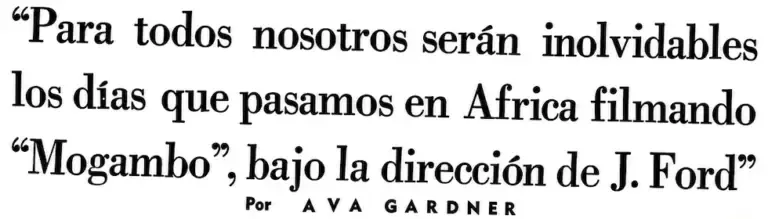
The chronicle published in El Comercio on April 7, 1954 —written by the renowned American actress Ava Gardner about her experience in Africa during the filming of the movie “Mogambo” (1953), alongside Clark Gable and Grace Kelly— offers a fascinating, yet markedly exotic view of the African continent and its inhabitants. Far from constituting a kind of anthropological analysis, Gardner’s testimony inevitably reflects the perspective of a 32-year-old North American celebrity venturing into territories unknown to her. Her vision of the so-called “uncivilized natives” is shaped by the stereotypes and amazement typical of someone unfamiliar with that culture, observing local communities through the eyes of a privileged tourist.
Read more On this day, September 4: What happened in the world on a day like today?
Without a hint of malice, but loaded with the Western prejudices of her time, the actress describes nature and native peoples with a mix of genuine sympathy and maternalism, portraying that mid-1950s Africa essentially as an exotic, curious, and at the same time dangerous setting, designed exclusively for the delight, adventure, and showmanship of Hollywood. ‘Mogambo’ premiered in the United States on October 9, 1953, and in Peru on February 18, 1954. Being an MGM film, it premiered in Lima at the iconic Metro cinema, facing Plaza San Martín.
Interestingly, Ava Gardner did not approach Peru only through an African chronicle; months later, on August 27 of the same year, the diva landed at the old Limatambo airport to enjoy a few days of vacation in our country.
&&&&&&&&&&&&&
“For two months I walked through the dense African jungles during the day, and at night I slept under a mosquito net in a tent. I saw lions, elephants, and leopards in their natural habitat during the day and heard the screams of mandrills, the grunts of hippos, and the howls of hyenas in the late hours of the night. I watched in amazement as the natives performed their tribal dances with precision and artifice. I found practically hundreds of uncivilized Africans in their own villages. I enjoyed the incredible beauty of a bright sunrise on the vast African plains and felt intoxicated by the wonderful and fiery sunset, in the coolness of an evening over the Equator.

I probably would never have lived those exciting and stimulating moments if Metro-Goldwyn-Mayer had not assigned me to appear alongside Clark Gable in ‘Mogambo,’ the new Technicolor adventure film, made almost entirely on the African continent.
Africa and the adventures that Clark Gable, Grace Kelly, John Ford, and the others shared during the filming of ‘Mogambo’ will be something we remember for a long time. Many of us plan to return to that continent someday. Because most of Africa, despite the surprisingly modern cities it has in some places, is still basically a primitive land where danger lurks behind every tree and bush. Its swamps and jungles may be infested with disease-carrying insects, and its mountains and plains teeming with wild animals ready to attack. Its days, along the Equator, can be humid and hot… its nights long and no less humid. But Africa, after all, is undoubtedly a land made for adventures.
And, how can we forget the charming naivety of many of the natives? Those of the friendly Wacomba tribe, for example, who came to our camp to appear in front of the cameras and brought their chickens, goats, and other possessions. Then they slept with all of that in small adobe huts. Or the Wagenias of the Belgian Congo, who sent ahead three of their chiefs to determine if the spirits of their ancestors were in our area, and to ask if they approved of the tribe members appearing in the film (approval, by the way, that the chiefs said they had received from the spirits). And the Samburu, with a barbaric appearance, whose chiefs accepted a sum of money in exchange for a dance that the tribe performed in front of the cameras, and then didn’t know what to do, whether to donate that sum to the missionaries, who promised to build a much-needed hospital in their area, or to use it to dig a new water well for their livestock.
Read more Two workers rescued alive from a tunnel ten days after the flood in Nepal | VIDEO

At the same time, we will still remember with some caution those hundreds of hostile black Masai tribe members, who never smiled and, brandishing their spears, jumped in the air in mysterious movements while performing one of their ancient heroic ceremonies in front of the cameras. We still do not know what thoughts crossed their strangely adorned heads when they looked at us.
Likewise, we will always recall that night when a hippopotamus (actually considered by most white hunters as the least dangerous of all large animals) stumbled into our camp and got tangled in the ropes holding Gable’s tent, knocking down the canvas before the surprised eyes of the famous actor. And I am sure we will all remember for the rest of our lives that moonlit night when two inquisitive lions calmly walked around the campfire we kept at our camp and then left without even uttering a slight roar.


We will always feel proud of the magnificent achievements of our technical staff who set up the tents of the provisional camp in the tangled jungle almost overnight and learned to build 1,650-meter-long “landing fields” in a matter of hours, so that a small airplane could bring us fresh food and take the Technicolor film, which had to be packed in dry ice, to Hollywood immediately after being exposed.
Our playful efforts to converse with the natives in the Swahili village; the first time we tried the native food called “poshe,” which is the tribe’s main food; the warm welcome we received in most of the villages, where the natives crowded around us to greet us and ask for trinkets and colorful rags. All those things we will remember with great delight and emotion.
And all of that, or most of it, we hope to experience again sometime in the future.”