




![Alberto Beingolea: “If they insist on not giving [the powers], they are complicating life for Peru”](https://insightermedia.com/wp-content/uploads/2026/09/bb3fa9e11304ea13fe2cd333955007bc-150x150.webp "Alberto Beingolea: “If they insist on not giving [the powers], they are complicating life for Peru”")



The night before, Wednesday October 2, 1974, the football world came to a halt when Edson Arantes do Nascimento, Pelé, played the last match of his professional life. The “King” decided to retire wearing the jersey of his eternal team, Santos. The people of Lima wept for the farewell of the best football player of recent years.
Read more Argentina: 62-year-old woman becomes a mother for the first time after fertility treatment
Meanwhile, the government of General Juan Velasco Alvarado was rather happy for another reason. Weeks before, they had planned a day of celebration precisely on that October 3 1974, a fateful day, as it marked the sixth anniversary of the so-called “Armed Forces Revolution”; that is, the coup d’état of October 3, 1968 against the constitutional government of Fernando Belaunde Terry.
ALSO READ: The memory of Yungay: the story of the earthquake and landslide that wounded all of Peru 55 years ago | EXCLUSIVE PHOTOS
Amid the sadness over Pelé‘s farewell and the joy of the military in power for their anniversary, the people of Lima would soon feel fear and pain hours later. At 9:21 a.m. on Thursday, October 3, 1974, the calm of a day declared a holiday was shattered in the most tragic way.
Surprise, horror, and fear
The earthquake was felt with terrifying intensity throughout Lima and the ‘Sur chico’, especially in Mala, Lurín, Chilca, Pisco, Lunahuaná, and Chincha, but it was also felt in Trujillo to the north and Arequipa to the south. The Panamericana Sur Highway was affected and, to a lesser extent, the Central Highway. The train to Huancayo was halted for 7 hours.
The first Civil Defense reports on that same October 3 indicated that the seismic movement had an intensity of almost 8 degrees on the Mercalli scale and a magnitude of 5.6 on the Richter scale. Only in the initial reports for Metropolitan Lima was the death of eight people in Chorrillos, three in Barranco, and two in Surco announced with regret. But the dead and injured would be many more. Within the first 24 hours, the official count was 44 dead and 806 injured.
The epicenter was 60 kilometers offshore, in front of the Cerro Azul beach resort, in Cañete, south of Lima. The effects in Metropolitan Lima were as strong or stronger than those of the earthquake on May 24, 1940, or the other strong quake on October 17, 1966, which until then was the last memorable one in the capital.
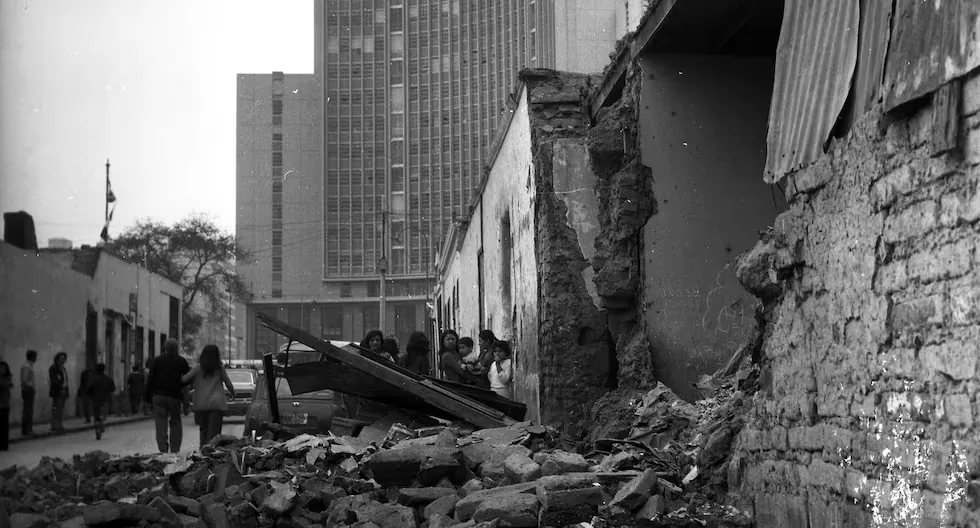
The 1974 earthquake especially damaged the districts of Chorrillos (where 50% of adobe and quincha constructions collapsed), La Molina (which at that time had many adobe houses), the Cercado de Lima (such as the collapse of a wall of the Assault Guard building on block 1 of Amazonas street), and the Constitutional Province of Callao. But it also affected traditional areas with old buildings like Barranco, Barrios Altos, and Rímac.
A war-like scenario
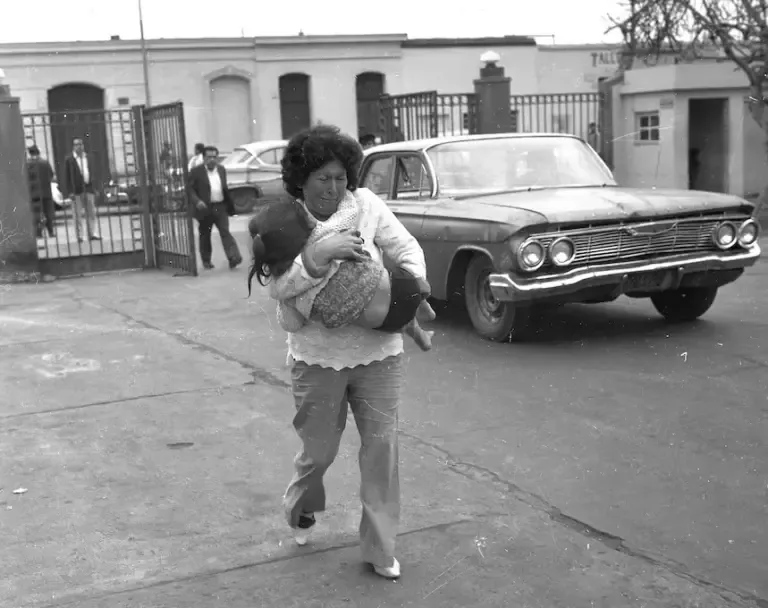
The news reports the next day, Friday the 4th, reflected the anguish experienced by children and parents, who after the earthquake that lasted 2 minutes and 15 seconds fled in panic seeking open areas like parks or plazas. Panic attacks were observed in Lima’s buildings, while neighbors suffered heart attacks or fell down stairs or on the street. On the roads, many knelt, begging for God’s forgiveness.
ALSO KNOW: Major blackouts in Peru and the world: which were the most impactful in history? | PHOTOS
Another example of panic was the case of a dietitian from the Obrero Hospital (Guillermo Almenara Hospital), who jumped from the third floor and fell onto the roof of a consulting room, fracturing the tibia in one leg. All hospital centers in Lima, belonging to the Ministry of Health and the former IPSS (now Essalud), were overwhelmed in emergency services. The general comment was that everything would have worsened if there had been school classes.
In the face of the disaster, the military celebration had to be suspended (although they held it six days later, on October 9); meanwhile, the government decreed Law No. 20754, stating that no one affected by the earthquake should be evicted for any reason. The earthquake was on a Thursday and the hours dragged on endlessly. There was no electricity and radio waves collapsed. There were pipe breaks and floods, collapses, and damaged telephone lines. There were also people with anxiety crises trapped in city elevators.
The lessons from the memorable 1970 earthquake, which wiped out the city of Yungay in Ancash, helped to face the Lima earthquake with more technical and humanitarian competence. With a service like Civil Defense, created after the seismic event four years earlier, a coordinated aid system was activated in Lima. The National Emergency Operations Center also collaborated operationally and efficiently.
Read more LIVE: Peru vs Argentina for the 2026 U17 Volleyball World Cup
MORE INFORMATION: The tragic case of the FAP plane that crashed over Lima leaving two dead in 2004
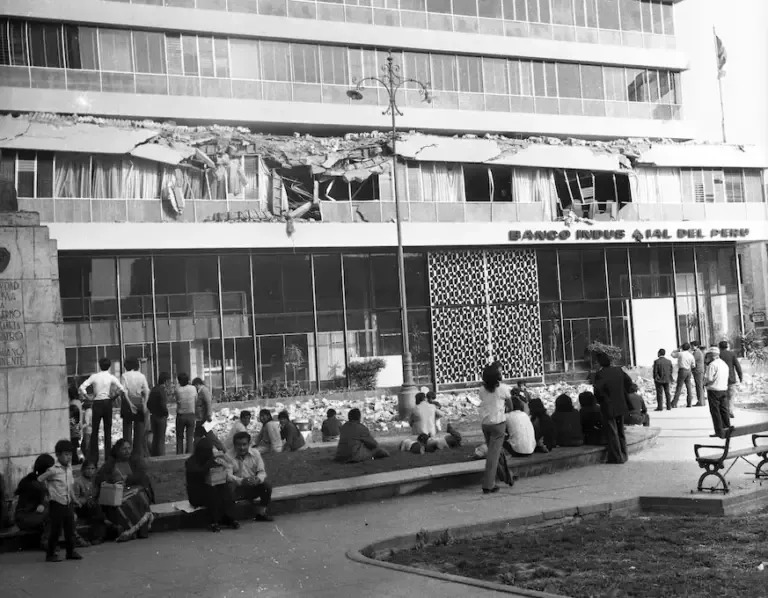
However, the capital revealed its weakest side: old or informally built constructions suffered as expected in such a situation. Even apparently resistant buildings suffered minor, unexpected damage, such as the Ministry of the Interior buildings, the Palace of Justice, the Panamericana Televisión (Channel 5) building, and the second floor of the Banco Industrial building, now housing Reniec, in Plaza Gastañeta, downtown Lima, and even the Jorge Chávez International Airport showed some cracks.
Additionally, churches such as San Pedro de Chorrillos, the Bridge of Sighs church, Santa Clara church, and Carmen church, as well as the old building of the Lima Public Charity (Lampa street), suffered serious damage. It is also anecdotal that at the moment of the earthquake, one of the clocks in Plaza San Martín, downtown Lima, stopped its hands in full view of everyone.
Events during and after the earthquake
On the same day of the earthquake, October 3, there were 25 aftershocks that people could feel, adding to other micro-aftershocks. Another unusual event that day was the strange movement of the sea which, in some places of the ‘Sur chico’ (such as Pisco), receded dozens of meters beyond the shore, raising fears of a tsunami. However, there were only strong swells, so intense that in Pisco the boats on the beach ended up in the Main Square itself.
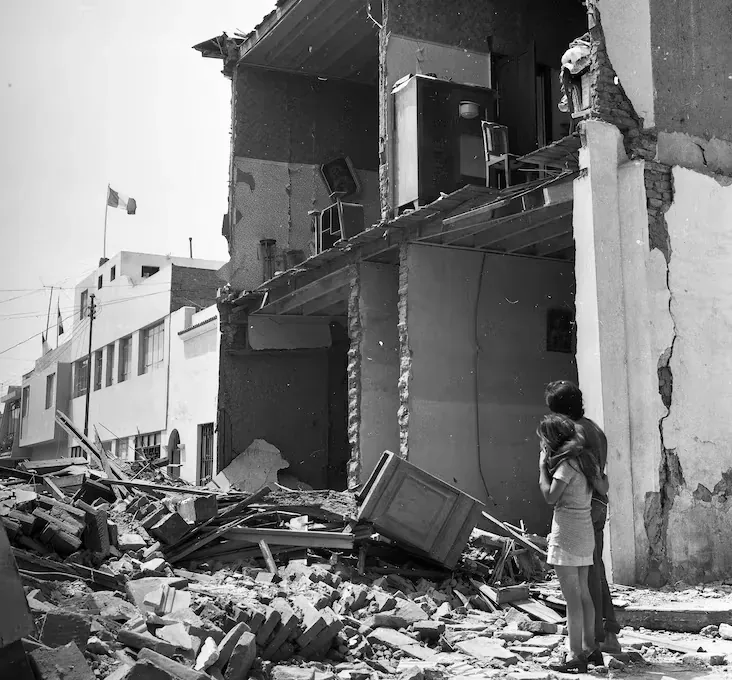
This maritime phenomenon on the Lima coast caused unexpected situations such as in the district of Barranco, where, as the sea receded, locals took advantage of the sandbank that formed to collect as many mussels stranded in that unexpectedly formed area as possible.
ALSO READ: Heroic sea rescue: when a fisherman from Trujillo saved 10 people with a totora reed boat in 1962
Other rather supportive gestures from neighbors were seen in various parts of Lima, such as giving rides in their cars, motorcycles, bicycles, and even tricycles to people walking or running to reunite with their families. Another police report noted that, at least for the rest of the earthquake day, there were no reports of looting or burglary of homes or commercial stores in Lima, as had happened in similar cases before.
From Cerro Azul further south, 13 dead and about 150 injured (30 seriously) were reported on that first day. Chincha, for example, suffered about 52 injured (20 seriously) and Pisco 20 injured (one seriously) in those terrible first 24 hours. Even in Ica, victims were reported (one dead and 10 injured). In these southern Lima areas, the destruction of homes was 50%, almost all made of “noble material.”
Some urgent measures
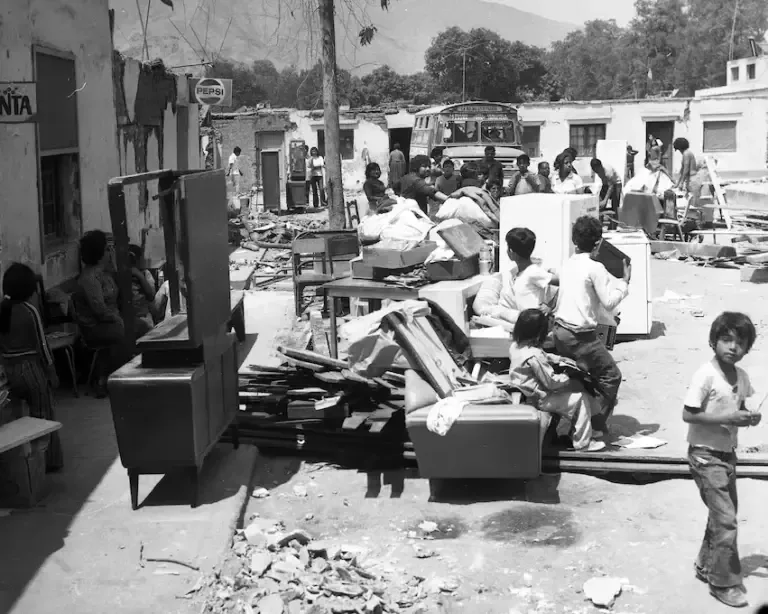
International aid was quick to arrive with offers from Venezuela, Ecuador, and Chile, countries that were among the first to extend a helping hand. On the other hand, the military government took on the task of supporting families directly affected by the collapse of their precarious homes. TheSimulacroSis relocated and supported the construction of new neighborhoods, as happened to a large number of neighbors from Amazonas street, downtown Lima, who were relocated to the Ascarruz area in San Juan de Lurigancho.
Three days later, on October 6, 1974, the figures already reflected the reality of the events. There were 73 dead, more than 1,000 injured, and nearly 4,000 homes destroyed in Lima and the ‘Sur chico’. Also, 22,000 people were affected, 261 school buildings were damaged causing classes to be suspended for 11 days; and 690 aftershocks occurred during the week following the seismic event.
Days later, the first procession of the Lord of Miracles had a special character. Seeing the sacred figure walk through the affected streets, many of them collapsed, was moving. The faith of the people of Lima during those days appeared intact, reborn, and luminous, despite the drama suffered.
Read more Results Superior Draw: grand prize and today’s broadcast, August 14
- Father’s Day: interesting reflections by Peruvian historian Joseph Dager on what it means to be “father of the nation”
- Fire under control: this is how the future of fire extinction was tested in El Potao in 1934 | PHOTOS
- Battle of Arica: the story of the soldier who met Bolognesi on June 7 | His story in El Comercio
- Farewell to the steel and marble colossus: historical milestones of the old Jorge Chávez International Airport | PHOTOS
- The great raid of 1926: eradication of gambling in the Chinese theater on Cangallo street in Lima