







Three years later, a similar emergency scenario is once again a possibility. The latest ENFEN statement maintains the Coastal El Niño alert and estimates a probability equal to or greater than 62% that it will reach an extraordinary magnitude between September 2026 and January 2027. For the summer of 2027, above-normal rainfall is also expected on the northern coast, central coast, and northwestern highlands.
The risk has already been assessed. Estimates from the National Center for Estimation, Prevention, and Disaster Risk Reduction (Cenepred) place 209 districts in the country at a very high risk level for flooding, where more than 7.9 million people live.
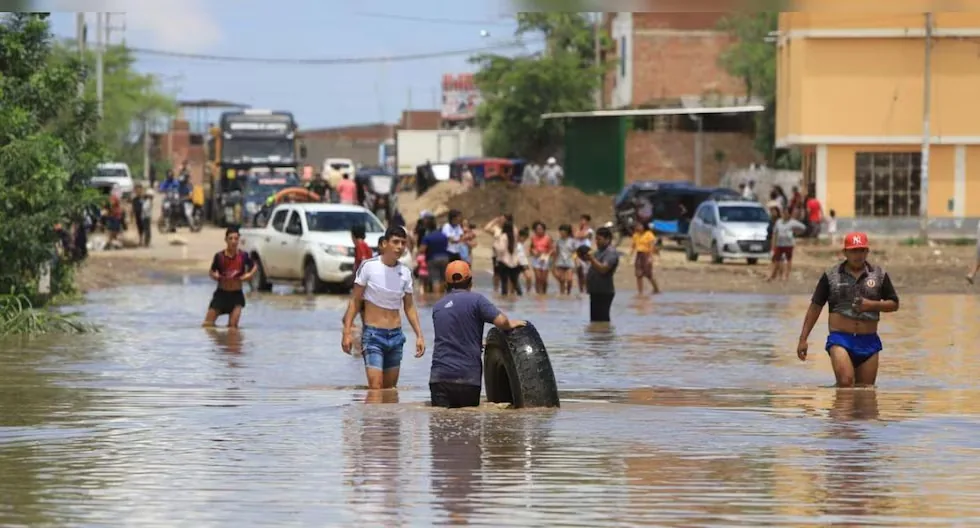
The 2023 scenario was bleak. Flooded clinics, affected equipment, and health personnel who had to continue attending while the health infrastructure itself suffered the effects of the rains. According to a report from the Ministry of Health (Minsa), during the 2022-2023 season, 1,229 facilities were affected but managed to remain operational, while another 20 became inoperative.
The emergency also left consequences among the population: 345 people were reported injured – 339 residents and six health workers -, 177 deaths, and 18 missing persons. The impact on facilities extended across different regions. Piura recorded 225 affected but operational Minsa facilities; Metropolitan Lima, 197; Áncash, 160; La Libertad, 145; and Lambayeque, 102.
Most of the damage also reached the first line of care. Of the 1,229 affected facilities, 93.5% belonged to the first level, precisely the one the population initially goes to for care.
In the Health sector, the risk scenario again mainly concentrates on that first line. The plan prepared by Minsa for the 2026-2027 period identifies 4,393 health facilities at imminent risk, distributed in 796 districts declared in emergency. Of these, 4,294 belong to the first level and only 99 to the second and third levels.
Care in pools, libraries, and sports courts
Of the 20 Minsa IPRESS that became inoperative nationwide, 15 were concentrated in Lambayeque, Áncash, Lima Provinces, and Ica. Maintaining care forced the transfer of services to other facilities or temporarily enabling spaces outside the health infrastructure.
In Lambayeque, the San Antonio health center in Chiclayo moved its care to the José Leonardo Ortiz municipal pool. In Túcume, where the flooding was accompanied by the entry of sewage water after the sewer collapse, services moved to a municipal library. In Maravillas, care was provided in the home of a health promoter, while in Moyán the garage of the new facility was used.
The situation repeated in other regions. In Áncash, San Miguel attended in a community hall; Cochabamba, in municipal premises; and Chingalpo, in the locker rooms of a sports court. In Lima Provinces, Sayán moved its care to a parish, while El Valle initially used spaces from another facility and later a sports court. In Ica, El Ingenio moved care to the Tulín health post.
For former Health Minister Víctor Zamora, these spaces may be necessary as a first response but should not become a permanent solution. “A pool, a library, or a sports court can be indispensable when a flood or landslide puts a facility out of service. The problem arises when a solution designed for a few days extends for months or years,” he said.
Read more 1926: The Spanish plebiscite in Peru
Augusto Tarazona Fernández, former Deputy Minister of Health Benefits and Insurance at Minsa and former executive of the Medical College of Peru (CMP), considers that the problem starts before the emergency occurs. “We can categorically affirm that there is no risk planning,” he told El Comercio. As he explained, prior planning should allow defining expansion areas, places to transfer care, and having infrastructure with greater capacity to withstand these types of events.
The challenge of maintaining care in an emergency
Faced with this scenario, Minsa approved in September the Action Plan against the effects of the El Niño Phenomenon and associated hazards 2026-2027, which seeks to guarantee continuity of care. Among its measures are damage monitoring, mobilization of teams, medicines, and mobile infrastructure, as well as deployment of medical posts and field hospitals when local infrastructure is affected.
One of these tools is the Advanced Medical Posts (PMA). Willington Abraham Mendoza Valladolid, coordinator responsible for the Campaign Hospital Team of the Health Mobilization Unit (UMS) of the General Directorate of Disaster Risk Management and National Defense in Health (DIGERD), explained to El Comercio that the sector currently has more than 50 and is in the process of acquiring about 70 more. These temporary spaces allow providing initial care, stabilizing patients, and referring them to higher-capacity facilities. “Before the phenomenon starts, we must already have the medical posts strategically located,” he said.
The plan also includes actions to reduce service interruption before and during an emergency. These include emergency corrective maintenance work, technical assistance to regional teams to assess damage in facilities and prepare maintenance interventions, as well as monitoring telemedicine services and the 113 Health Line. In case of infrastructure damage, the document also foresees mobilization of brigades, medicines, and mobile infrastructure to sustain care.
If several facilities are affected simultaneously, Mendoza indicated that the response includes reinforcing I-4 facilities and coordinating with SAMU for patient transfer to hospitals that remain operational. For Víctor Zamora, former Health Minister, the pandemic experience left a lesson that should be applied to El Niño: the response must be organized beforehand as a single territorial network. He recalled that during the health emergency it was necessary to create the COVID Command to coordinate a fragmented system and know the actual capacity available among different providers. “The El Niño phenomenon demands similar leadership: updated information, operational command, and agreed rules to mobilize resources,” he said.
Augusto Tarazona Fernández, former Deputy Minister of Health Benefits and Insurance, warned that planning must also consider increased demand due to diarrheal diseases, dengue, leptospirosis, and other conditions, as well as the possibility that health personnel themselves may be affected. Therefore, he said the response requires anticipating additional personnel, medicines, diagnostic tests, and capacity to transfer patients.
Added to this is the age of part of the health infrastructure. Mendoza acknowledged that there are first-level facilities several decades old that need to be replaced. “Yes, there is a delay, as you may have noticed, of 50 years in health matters,” he stated.
The plan includes S/1,450,106 for activities scheduled between 2026 and 2027 by Minsa and the National Institute of Health. Zamora warned that this figure does not represent the cost of protecting or recovering the 4,393 facilities identified at risk nor includes resources from regional governments and other providers. For the former minister, contingency measures allow temporarily sustaining services but do not replace a fundamental response. “Contingency serves to buy time. It does not replace investment, maintenance, or relocation of exposed facilities,” he concluded.
Read more Piero Guaylupo fights on September 22 for a UFC contract: «I’m a cholo, I like to fight»