




![Alberto Beingolea: “If they insist on not giving [the powers], they are complicating life for Peru”](https://insightermedia.com/wp-content/uploads/2026/09/bb3fa9e11304ea13fe2cd333955007bc-150x150.webp "Alberto Beingolea: “If they insist on not giving [the powers], they are complicating life for Peru”")



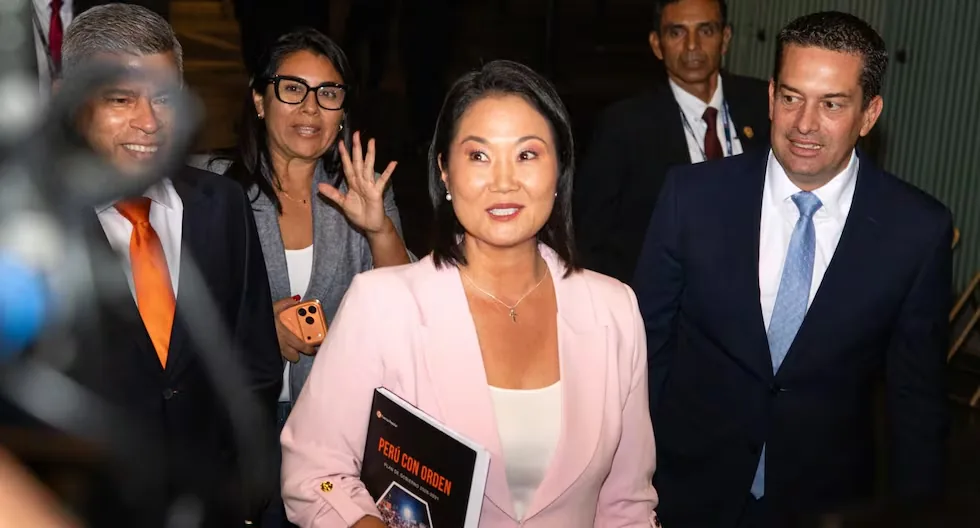
But the group founded in 2010 by Fujimori –formerly called Fuerza 2011– has not replicated its electoral success at the regional and local level, not even in Metropolitan Lima.
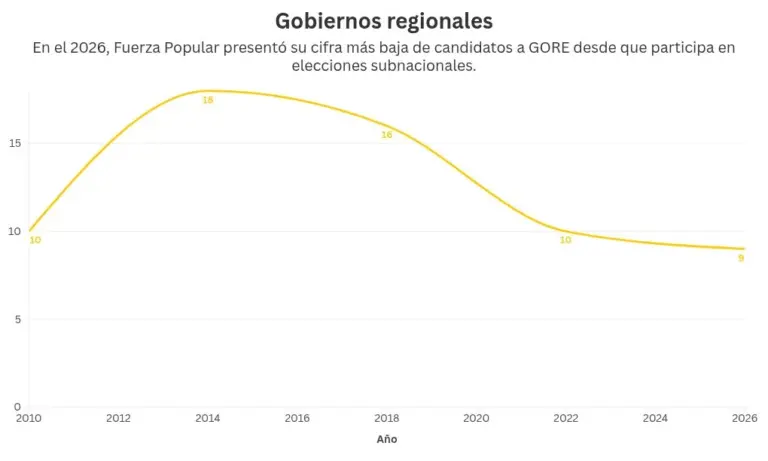
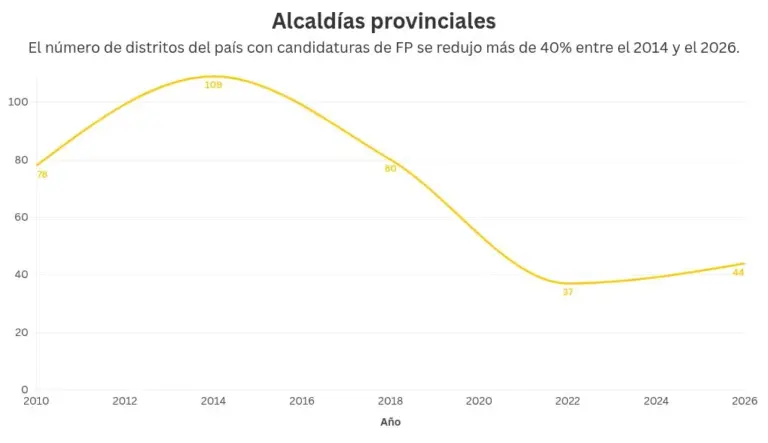
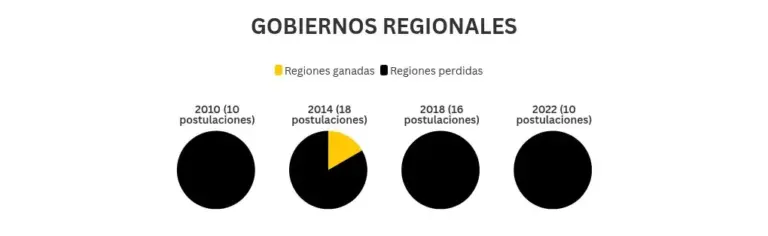
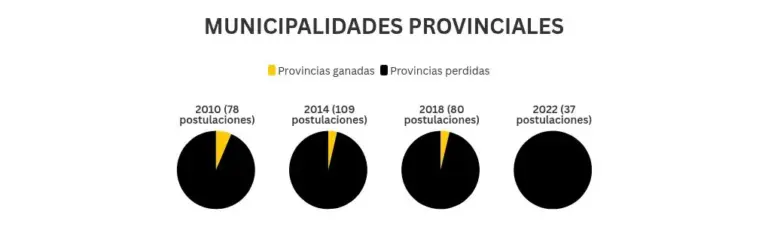
In the 2010–2022 period, Fuerza Popular ran 54 times for regional governments (GORE) and only won three, all in 2014: Ica, Pasco, and San Martín. In that same period, it ran 304 times for provincial mayoralties and won in just 14.
How did the number of Fuerza Popular candidacies
vary at the subnational level?
Hover over the lines to see the year.
In the capital, the results are even more critical. In 2014, candidate Alberto Sánchez Aizcorbe obtained a meager 2.7% of the votes. Four years later, Diethell Columbus –now a congressman for Lima– also reached 2.7%, and in the 2022 process, Fujimorism gave up competing.
Read more Quini 6 LIVE today, draw 3402 on Sunday, August 23: how to play and where to watch live
In January of that year, the leader of Fujimorism had presented César Combina as the pre-candidate of her group for the city. “I have decided to accept the invitation of Fuerza Popular,” responded the former congressman.
But the projections were not encouraging at all. In February, Ipsos Peru polls gave Combina a modest 3% of preferences. Two months later, Fuerza Popular abandoned that electoral race.
“Fuerza Popular declines to participate in the elections for the mayoralty of Lima. With no greater condition than preserving our democracy, we will support a candidacy that manages to unite those of us who believe that Lima should not fall into the hands of populism or the left,” tweeted Keiko Fujimori on April 22.
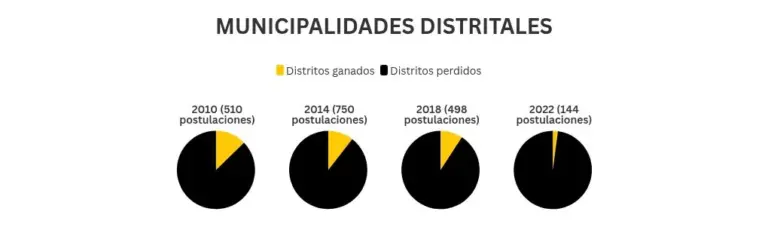
The result has also not been better in the districts of the capital: to date, Fuerza Popular has not placed a single mayor. For the upcoming October 4 elections, it presented lists in only 10 districts, the lowest number in its electoral history.
The scenario is similar outside Metropolitan Lima: this year, Fujimorism only presented nine candidates for GORE, one more than the minimum required by law to avoid losing its registration, also the lowest number in its party history.
Likewise, it will compete in only 44 provinces, representing coverage of just 22.4% of the jurisdictions that make up the country. At the district level, it will have 221 candidates (13% national coverage).
El Comercio tried to contact Fuerza Popular spokespeople, but by the time of this report’s closure, there was no response. Congressman Columbus excused himself from participating, due to his status as an authority requiring neutrality during an ongoing electoral process.
Fuerza Popular’s performance in subnational elections
Hover over the charts to see the number of constituencies won or lost.
One Peru, two realities
In 2011, in its first general election as a political party, Fuerza Popular not only contested the runoff with Keiko Fujimori as its candidate, but its caucus became the main opposition force in Congress, with 37 of the 130 seats.
Read more New Pension 65 with increase: beneficiaries and when the S/ 700 are paid
Three years later, Fujimorism tried to strengthen its political presence at the regional and local level. 2014 is to date the electoral year in which it presented the most subnational candidacies: 18 candidates for GORE, 109 for provincial mayoralties, and 750 for district ones, and in Lima, it ran in 32 districts.
Fujimori’s role in that electoral contest was prominent. “I have had the opportunity to travel. […] I have personally traveled to 15 regions of our country,” she said in an interview with RPP on October 8, 2014, days after the election day.
Although the results were not auspicious, they are so far the best in its history in regional and local politics.
“We have had above all the responsibility to seek leaders, to open up, to make an opening of the party, to seek Fujimorist and independent regional leaders to give citizens an option,” Fujimori highlighted in that interview.
To understand how electoral politics works at the subnational level in Peru, it is key to understand regional and local leaderships.
“For national parties it is very difficult to recruit good candidates, because they do not want to go with a [political] brand that could discredit them, they prefer not to associate with a known national brand,” explains Mauricio Zavaleta, political scientist at the University of Pittsburgh and author of the book “Coalitions of Independents. The Unwritten Rules of Electoral Politics” (IEP, 2014).
In the 2022 – 2026 period, for example, regional movements govern in 14 of the 25 GORE (56%) and in 122 of the 196 provinces of the country (62%).
In the particular case of Fuerza Popular –adds Zavaleta–, the anti-vote it drags complicates its ability to attract viable candidates in the interior. “If you are someone with ambitions in Cusco, for example, it would be political suicide to go with Fuerza Popular,” he added.
In the north, an area with an important Fujimorist presence in general elections, there is another obstacle. “The brand there can be neutral and even positive, but they do not want to go all the way to Lima to ask for things, there is an element of autonomy: no one wants to consult Lima on how to proceed in their region,” concludes the specialist.
Read more Alianza Lima vs. Melgar LIVE for Liga 1 — Watch ONLINE broadcast