




![Alberto Beingolea: “If they insist on not giving [the powers], they are complicating life for Peru”](https://insightermedia.com/wp-content/uploads/2026/09/bb3fa9e11304ea13fe2cd333955007bc-150x150.webp "Alberto Beingolea: “If they insist on not giving [the powers], they are complicating life for Peru”")



In March 2014, the ruling Salvador Sánchez Cerén defeated Norman Quijano by just 6,364 votes; that is, 0.22 points.
Read more Today’s horoscope, Tuesday, August 11: Read your sign’s predictions here
“The Central American country was in a political limbo for several days [awaiting results]. […] Precisely that narrow difference caused all the delay”, reported then the BBC Mundo portal about the unprecedented electoral result in El Salvador.
But that close outcome was an exception: no other election held in that nation in the last 25 years went to a second round.
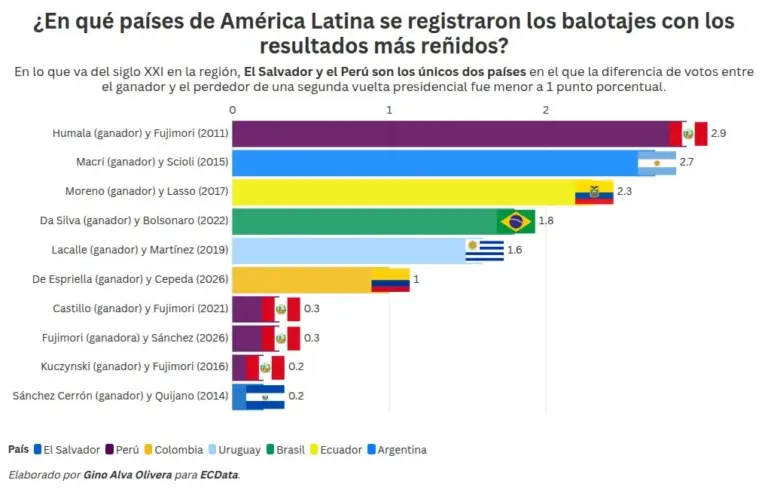
In Peru, on the other hand, the runoff is the rule: the six elections of the 21st century, including this year’s, were decided in the runoff.
Among 13 Latin American countries analyzed where a second round exists as a mechanism for presidential elections, scenarios similar to our country only repeated in Brazil, Chile, and Guatemala.
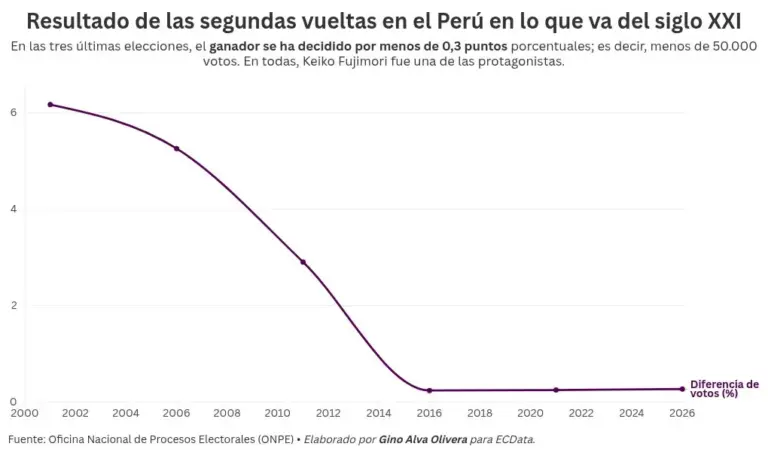
Also, in the last three electoral races – all with Keiko Fujimori as one of the protagonists – the margin between the winner and the loser of the contest has been minimal.
In 2016, Pedro Pablo Kuczynski defeated her by only 0.24 percentage points (41,057 votes). Five years later, Pedro Castillo defeated her with a margin of 0.25 points (44,263 votes).
This 2026 election was no exception: the leader of Fuerza Popular surpassed Roberto Sánchez, candidate of Juntos por el Perú, by 0.27 points (49,641 votes).
“We have seen two halves [electoral] very close to each other. There was no enthusiasm around a leader who makes a difference, so the anti-vote was the majority. 70% did not vote for either Keiko or [Roberto] Sánchez in the first round. That dynamic tends to divide [the voters],” explains Sandro Macassi Lavander, PhD in Sociology and professor at PUCP.
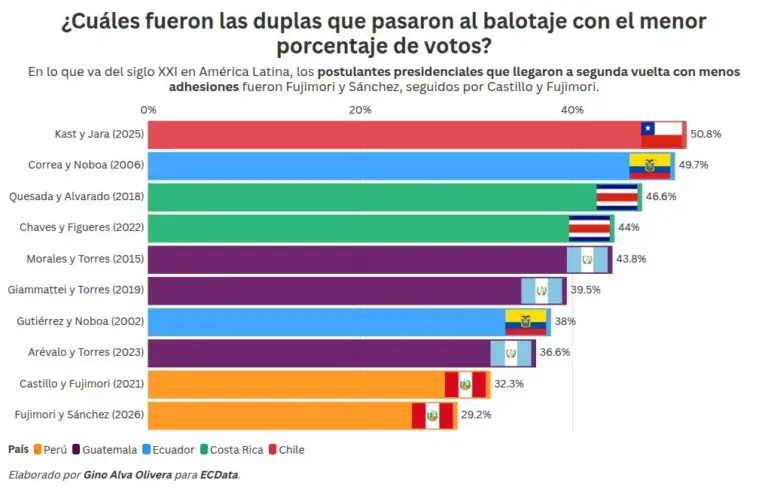
In the first round, Fujimori (17.2%) and Sánchez (12%) together obtained only 29.2% of the valid votes in the country.
Thus, both form the pair of candidates who competed in a runoff with the lowest support in history not only in Peru but also in Latin America.
So far this century, no pair of electoral rivals in the region has had a vote lower than 35%.
Ideology and legacy
In 2022, Lula da Silva won the presidency of Brazil for the third time by surpassing in the runoff by 1.80 points (more than two million votes) another former president: Jair Bolsonaro. In the first round, together they reached 91.63% of the support.
One year later, in Argentina, Javier Milei defeated Sergio Massa by a wide margin (11.30 points or more than two million votes) in the runoff. In the first round, they gathered as a pair 66.77% of the votes.
In both countries, as well as last June in Colombia, the electoral debate focused on a confrontation between left and right political ideologies. But what happens in Peru?
“Populism leaves a legacy of polarization that is not ideological, but related to the legacy of a leader. In Peru, the vote polarizes around [Alberto] Fujimori: you either support or reject what he represents. This is a case similar to Ecuador with the figure of Rafael Correa”, explains Julio Carrión, professor of Political Science at the University of Delaware.
“That allowed her to have a more stabilizing than confrontational image. Keiko read the reality of the country more appropriately”, he added. In his opinion, the presence of Rafael López Aliaga as a candidate also “generated the perception that she [Fujimori] is much more moderate”.
The study “Peru: citizen perception on governance, democracy, and trust in institutions,” published last May by the National Institute of Statistics and Informatics (INEI), reveals that crime (53.6%) and lack of security (22.1%) are two of the main problems in the country, only surpassed by corruption (59.6%).