




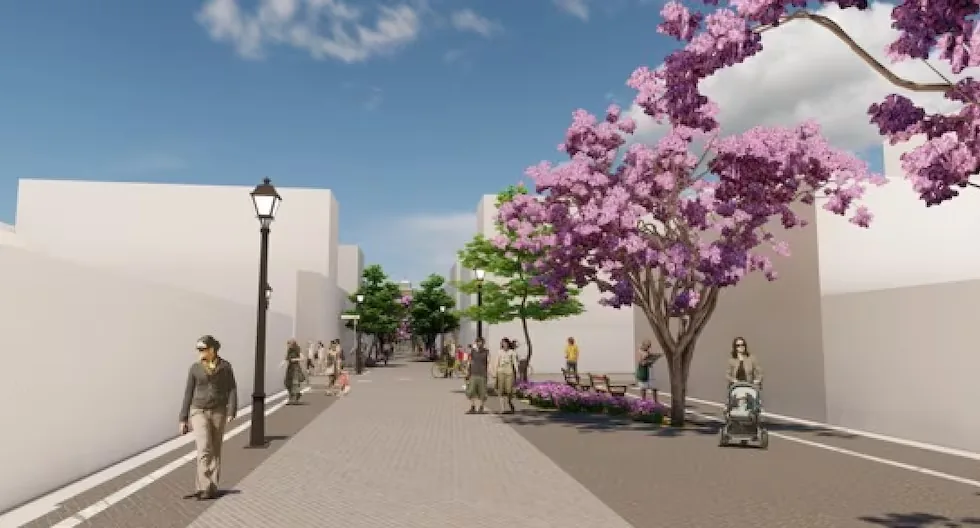
It will be two years since the World Bank announced a $150 million loan to finance a program aimed at transforming urban mobility in Lima. The initiative, with a planned duration of 10 years, included the execution of various works, among them the so-called superblocks.
Read more Great Civic-Military Parade 2026: schedule, location, participants, and which channels broadcast it
READ HERE: El Niño Phenomenon with 99% probability of being very strong demands accelerating prevention works
This is because, according to the World Bank, Lima is one of the most congested cities in Latin America and the costs related to traffic in the Peruvian capital amount to 1.8% of GDP, while the vehicle fleet represents 40% of the city’s greenhouse gas emissions.
“The project aims to reduce congestion and improve air quality by optimizing traffic, strengthening road safety at high-risk intersections, and promoting sustainable modes of transport, such as bicycles,” the bank stated in October 2024.
The first phase of the project included the implementation of an electronic traffic violation detection system. It also included the construction of a metropolitan bicycle system and calm traffic zones.
The implementation of superblocks was projected in five districts of Lima. The municipalities of Surco, Surquillo, Lince, La Molina, and San Miguel were selected to access World Bank financing.
The superblock in Surco
Aldo Facho Dede, architect and urban planner, told El Comercio that the only superblock currently under execution is the one in Surco, located in the area known as Surco Pueblo, while in the other districts the works have not yet started.
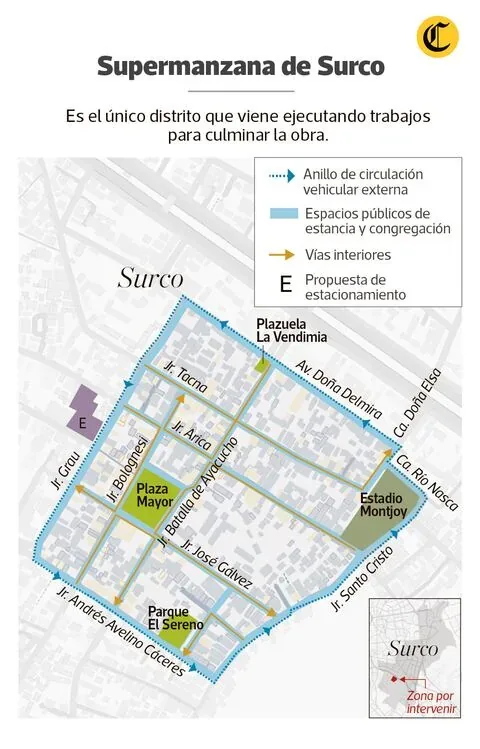
The specialist, who is closely familiar with the project because he participated in its implementation, stated that the Surco superblock shows significant progress and that the administration of Mayor Carlos Bruce decided to execute the initiative with the municipality’s own resources due to a delay by the Municipality of Lima in making the World Bank loan effective.
SEE HERE: Electric motorcycles with license plates, SOAT, and license: Details of the key meeting between the MTC, drivers, and vehicle sales companies
“The first part, which is the plaza, has already been covered, and progress is being made with the surrounding streets,” Facho said.
“The flow that previously crossed the superblock has been diverted to the side roads. Some road solutions have been generated within the superblock so that residents can access their homes,” he added.
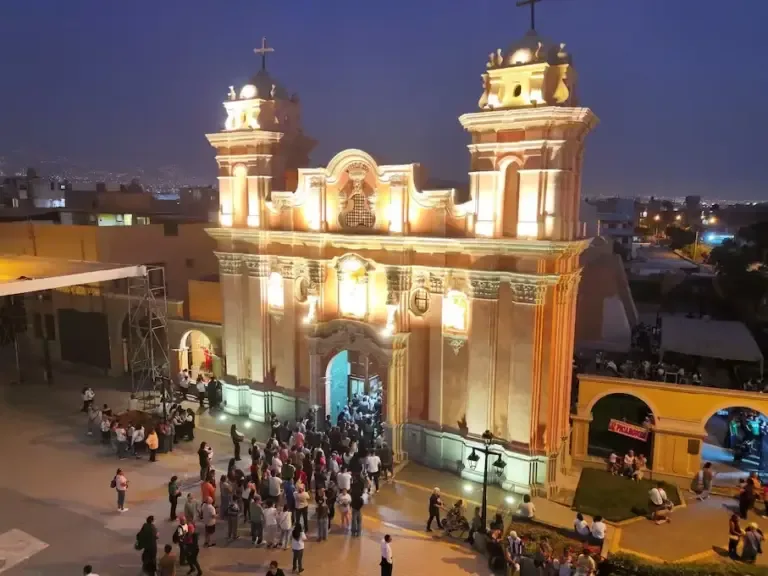
Facho Dede recalled that the superblock is an urban solution that originated in Barcelona and was promoted by urban sociologist Salvador Rueda. He explained that the project consists of organizing city sectors as if they were neighborhoods, bounded by main roads. “It is designed so that residents enter their homes or businesses avoiding through traffic. Only vehicles with a destination within the superblock enter,” he specified.
“The superblock starts from a shared-use road and prioritizes pedestrians, cyclists, and other non-motorized forms of mobility, especially walking. It also takes advantage of intersections and other spaces to create resting areas for pedestrians,” he stated.
Surquillo waiting
Surquillo accessed the non-reimbursable World Bank loan to implement the superblock after being chosen among 17 finalist districts. The municipality would be granted 16 million soles to execute the project. The sector to be intervened would be comprised of the streets Santa Rosa, El Carmen, José Manuel Iturregui, and the avenues República de Panamá and Mariscal Andrés Avelino Cáceres.
According to the Municipality of Surquillo, the superblock will prioritize pedestrian mobility through calm traffic zones. These are spaces where vehicle circulation and speed are restricted to protect residents’ safety.
Read more Among Us legislative
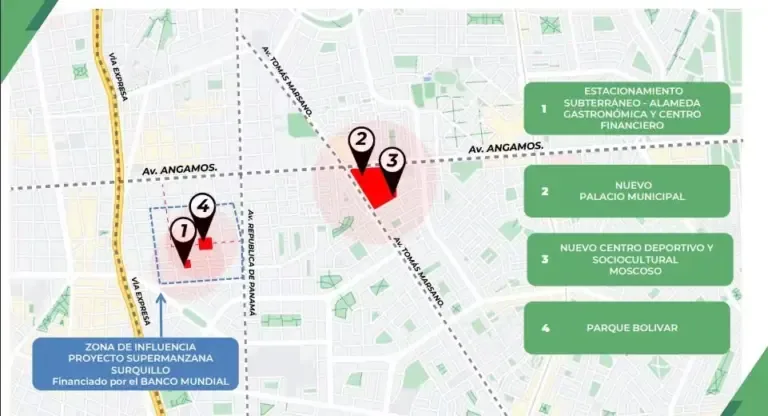
“In the superblock proposal, pedestrians will be prioritized, which means that public spaces, sidewalks, side and central berms, and setbacks will have recreational and leisure spaces, prioritizing that pedestrians can move more safely and that vehicles travel on these roads at 30 km/h,” said Cintia Loayza, mayor of Surquillo.
The municipal authority detailed that the development of the superblock will include intervention in 33 blocks located in the historic part and center of the district.
However, architect Aldo Facho stated that so far the superblock in Surquillo has not begun to be executed.
Superblock proposals in Miraflores
Although Miraflores was not selected as one of the districts where a superblock would be developed, there were projects years ago to implement spaces where vehicle movement would be limited and pedestrian mobility facilitated.
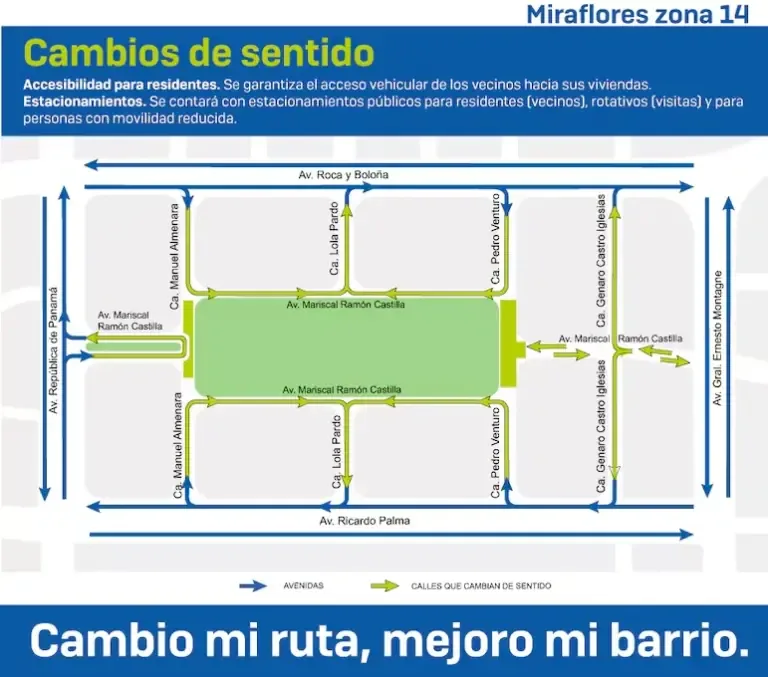
The project was divided into three sectors: Microcenter superblock (bounded by the avenues Ricardo Palma, Paseo de la República, Benavides, and Larco), Balta superblock (comprised of the streets Berlín, Bolognesi, and the Malecón Balta), and Aurora superblock (area covering the avenues República de Panamá, Roca y Boloña, General Ernesto Montagne, and Ricardo Palma).
The initiatives for these superblocks were promoted between 2019 and 2020, during the administration of then-mayor Luis Molina. Neighborhood hearings were even held to explain the project. However, so far there are no signs that it will materialize. In fact, the current administration of the Municipality of Miraflores informed this newspaper that the proposal is not included in their plans.
Opinions
Francisco Barreto, civil engineer, told El Comercio that there is much expectation in the real estate market regarding the development of a superblock in the area between Vía Expresa Luis Bedoya Reyes, Av. Benavides, the Balta descent, and a road parallel to Av. Ricardo Palma.
He emphasized that the proposal would take Kennedy Park as the central axis and aims for pedestrians to access services and cultural, gastronomic, and entertainment spaces in a highly touristic district.
“A superblock will always initially have some friction because the question will be how those living nearby will park and how businesses will attract more people, but in the long term, as in the case of Jirón de la Unión, walking gives a different feeling to the environment, as it is much more pedestrian-friendly, there are many more green areas, and there is respect for cyclists,” he asserted.
For his part, Aldo Facho indicated that an option for Miraflores is to establish calm traffic zones in the central part, as was done a decade ago. “The roads in Miraflores were reformed as calm traffic zones, where level roads were installed, pedestrian traffic was encouraged, and the maximum vehicle speed limit was lowered. What was worked on many years ago deserves to be recovered to allow people to walk more calmly and safely in Miraflores,” he said.
“What I do see as viable is implementing a calm traffic zone, which is not a superblock, but the design of interior or local roads with lower speed to encourage pedestrian traffic,” he added.
Read more Dollar price in Peru today, Wednesday, July 29: what is the exchange rate of the day