










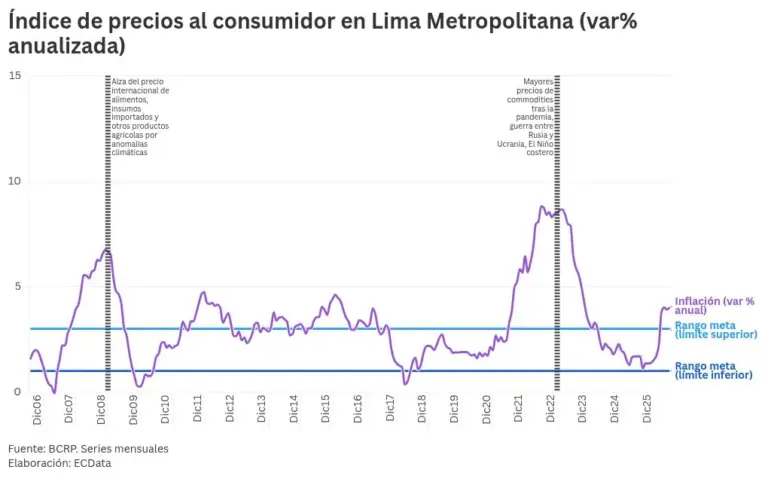
In 11 of the last 20 years, annual closing inflation remained below 3% and only escaped the target range (between 1% and 3% of the annualized rate) in specific periods, mainly associated with supply shocks related to international factors.
“I would say that inflation in Peru is the envy of the region: several neighboring countries have had inflation well above the levels we boast —Brazil and Colombia, for example— and Peru has managed to control this variable quite well, to the point that it is not a central problem,” remarks Eduardo Jiménez, Head of Macroconsult’s Information System.
Economist Paola del Carpio, Research Coordinator at Redes, agrees with Jiménez, adding that, beyond being an entity represented by Julio Velarde, the BCR stands out for its level of institutionalism, which is sustained by its team of technicians.
“By maintaining low inflation, a stable exchange rate, and the value of our currency, it has managed to stand out for fulfilling its role of ensuring price stability,” del Carpio details.
Adverse Scenario
The supply shocks that our inflation has had to face are diverse: for example, in 2007 and 2008, it was impacted by the rise in the price of imported food and inputs. Between 2014 and 2016, it was associated with a rise in the exchange rate, an increase in service tariffs, and climatic phenomena. Between 2021 and 2023, it was due to higher commodity prices after the pandemic and the war between Russia and Ukraine – which made fuels and agricultural fertilizers more expensive – and the coastal El Niño.
“We know that the Central Bank manages this variable very well and that, when inflation goes outside the target range, it will do everything in its power to bring it back, based on the trust it has built over all these years. The BCR was already a reliable institution in the nineties, but it has further strengthened that technical criterion, and thanks to that trust, economic agents have their expectations quite well anchored,” says Jiménez.
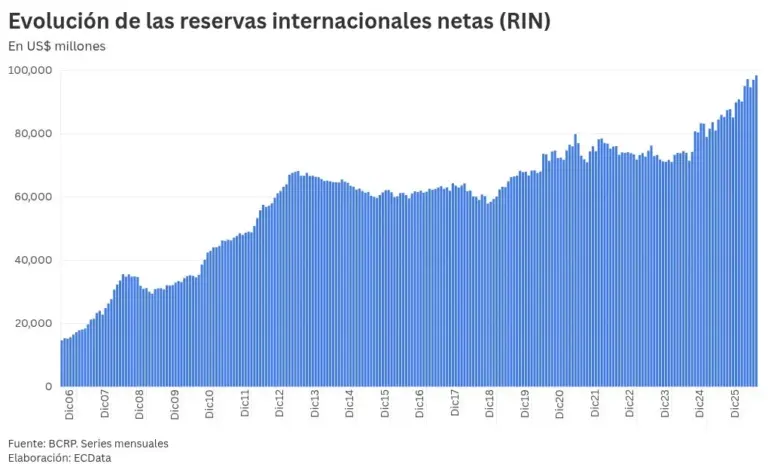
On the other hand, international reserves – composed of gold and foreign currency assets that guarantee the availability of foreign exchange in the face of financial market turbulence – multiplied sevenfold, increasing from US$14.638 billion in July 2006 to US$98.436 billion at the end of May this year. According to the bank, these reached US$100 billion by June 9, 2026. This amount represents 28.8% of local GDP, well above the proportion recorded in other nations in the region, such as Brazil (16.3%), Colombia, or Chile, both with 14.7% of GDP.
Del Carpio explains that international reserves stand out as one of the strengths of the Peruvian macroeconomy, providing security against other open risks that exist in the country.
“Despite all our shortcomings, markets continue to believe in us. Our high level of reserves makes it clear that we will continue to meet our commitments,” explains the economist.
Read more Silvana Robles denies alleged betrayal: “I emphatically reject having given my vote to Fujimorism”
Jiménez recalls that the bank failures in 1998 reinforced the Central Bank’s concern to accumulate reserves and maintain them at higher levels than the average for countries in the region.
“That is positive beyond the number of reserves, because it shows the commitment to the country to protect accounts and have resources to face crises, especially in the face of sudden capital outflows, which greatly affect the exchange rate,” he notes.
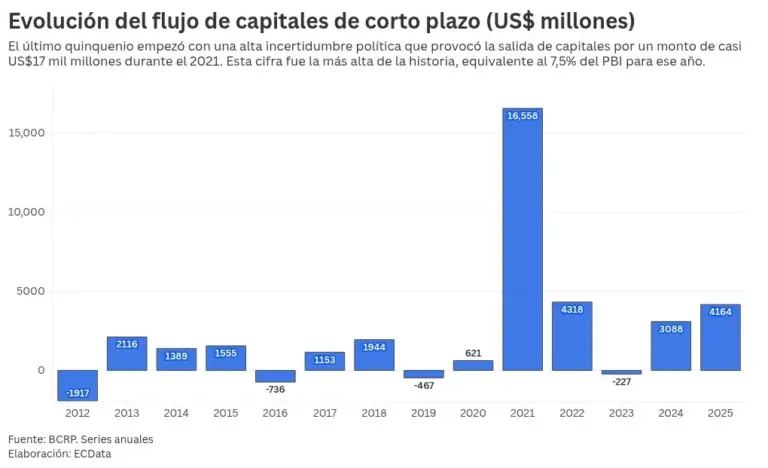
The national and international turbulences recorded in the last five years demanded interventions from the BCR to also reduce exchange rate volatility. In a context of high political uncertainty, the highest short-term capital outflow in history was recorded in 2021: some US$16.858 billion left the country, a figure equivalent to 7.5% of GDP.
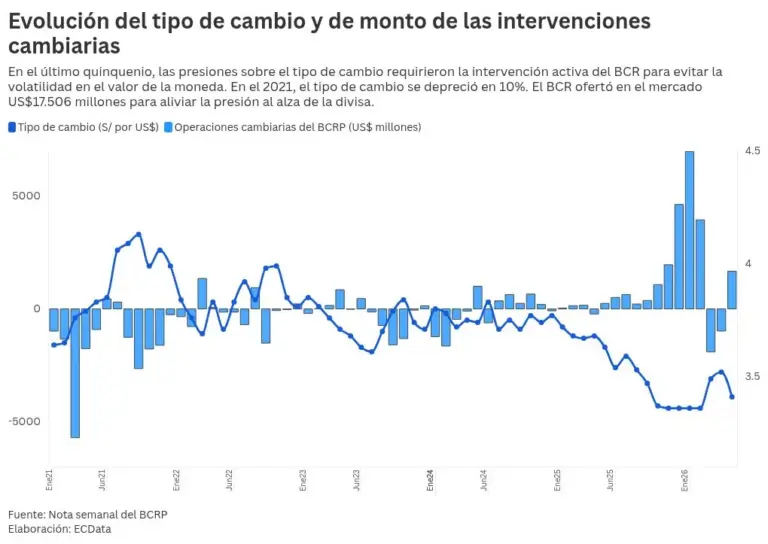
An abrupt capital outflow, in addition to the negative impact on the financial system, produces strong upward pressures on the exchange rate. That same year, the exchange rate depreciated by 10%, and the issuing entity had to offer US$17.506 billion in the market to prevent the national currency from falling further.
Internal Administration
The low inflation rate, the unprecedented accumulation of international reserves, and the good management of the exchange rate were due to the institution’s correct management. Although the BCR is a constitutionally autonomous body and is financed with its own resources, its total budget, payroll expenses, and the number of employees have increased in a much smaller proportion than other public institutions.
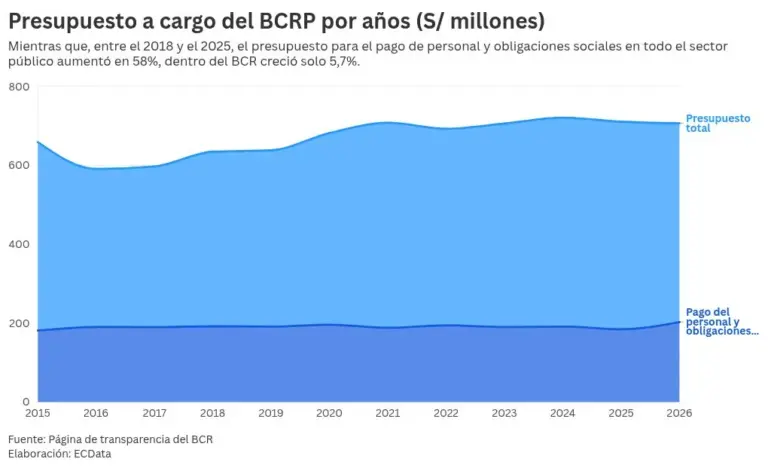
Between 2018 and 2025, the funds allocated for personnel payment and social obligations within the BCR only grew by 5.7% (from S/192 million to S/203 million). The number of employees only increased by 3.7% (from 923 to 957).
In the same period, payroll expenses for the entire public sector increased by 58.4% (from S/54.665 billion to S/86.610 billion), while the employed EAP in the public sector increased by 12.1% (from 1.37 million to 1.54 million), according to figures from the Private Competitiveness Council. That is, the increase in remuneration expenditure was 8 times higher in the State than in the BCR, and the increase in personnel in the State was triple that in the issuing entity.
“Beyond the macro, one of the Central Bank’s most important contributions to the country is to show that a public institution can be trusted, that it can have high-level staff and strong institutionalism. The BCR has a very rigorous recruitment system —I had the honor of going through that course— and today it has more programs. Personnel are selected very strictly, and those who work there are high-level professionals,” says Jiménez.
Read more LINK LIGA 1 LIVE, Alianza Lima vs. Comerciantes Unidos for Liga 1 Clausura Tournament