




![Alberto Beingolea: “If they insist on not giving [the powers], they are complicating life for Peru”](https://insightermedia.com/wp-content/uploads/2026/09/bb3fa9e11304ea13fe2cd333955007bc-150x150.webp "Alberto Beingolea: “If they insist on not giving [the powers], they are complicating life for Peru”")



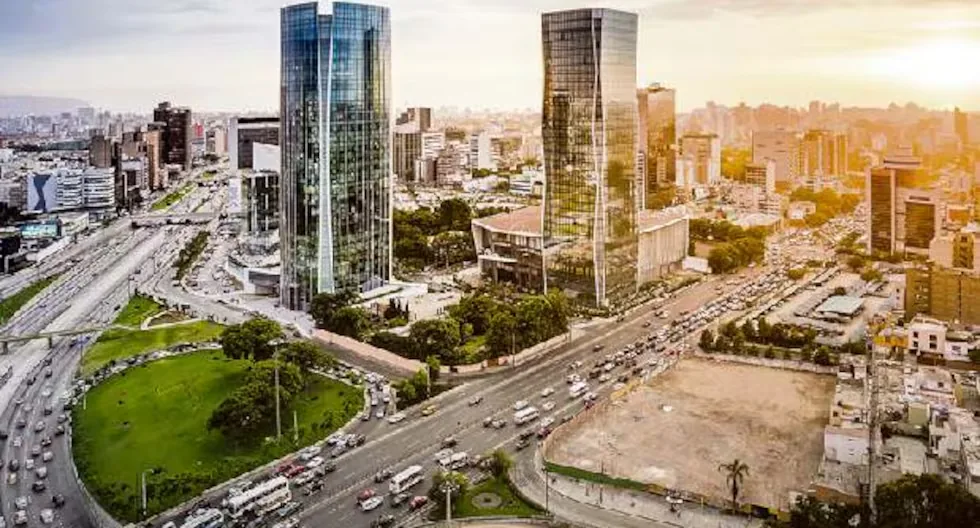
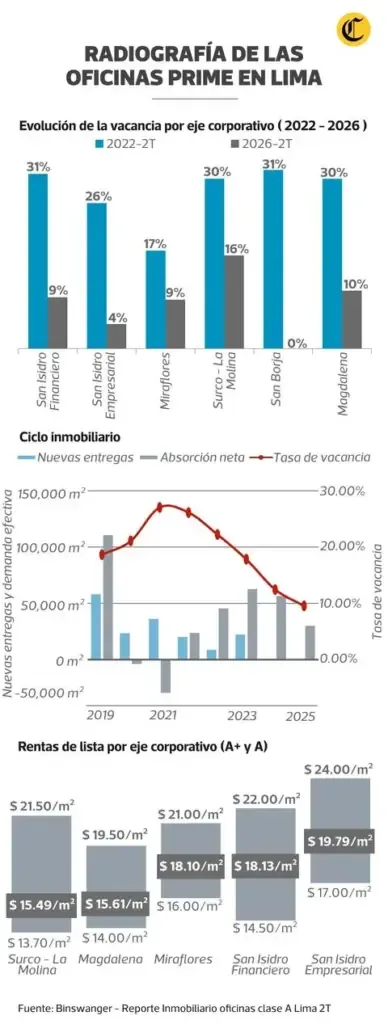
The vacancy rate of prime offices in Lima fell to 9.53% at the close of the first half of 2026, its lowest level in more than a decade, due to the recovery in demand and the limited entry of new buildings, according to the latest real estate report from Binswanger Peru.
Read more The rise of American socialists
The market totals 1.03 million square meters distributed across 77 class A and A+ buildings. During the second quarter, no new projects were added, while net absorption (the result of subtracting vacancies from occupancies) reached 12,228 m2. By mid-2026, Binswanger identified an occupancy close to 30,000 m2, mainly concentrated in San Isidro Financiero and Miraflores.
Between April and June, 20,300 m2 were occupied and 8,072 m2 were vacated. San Isidro Financiero led demand with a net absorption of 6,878 m2, followed by Miraflores with 4,489 m2. The operations mainly corresponded to public entities and companies in finance, insurance, technology, IT, and consulting.
The highest vacancy was recorded in Magdalena, where a public entity vacated about 3,500 m2. Despite this exit, total availability decreased by 39% compared to the second quarter of 2025, dropping from 159,000 m2 to approximately 98,000 m2.
Max Medina, Manager of Studies and Research at Binswanger Peru, states that the drop in vacancy below 10% represents a milestone for the market, as such a level has not been seen in more than a decade.
The reduction is present in practically all corporate hubs. San Isidro Empresarial records a vacancy of 4.3%; Miraflores, 8.58%; and San Isidro Financiero, 9.01%. Surco–La Molina remains at 16%, while Magdalena stands at 10%. San Borja, meanwhile, no longer has available class A spaces.
Medina explains that this scenario reduces tenants’ options, strengthens landlords’ negotiating power, and puts upward pressure on list prices.
Large offices are scarce
According to the Binswanger report, there are still about 98,000 m2 available, but 72% corresponds to gray offices (unfitted spaces). These spaces mainly concentrate the demand from companies requiring large areas, while fitted or furnished offices are generally requested by companies seeking areas between 100 m2 and 600 m2.
The availability of entire floors or continuous spaces is also decreasing. Medina explains that a company looking for between 2,000 m2 and 5,000 m2 in San Isidro or Miraflores currently finds few alternatives in A or A+ buildings.
This scarcity leads some companies to consider offices still under construction or development that will enter the market in 2027, according to Medina.
José Carlos Leigh, Business Director at Urbanova, points out that while a few years ago companies started their search a few months before their contracts expired, now they do so between 12 and 18 months in advance, especially when they require large areas or specific locations. The lower availability is also reflected in Urbanova’s portfolio, which projects closing 2026 with a vacancy between 1% and 2%.
Urbanova rented less than 5,000 m2 during the first half. Leigh specifies that the result is more due to limited availability within their portfolio than a lack of demand. The placements come from both clients expanding their offices and companies relocating their operations to other buildings.
The most marked case is in San Borja, where Urbanova’s four towers are practically fully occupied. Leigh attributes this performance to the connection with Javier Prado and Lima Metro Line 1, as well as the proximity to restaurants, shops, and services.
Medina adds that San Borja’s class A inventory is small compared to San Isidro’s, which contributes to its availability being exhausted more quickly. Connectivity with public transport also gains greater importance among large corporations, which choose their offices considering employees’ residences and commute times.

Rents on the rise
According to Binswanger, lower availability is beginning to pressure rents. The average list rent for A+ offices reaches US$20.45 per m2, while that for A buildings is US$16.43 per m2. The weighted average of both categories is US$16.97 per m2.
San Isidro Empresarial records the highest average rate, at US$19.79 per m2, followed by San Isidro Financiero with US$18.13, and Miraflores with US$18.10. In certain buildings, list prices reach between US$22 and US$24 per m2.
Read more Netanyahu rejects Trump’s plan for Gaza: these are the reasons and what may happen now
Medina explains that the difference is due to the higher standard of A+ properties, which have better common areas, infrastructure, equipment, backup systems, and environmental certifications. However, he notes that the figures correspond to list prices and not necessarily the final contract amounts.
He also notes that negotiating power depends on the required area: a tenant looking for 5,000 m2 can obtain better conditions than one needing 500 m2. However, the reduction in available alternatives limits the discounts tenants obtained during years of oversupply.
Jorge Ramos, Director of Capital Markets and Investor Relations at Fibra Prime, agrees that the balance of negotiations is changing. Two or three years ago, he says, landlords mainly competed through incentives to attract tenants. Now, the more limited supply allows them to negotiate better terms.
However, Fibra Prime prioritizes tenant retention and seeks to accommodate their expansions within its own portfolio. “We believe that a tenant who stays many years generates much more value than a slightly higher rent over a short period,” Ramos says.
According to Gary Moncada, Vice President of Real Estate Rental at Grupo Centenario, the rent for new placements by Centenario in San Isidro increased by around 20% compared to the previous period, with a higher variation in fitted offices. This format rents at values between 25% and 27% higher than gray offices.
Moncada explains that the difference is because companies can start operations without dedicating time and resources to space fitting. The company closed the first half with 90% occupancy in its prime portfolio and projects to approach 95% by year-end.
During the first half, Centenario rented 5,034 m2. The operations averaged 290 m2 and mainly corresponded to fitted offices aimed at companies with between 20 and 40 employees.
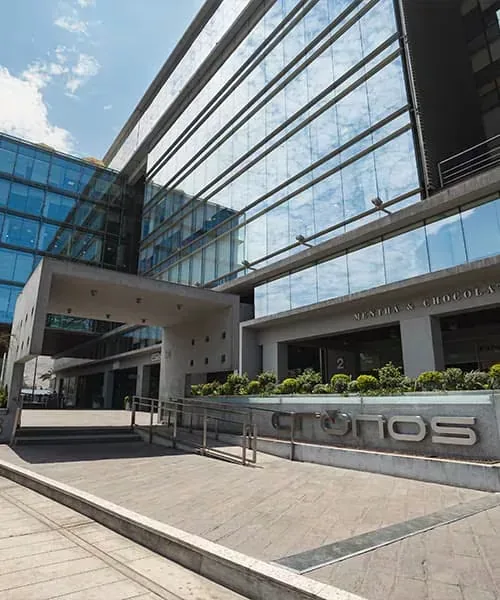
Moncada explains that of the 1,000 m2 fitted in the Cronos complex in Surco, 50% is already rented and the remaining area is under negotiation. In San Isidro, the company expanded its fitted office offering from 6,000 m2 to 6,500 m2 and has commercial agreements on more than 84% of that space.
Companies reserve spaces for 2027
Binswanger estimates that vacancy could approach 8% by the end of 2026. Medina adds that the only building about to be added would enter with an occupancy between 80% and 90%, so it would not substantially increase alternatives for new tenants.
Thus, supply will begin to expand in 2027 with Torre Rosales in San Isidro Financiero; Santa Cruz 4 in San Isidro Empresarial; and potentially More Living in Surco–La Molina. Together, these projects would contribute around 50,000 m2 of leasable area. A similar volume is under evaluation for the following years.
Leigh points out that Torre Rosales, developed by Urbanova on Paseo Begonias, will add 30,000 m2 of leasable offices and will be ready by the end of 2027. The project already has more than 40% of its area committed, reflecting how early some companies are securing new spaces.
Urbanova expects to finish 2026 with 60% of Torre Rosales leased, more than a year before its delivery. For now, the company focuses its efforts on this project, although it is also analyzing opportunities for new buildings and mixed-use developments.
Centenario, meanwhile, is designing a building of more than 30,000 m2, with floors between 2,000 m2 and 2,500 m2, projected to be completed in the first half of 2029. The start of construction will depend on maintaining current absorption levels, pre-leasing a significant part of the project, and a stable economic environment.
Fibra Prime also keeps investment opportunities in offices under evaluation, in addition to logistics and commercial assets. According to Ramos, the strategy focuses on acquiring properties with potential to increase occupancy and valuation through operational improvements, repositioning, and sustainability certifications, although he does not disclose operations or investment amounts.
For Medina, the market is heading toward a more favorable scenario for landlords, after several years in which tenants could choose from numerous alternatives. However, he warns that the development of new projects must maintain a pace aligned with demand to avoid generating oversupply later. For now, Binswanger does not anticipate that risk between 2026 and 2028.
Read more United States runs out of shield: its Patriot missile reserves fall 65% due to the war with Iran