




![Alberto Beingolea: “If they insist on not giving [the powers], they are complicating life for Peru”](https://insightermedia.com/wp-content/uploads/2026/09/bb3fa9e11304ea13fe2cd333955007bc-150x150.webp "Alberto Beingolea: “If they insist on not giving [the powers], they are complicating life for Peru”")



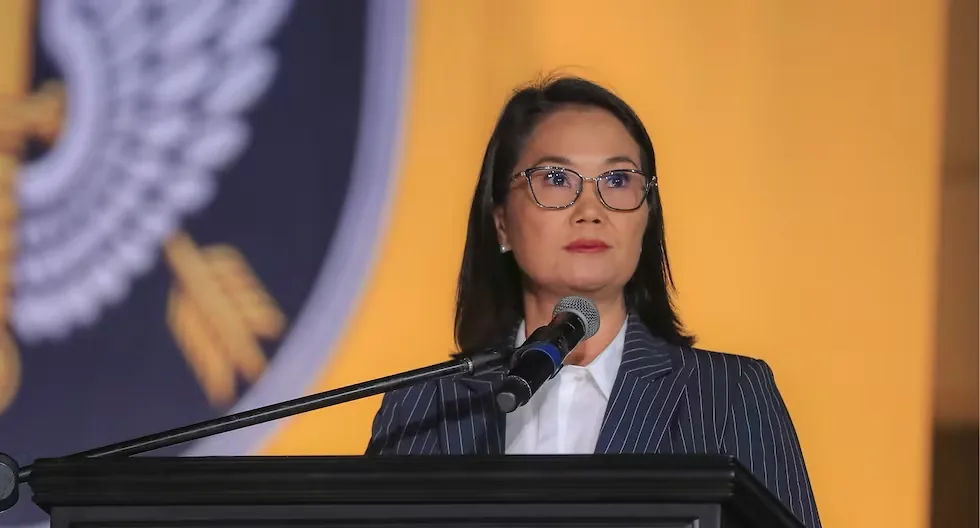
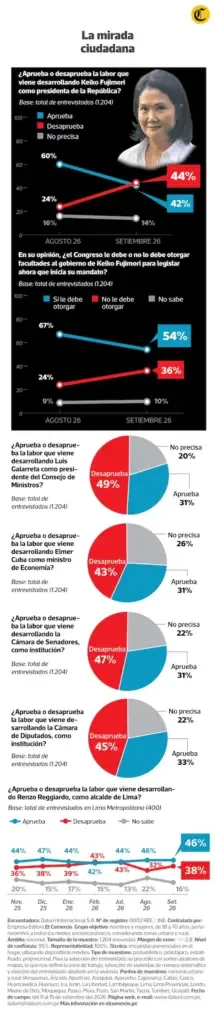
President Keiko Fujimori‘s approval rating dropped from 60% in August to 42% in September, a decline of 18 percentage points in one month, according to the latest national survey by Datum Internacional for America.
Read more Earthquake in Piura via IGP: latest minute of earthquakes in Peru, magnitude and epicenter
In the same period, the president’s disapproval increased from 24% to 44%.
Thus, disapproval now exceeds approval by two percentage points.
By region, President Fujimori’s approval is highest in Lima and Callao, with 51%; in the north it stands at 40%; and in the east, at 39%.
Meanwhile, in the central and southern parts of the country, it records its lowest levels, with 32% and 33%, respectively.
The south was one of the areas where she had the least electoral support in the second round last June. Official results show, for example, 13.59% of the votes in Puno and 18.60% in Huancavelica.
However, in August, in the first days of her administration, she had reached 44% approval in the south.
By age, the highest approval for the president is recorded among young people aged 18 to 24, with 50%. However, in this group, approval fell 21 percentage points compared to August, when it reached 71%.
Disapproval of the Prime Minister
Forty-nine percent of Peruvians disapprove of the work being done by Prime Minister Luis Galarreta, while 31% approve and 20% say they do not know.
In the case of the Minister of Economy, Elmer Cuba, 43% disapprove of his management and 31% approve.
Greater disapproval for both chambers
The survey also asked about the work of the two chambers of Congress. Forty-seven percent disapprove of the work of the Senate, compared to 31% who approve.
Regarding the Chamber of Deputies, 45% disapprove of its work and 33% approve.
Request for legislative powers
Although the majority supports granting legislative powers to the Executive, support decreased by 13 percentage points in one month. It went from 67% in August to 54% in September.
Meanwhile, those who believe that Congress should not grant them increased from 24% to 36%.
Eight percent agree with the participation of the Armed Forces in external security actions and operational support to prison personnel, while 16% disagree and 4% say they do not know.
The study also reveals that 71% are in favor of establishing rules to consider certain criminal organizations as terrorist organizations. Meanwhile, 23% are against and 6% say they do not know.
The questions about legislative powers arise in the context of the request that the Executive has made to Parliament to legislate on matters related to its government agenda.
The Executive’s proposal to receive legislative powers for 120 days and legislate on eight matters has been rejected by the majority of the standing committees of the Chamber of Deputies.
Of the 12 committees that evaluated the initiative, eight voted against it. The request includes 66 measures and is supported by a 436-page explanatory document.
Read more This is how the U.S. bases were left after the attacks from Iran: how serious is the damage?
The study was conducted nationwide from September 11 to 15.
![Alberto Beingolea: “If they insist on not giving [the powers], they are complicating life for Peru”](https://insightermedia.com/wp-content/uploads/2026/09/bb3fa9e11304ea13fe2cd333955007bc.webp "Alberto Beingolea: “If they insist on not giving [the powers], they are complicating life for Peru”")