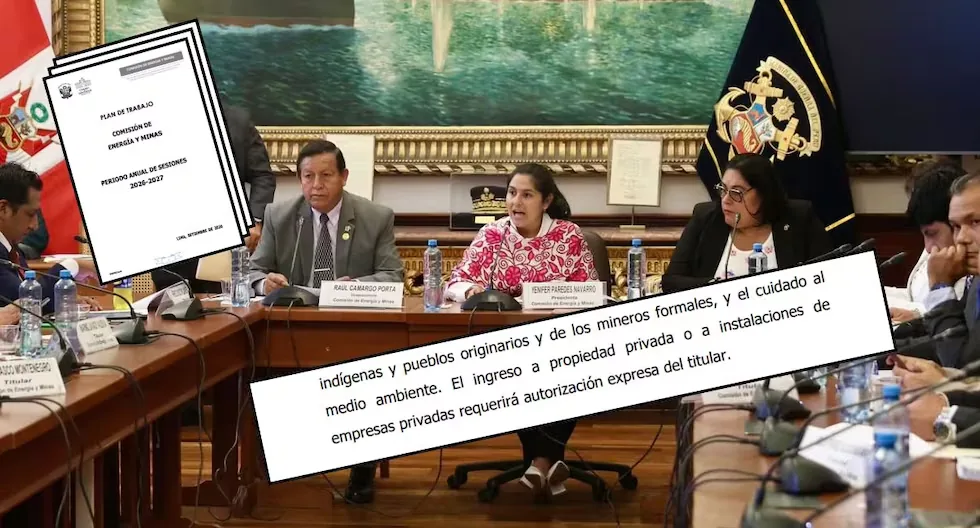









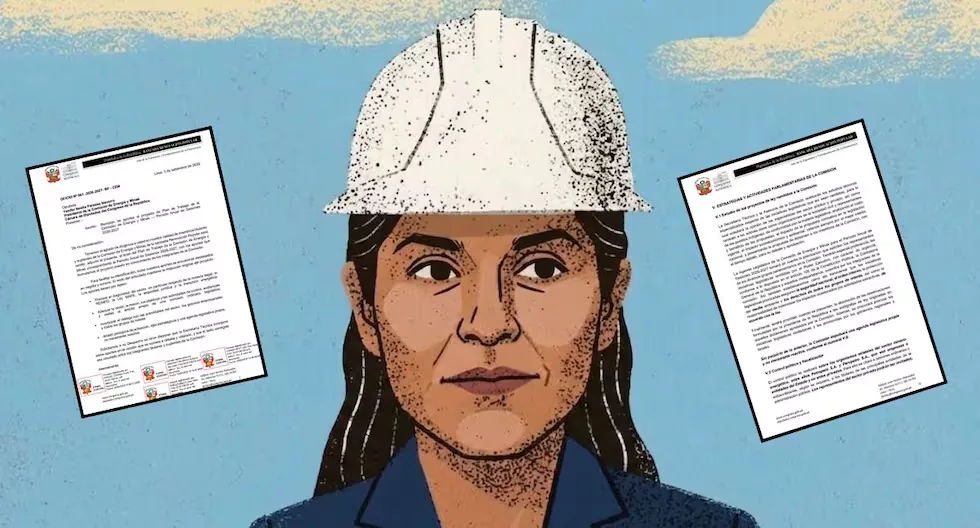
After the publication of a report by El Comercio about the plan of the Energy and Mines Commission to open the doors to Confemin, its members decided to take action and send a letter to Yenifer Paredes, who chairs the Board, requesting her to adjust the proposed route.
Read more “The low-intensity war between the United States and Iran can be sustained indefinitely”
One of the groups that proposed modifications to the plan was the Popular Renewal caucus, through commission members Felix See Hung Chang, Frank Krklec, José Baella, and Gustavo Segura. All signed a letter addressed to Paredes Navarro, sister-in-law of the coupist former president Pedro Castillo.
In the document, they made clear that their contributions aim to specify the sector’s diagnosis, particularly regarding illegal mining, Reinfo, the MAPE Law, legal security, and the energy transition.
They also proposed adapting the vision, mission, objectives, and control activities, hearings, and visits to the scope proper to an ordinary legislative commission.
They also proposed incorporating dialogue with sector authorities, business associations, and all interest groups.
Additionally, they requested adding principles of action, strategic axes, and a legislative agenda of their own, not merely reactive.
Popular Renewal was not the only caucus that observed the work plan. Asked by El Comercio, Diethell Columbus, a member of the Energy and Mines Commission for Popular Force, indicated that on August 31 he sent a letter to Paredes highlighting, among other points, that political control cannot be exercised over private entities, but only over public bodies.
“I requested the adjustments last week. Before the session. Personally as a member of the commission,” he said.
All these criticisms coincide with several points addressed by a report from this newspaper published on September 3. It highlighted two key aspects of the proposed route: the participation of artisanal miners in the sessions, apparently favoring Confemin, and the oversight of companies linked to the mining and energy sectors.
Finally, this Tuesday at 9 a.m., the work plan will be debated.
—Gradual changes—
In the work plan proposed by Popular Renewal, the deputies indicated that political control should be exercised over public and autonomous bodies and instances of the mining-energy sector, as well as monitoring illegal activities linked to this sector — particularly illegal mining — without replacing the administrative oversight powers of Osinergmin, OEFA, Sunafil, or other Executive bodies, nor the investigative powers of the Public Ministry and the Judiciary.
In Yenifer Paredes’ work route, however, it was only indicated that the commission could exercise political control over public, autonomous, and private bodies that carry out activities in the country’s mining and energy sectors.
In the section referring to public hearings, the Popular Renewal caucus specified that the plural participation of small and formal artisanal miners, holders of medium and large mining, peasant and native communities in the area of influence, regional and local governments — competent in small and artisanal mining — specialized public bodies, workers’ organizations, and business associations is important.
“The current plan does not anticipate the direction of the rulings on the MAPE Law nor on the continuity of REINFO,” it specifies.
Previously, the document only stated that decentralized public hearings would be held, semi-presential or in-person, in the interior of the country, and that the participation of small and artisanal miners, who play a leading role in exploration and exploitation of natural resources, was important.
Regarding unannounced visits to mining company facilities, the commission members proposed that entry to private property or private company facilities requires the express authorization of the owner.
Meanwhile, Paredes’ plan indicated that the Energy and Mines Commission could make unannounced visits to public and private works under execution, as well as to public and private establishments related to the energy and mining sectors, in order to verify the proper use of public resources.
In the observations of Popular Force, emphasis is placed on the commission needing to have a balanced position on the debate of the MAPE Law and Reinfo.
“The plan assigns a “leading role” to small and artisanal miners, but does not grant similar consideration to workers, communities, consumers, universities, regional governments, formal companies, and other involved sectors. I consider that small mining deserves to be heard, but we must maintain a balanced position, particularly during the debate on REINFO, the MAPE Law, and mining formalization,” it specifies.
He then indicated that visits to private facilities should be carried out in a coordinated manner, with the corresponding consent or together with the competent supervisory entities.
He also opined in a letter that the reference to Petro-Perú and Perú-Petro as examples of “private entities” should be corrected, as they are state companies subject to a business regime.
—Argumentation—
In the proposed work plan, Popular Renewal deputies emphasized the warning that the commission’s Presidency sought to exercise political control over various state agencies and private entities related to the mining and energy sectors.
Regarding this, they indicated that political control is a function exercised over government acts and public administration, not over private individuals.
“Private companies in the sector are not passive subjects of parliamentary political control,” they stated.
However, they made clear that the commission can invite representatives of the private sector, but not summon them.
Regarding the point that, in decentralized public hearings and working groups, the participation of small and artisanal miners, who play a leading role in exploration and exploitation of natural resources, is important, the Popular Renewal caucus stated the following:
“The paragraph singles out only one stratum of sector actors. Since these are participation spaces convened by an ordinary commission, the applicable criterion is plurality,” they said.
They argued that if small and artisanal miners are named, medium and large mining holders, peasant and native communities in the area of influence, regional and local governments, as well as specialized public bodies, should also be mentioned.
Regarding this, César Ipenza, an expert on mining issues, considered that the observations of both caucuses are important because, in terms of including artisanal miners in the group’s ordinary sessions, it seemed to be directed only to favor Confemin.
“The adjustment is important but other voices should be included and not only those who generate blackmail measures against the State. Only and always they [Confemin] are heard and they do not call other specialists and those affected by the activity,” he said in an interview with this newspaper.
- The story behind the meetings between Roberto Sánchez, the JP leadership, and informal mining representatives
- Deputies: Energy and Mines Commission seeks to approve work plan to open doors to Confemin and oversee private mining companies
- Intelligence operations of DINI, criminal organizations as terrorists, and more: other powers
- The three oranges, a chronicle by Fernando Vivas about Fujimorism