







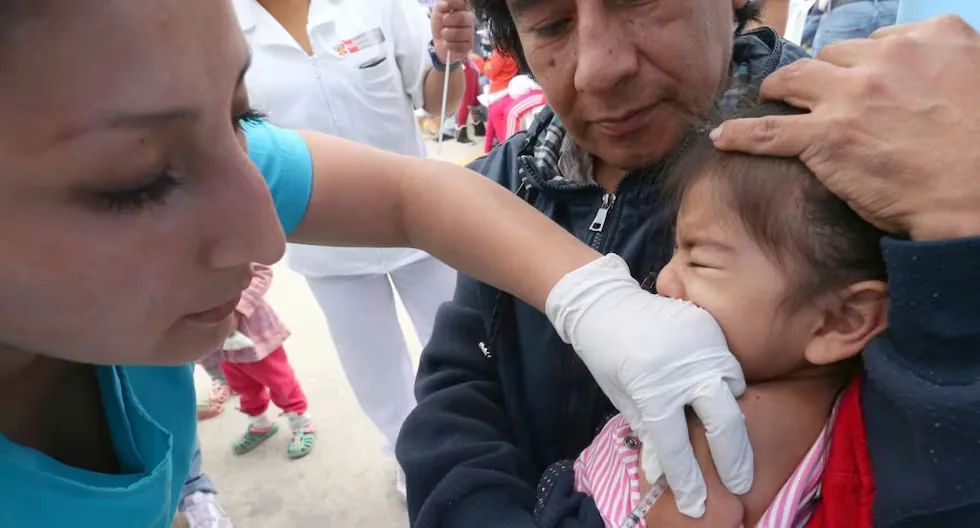
The two confirmed cases of measles in Loreto have raised concern among specialists, as it is one of the regions with low vaccination coverage and high rates of malnutrition in children, which could make the disease have a high impact.
Read more Temperature in Lima reaches new historical records in July, reaching 10.1 °C above normal
READ HERE: El Niño Phenomenon with 99% probability of being very strong demands accelerating prevention works
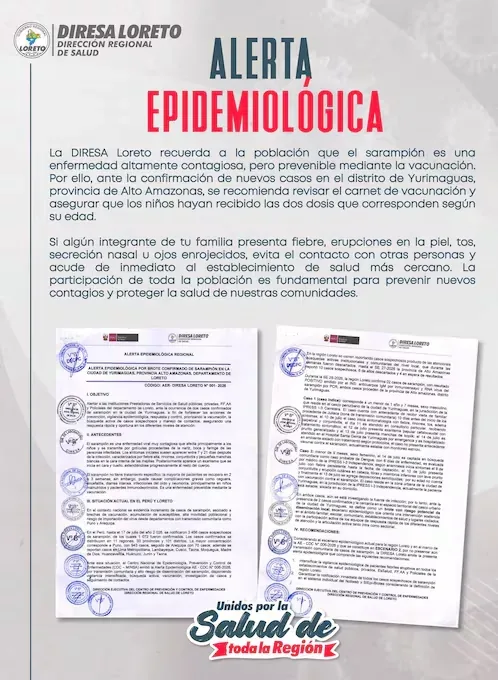
The Regional Health Directorate (Diresa) of Loreto detailed that the two cases were reported in the city of Yurimaguas, in the province of Alto Amazonas, so it issued an epidemiological alert to intensify surveillance, apply investigation protocols, outbreak control, active case search, and vaccination blocking to prevent the spread of the disease.
The Government had declared, on May 16, a health emergency for 90 days due to a measles outbreak in the country. The measure covered Metropolitan Lima and the regions of Puno, Arequipa, Cusco, Huancavelica, Moquegua, Amazonas, Loreto, Tacna, Tumbes, Ucayali, Madre de Dios, and Apurímac, as well as the constitutional province of Callao.
The Executive Branch based its decision on the fact that there is a confirmed record of local transmission in Puno and a high risk of spread in the other mentioned jurisdictions.
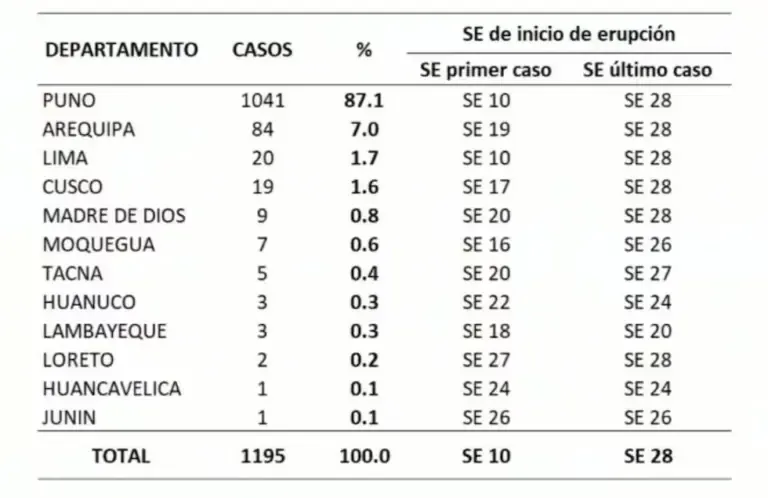
As of July 22, about 1,195 confirmed cases of measles have been reported in Peru, with Puno being the region with the most infections, with 1,041 cases, that is, 87.1% of the total.
Warning that measles will wreak havoc on children in native communities
Juan Carlos Celis, infectious disease doctor, explained to El Comercio that two cases of measles have been officially reported in Loreto, but warned that the number should be higher, as it is a highly contagious disease and could have the same impact as whooping cough.
The specialist pointed out that the number of infections could increase significantly in the coming weeks as the National Holidays celebrations approach, which implies the movement of large groups of people in the cities of Loreto.
In that context, he emphasized that the greatest risk is that the people who move around reach native communities and infect the most vulnerable people, such as children, since these groups have only up to 20% vaccination coverage against measles.
“According to the National Unique Health Information Repository (Reunis) of the Ministry of Health, regarding the progress of measles vaccination, Loreto has the lowest coverage rate this year, even below Puno. That is not unusual in a region with such remote areas, with rivers and native communities, it is historical data, but measles is entering, just as whooping cough did. Previous rates have not even been surpassed,” he said.
“Loreto has districts that have not reached 10% or 20% vaccination because they are located in border areas. As happened with whooping cough, it is very likely that in three weeks measles will already be talked about in native communities. That is the problem in Loreto, when it reaches native communities, which have rates that do not reach 20% vaccination,” he added.

Therefore, he warned that the advance of measles in Loreto would cause “a disaster,” as deaths and hospitalizations would likely occur. He considered that the region requires a “major gap-closing project.”
Celis emphasized that a factor influencing the lethality of the disease is that affected children present malnutrition or anemia. “Measles is a very debilitating disease, which will affect anemic, malnourished children in remote Amazon communities,” he said.
He also indicated that case care is complicated because native communities are very remote, especially in border areas.
Celis stated that measles is not the only disease affecting the cities of Loreto, as whooping cough has caused, so far, 51 deaths, mainly in children from native communities without vaccination. “Whooping cough is still ongoing, it is an epidemic that is not over yet. To declare an epidemic over, there must be no reported cases for a month,” he asserted.
In recent weeks, 500 new cases of measles have been reported in Peru, said former deputy minister
Measles is progressively increasing, as about 500 new cases have occurred in the last four weeks, and the number of affected regions has increased, with 12 regions reporting infections, said Augusto Tarazona Fernández, head of the Infectology Service at Sergio Bernales Hospital.
He stressed that the risk of infections will increase during the trips that will take place during the National Holidays. He recalled that in Loreto, vaccination coverage is quite low, as last year it registered 67% vaccination, when 95% is needed, as it is a highly contagious disease. “Throughout the year, its vaccination remains low, as it is at 29% coverage, even though we are halfway through the year,” he said.
The former Deputy Minister of Health Benefits and Insurance at the Ministry of Health considered that Loreto’s geography, lack of budget, and authorities’ negligence have generated low vaccination coverage against measles.
Regarding symptoms, Tarazona explained that measles can seem like a cold at first, as the person presents fever, malaise, body or head pain, and during that period it is highly contagious and lasts three to five days. At that stage, only plenty of water and paracetamol are given. Then, the exanthematous phase appears, which are eruptive lesions on the face and body. If a severe condition does not develop, after five to six days the patient begins to recover.

Tarazona pointed out that in Peru, measles has affected people aged 10 to 29 years. In that context, he recalled that children aged 12 months are regularly vaccinated and a booster is applied at 18 months; however, in an epidemic situation, such as in the Puno region, where there is high transmission and an active epidemic, regular vaccination is indicated up to 10 years old, and it is even possible to evaluate immunizing people up to 29 years old who have not been vaccinated.
The specialist indicated that the advance of measles is associated with malnutrition, so malnourished children have a high possibility of developing severe forms, as well as people who have not been vaccinated and have comorbidities such as asthma, diabetes, HIV, or people receiving chemotherapy.
He recalled that measles had been controlled in Peru in the 2000s, but more than 20 years later it has reappeared due to weaknesses in vaccination coverage in recent years and the arrival of people from other countries who also have low immunization coverage.
Read more Triumph of Varillas, tribute to Mabela Martínez and concern about halted works in front of the Niño