




![Alberto Beingolea: “If they insist on not giving [the powers], they are complicating life for Peru”](https://insightermedia.com/wp-content/uploads/2026/09/bb3fa9e11304ea13fe2cd333955007bc-150x150.webp "Alberto Beingolea: “If they insist on not giving [the powers], they are complicating life for Peru”")



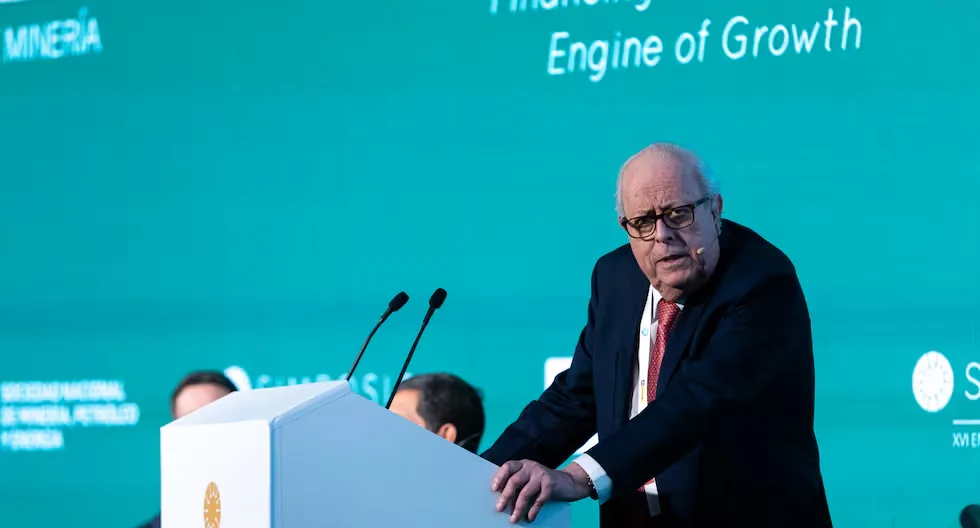
The president of the Central Reserve Bank of Peru (BCR), Julio Velarde, pointed out that the copper investment potential in the country reaches US$47 billion.
Read more Cusco: Father of missing tourist asks to intensify search for his daughter
“We are looking at an investment close to US$47 billion that we could have. With copper projects, production could double,” he said during his participation in the Symposium – XVI International Mining Meeting, organized by the National Society of Mining, Petroleum and Energy (SNMPE).
WATCH | Air and tourism sector unions reject the conditions for signing Addendum No. 9
The head of the BCR stated that this production potential could imply about 3.25 million additional tons of copper. Furthermore, copper production in Chile could be surpassed.
But for that, a roadmap with simplified procedures is required, he specified.
According to the BCR presentation, mining companies’ investment in the first quarter (US$1.491 billion) grew by 43% compared to the same period in 2025 (US$1.044 billion).
During the panel ‘Financing the growth engine in the country,’ Velarde commented that the deepest areas in mining operations have not yet been explored.
Economic engine
Velarde also highlighted the importance of mining for the country’s economy. He pointed out that periods of growth in the country have been largely associated with this extractive sector, especially in mining investment.
“The boom we had in investment and increased mining production between 2005 and 2013 led to enormous growth, of 6.6%,” he said.
This has translated into reductions in poverty levels and increases in fiscal revenues and public investment, as well as growth in other economic sectors.
In that period, private investment also had a growth rate of 13.9% and public investment of 14.8%.
“When there are these booms, the whole economy is affected. Other sectors also grow strongly,” he said.
Added to this is the growth in mining exports. Velarde detailed that these shipments increased almost 20 times from 2000 to 2025, surpassing Brazil (growth of 12.2 times), Argentina (8.8 times), and Chile (8.4 times). Only in mining shipments, Mexico had growth equal to Peru.
Likewise, in total exports Peru grew 14 times in the same period, surpassing Brazil (6.3 times), Chile (5.7 times), Mexico (4 times), Colombia (3.8 times), and Argentina (3.3 times), he explained.
“In 2000, Argentina exported four times what we exported. Last year, we exported more than Argentina. Colombia in 2000 exported twice what we did. Last year we exported almost 90% more than Colombia,” he said.
Political scenario
Despite the benefit of mining in economic growth, Velarde specified that there are areas where the population has not benefited from public services.
In the electoral context the country faces, he also stated that in mining-rich areas the population has voted for leftist positions, while in prosperous agricultural areas the support has been for the right.
On the other hand, Velarde said that reviewing the regulatory framework in the sector is pending, not treating it with “patches,” but looking at the entire mining scheme.
And in recent decades there has been “explosive growth in the number of required procedures”; there are up to 264 processes.
For a country to grow, it must have stable legal rules, predictability in the tax and judicial framework.
Among the sector’s problems are also changes in senior public sector positions. “It is really very complicated to have a continuous process when the authorities with whom one has to discuss, with whom different procedures have to be managed, change continuously,” he said.
In the framework of the second electoral round, Velarde was asked about a possible wave of exchange rate pressure. The official responded that in the last week “there has not been very strong appreciation pressure.”
He also mentioned that the symposium establishes a manifesto for the new government to take measures in favor of unblocking mining projects. In that sense, he highlighted the coordination between the public and private sectors.
Julio Velarde, head of the BCR, was honored during the event, accompanied by Julia Torreblanca, president of the SNMPE, and Diego Ortega, president of the Symposium.
Portfolio
Among the mining projects in the portfolio is Tía María (US$1.8 billion), an initiative of Southern Copper that is 35% complete in its construction and should start production in the second half of 2027; Zafranal (US$1.9 billion), a project by the Canadian company Teck, which has delayed its execution until 2027; and the expansion of Antapaccay, also called Coroccohuayco, whose construction could begin during this year aiming to start production in 2028.
There are two other major projects ready to start execution: the optimization of Cerro Verde (US$2.1 billion), aimed at extending the life of the Arequipa mine from 2046 to 2053; and Ferrobamba Replacement, which aims to extend the production horizon of Las Bambas by six additional years.
According to the US Geological Survey (USGS), Peru ranks third in world copper production with 2.73 million tons generated in 2025. It is preceded by Chile, in first place, with 5.3 million tons, and the Democratic Republic of Congo, with 3.2 million tons.
If Peru manages to put all its copper project portfolio into production, it would add 3.25 million tons to its current production, totaling 5.9 million tons.
Today, mining represents 10% of Peru’s GDP. The execution of all these investments would catapult this share up to 20%, pointed out Sebastián Arcuri, CEO and executive vice president of Scotiabank Peru.
Read more Alessandra Rivera, the Chalaca artist making her way in New York