







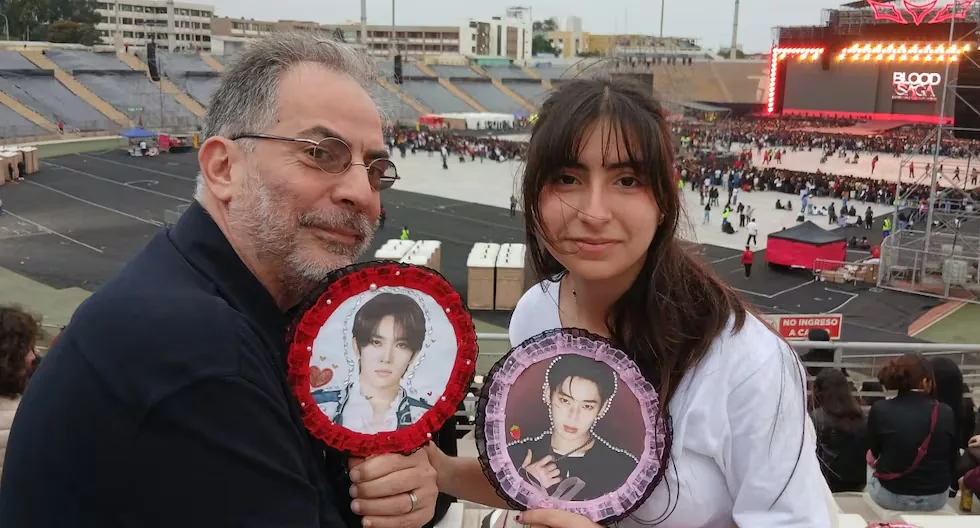
No one will accompany Montserrat and Andrea, her best friend, to the concert. Their parents will only give permission if they are accompanied by an adult. My daughter gives me eyes like a Japanese manga character to invite me into the world of Korean pop. “Dad, can you accompany us to the Enhypen concert?” she asks me. I didn’t hear her well. I thought of cumbias by the Yaipén brothers, but she soon corrected me: it’s the K-Pop band that, since its formation in 2020, has sparked the obsession of teenagers, young people, and even mothers. I thought I knew something about K-pop when I asked if they had anything to do with BTS, but she told me that band has been around since 2013 and dismissed my knowledge as outdated. She explained that the band was formed through the survival program I-Land, originally with seven members, releasing their first EP, “Border: Day One.” Just this March, the departure of Heeseung, one of its members, was announced, so the group arriving in Lima would be a sextet: Jungwon, Jay, Jake, Sunghoon, Sunoo, and Ni-ki. Although somewhat apprehensive, I said yes. How could I have known where this would lead us?
Read more Take advantage of 15% off on international flights with Air Europa
LOOK: Sang Jung, the chef who left his life in Seoul to join Central, the Peruvian restaurant considered the best in the world
Montserrat is 14 years old; she took over my old jazz records a while ago, and the voice of Ella Fitzgerald helps her relax in her room. We usually go together to Philharmonic Society concerts and the opera season at the Municipal Theater. Debussy is her favorite composer. Now it’s her turn to take me to discover the other side of music.
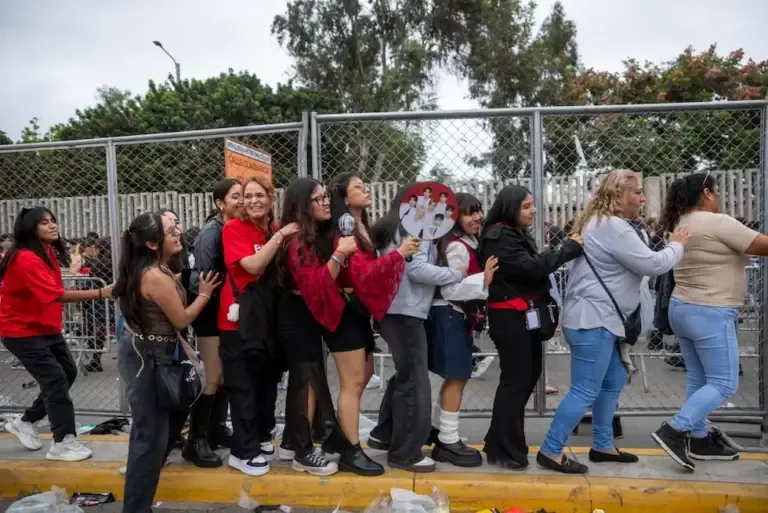
Two months earlier, Andrea’s father, an expert at waiting in front of the screen for ticket sales, got three coveted general admission tickets. The following month, they could already be downloaded on a mobile app. I had no idea how much the certainty of going to her first concert had affected my daughter. Not until weeks later, while waiting in line, she quietly told me in passing: “this is the best day of my life.”
In the weeks leading up to it, I saw her making bracelets, drawing fruits representing each member, painting full moons inspired by “Moonstruck,” the group’s favorite song. Her previously quiet passion for the sextet soon expanded to a whole variety of stimuli: she painted the shirt she would wear to the concert, went out to buy records in Arenales (her friends did the same, but for the stickers and photos that come as gifts), and although I didn’t listen to them attentively, Enhypen became the soundtrack in our apartment. A week before, I accompanied her to a pop-up fair organized in a Miraflores hotel lounge, focused on the band’s official merch. Among giant images of the group and videos shown on a giant screen, surrounded by girls her age, Montserrat searched among wallets, photos, and pins. I remembered the street vendors selling Menudo images at my sisters’ school gate at dismissal time in the eighties.
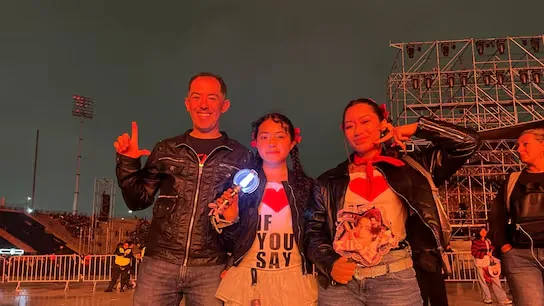
From the Ecuadorian city of Loja, this father came accompanying his daughters, fans of Enhypen. Their names are Fernando, Ivanna, and Brithany Román. (Photo: Melvyn Arce)
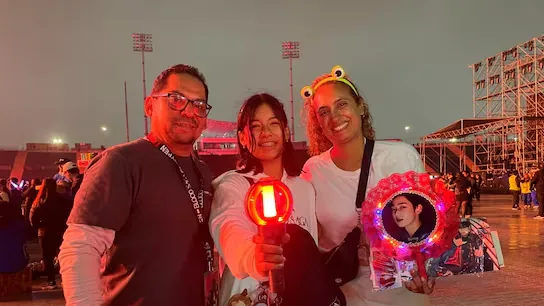
Many fans of musical groups like Enhypen are minors, so they go accompanied by a responsible adult. In this image, the Yafac Castro family. (Photo: Melvyn Arce)
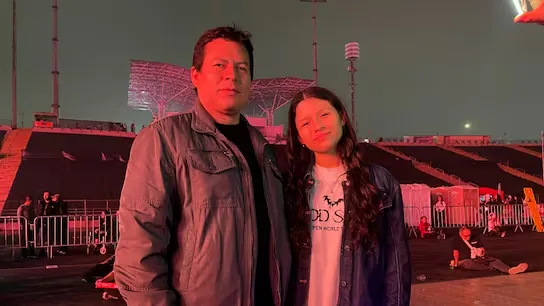
Many fathers discover music like Enhypen’s through their daughters. In the image: Carlos Pérez and his 15-year-old daughter Flavia. (Photo: Melvyn Arce)
However, here everything is elegant and exclusive: on a platform, what could be considered the most coveted product, the pièce de résistance, is displayed: the lightsticks, devices similar to a flashlight or wand, key in K-pop culture. In a place of expectation, it looks like a scepter to carry to the concert. My daughter explains that each group usually has its own customized design, representing a concept or their name, which fans use during concerts to create synchronized massive visual effects. The price overwhelms us, although two days later we will see these luminous points lighting up the happy faces of much of the audience. Montserrat manages her finances: she buys pins and photos about to sell out and, after a long line, pays the bill and leaves happy.
The red stadium
I have lived these last two months with the irritating sequence of a countdown: “Two months left, dad. One month. Three weeks left. Now only two. Seven days. Six. Five. Two. One.” On the morning of Wednesday, July 8, she still seems incredulous about what lay ahead. “The best day of your life?” I ask her in line, picking up on her categorical statement. “Or of this year. I’ll tell you when we get home,” she qualifies her answer.
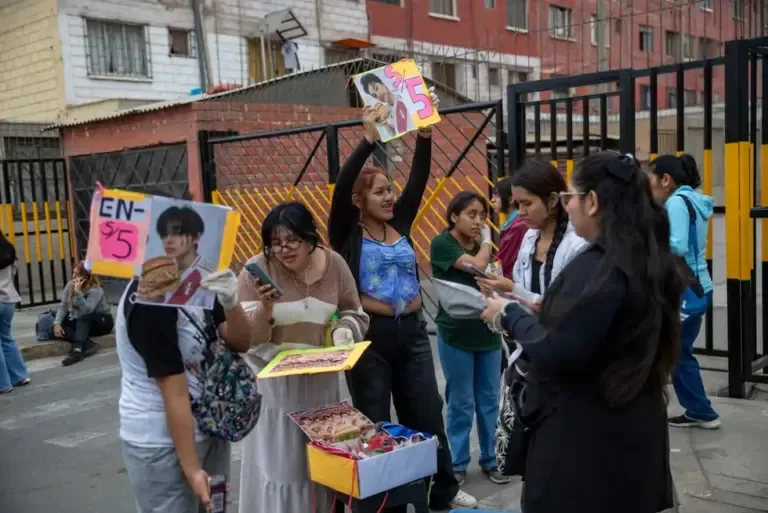
I have a terrible sense of direction, but I believe I can find the way through my old university. However, the lack of signage plunged us into oblivion. On the way, they start handing out their ‘freebies.’ I considered it an “exchange,” but Montserrat corrected me. It’s something much more generous. It’s a gift. And if someone has something to give, you receive it. She explains that it’s a tradition started by the first K-pop groups, from fans who didn’t have money to buy the group’s merchandise. So they devised their own networks to gift each other and share their passion. “It’s something that unites us as a community,” she explains. Her first encounter is with a group of Chilean visitors, a father and his daughter, and they exchange kind comments about each other’s work. She keeps a keychain from them. The flag they carry will be confused hours later with others carried by followers from Ecuador, Costa Rica, Bolivia. On the continent, Enhypen chose Peru, Brazil, and Mexico as stops on their “Blood Saga” tour before touring the United States.
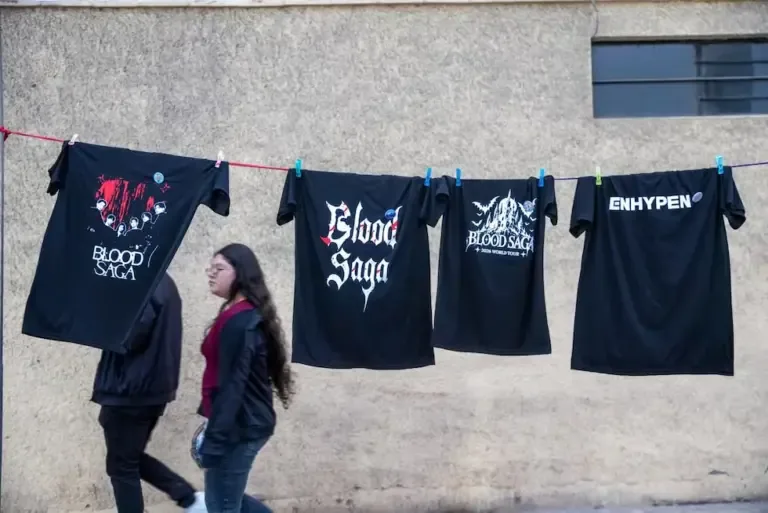
Along Avenida Universitaria, the commercial movement is a spectacle in itself: by the magic of generative AI, an image of Ni-ki, the group’s best dancer, poses about to devour an unusual chicken sandwich with all its creams on the sign crowning the food stand. His image and the rest of the band multiply in the market that leans on the perimeter fence separating us from the metro works on Amézaga Avenue, shortly before reaching gates 5 and 6 of the San Marcos stadium. It’s 4 p.m., and I feel we have arrived late. Those with the VIP 1 Blood Package entered shortly after noon, while VIP 2 Saga Package holders did so at 1 p.m. The general public could enter from 3:30 p.m., and upon arrival, the central stand was already full. We positioned ourselves on the left side, making sure the structures holding speakers and screens did not obstruct our view.
My daughter and her friend ask me to watch their seats. They roam the stands sharing their ‘freebies.’ The good vibe sometimes fades: Montserrat later confesses that many people only accepted exchanges. And others threw themselves at them for a gift. I look at the narrow strip of the section in front of the stage already full. The central field body gradually fills; a long line of girls joined in patient order, while the smell of grilled sausages rose over the stands, corn nuts were offered at 20 soles, and a bottle of water at ten to refresh the fright. The sung menu includes hamburgers, energy drinks, canned chilcanos, and cold beers that, for a moment, I think I deserve but won’t buy out of paternal modesty.
Sitting in the stands, I look at the profile of the Faculty of Letters where I studied and today feel life deforming. It’s cold. It drizzles. Soon the fine drizzle will fall harder. We must wait until 8 p.m. I see my daughter and her friend pull up their hoods. Nearby, girls make plans to jump the fence separating them from the platinum section, but the size of the security agents makes them cancel their attempts. I feel like a stowaway in the middle of a loud mass ritual: the girls start warming up their throats when, in front of us, the huge screen lights up showing the tour title, from whose gothic characters oily drops of blood fall. The sharp ovation lights up again when tutorials narrated in Korean, English, and Spanish are projected to correctly insert the lightstick batteries. New ovations resound when the face of an anonymous technician appears on screen doing tests. The same happens when the cleaning staff appears on stage to mop up the puddles of rainwater. The loudness relieves the cold. There’s not much to do. Just wait while the soundtrack of what seems like a dark video game plays.
Sitting in the stands, I start calculating: a row of 21 seats, by 16 rows. And I’m the only man among teenagers dressed in black or red leather jackets and miniskirts. My daughter wears a shirt with a heart and a phrase that says “If you say,” the same as her idols wear on the album “Romance: Untold.” While waiting, she and her friend take photos with filters, with rabbit noses or ears, or eating a digital ramen in front of them. The frame includes me, and I appear with a dog nose. On the back of the shirt of the girl sitting in front are the destinations the tour will cover: Enhypen left Seoul for Sao Paulo, then Lima, and from there will fly to Mexico City, Dallas, San Diego, Tacoma, Oakland, Las Vegas; to return to Asia and perform in Macao, Tokyo, and Aichi. Where is Aichi? I wonder and stop reading her back, lest her companions discover me and think I’m a pervert.
Thirty minutes before starting, the lightsticks light up and change color as the video tutorial promised. The waves in the stands calm down, attentive to those coordinated points of light. The stand tries to steal the show by singing a true cumbia anthem: “Never, but never, leave me, darling…,” dedicating the lines of composer Ángel Aníbal Rosado to their idols.
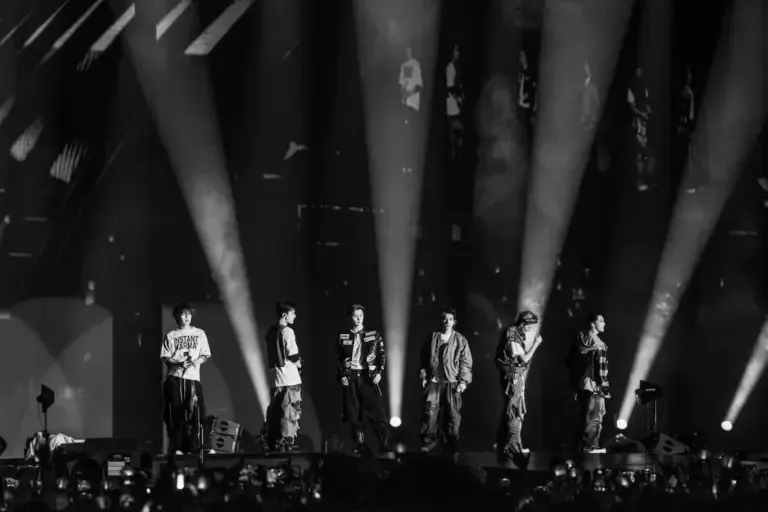
Suddenly, my daughter and her friend scream, and I am stunned like them by a laser light display I had never seen before. Jay, Jake, Sunghoon, Sunoo, Jungwon, and Ni-ki appear on stage to perform “Knife” supported by 10,000 voices singing in tune. Dressed in black leather and accompanied by their dancers, my daughter knows all the singles: “Daydream,” “Outside,” or “Brought the Heat Back.” K-pop envelops us in its gothic fantasy. It is the musical attack of angels facing darkness with drama, action, and romance. Each song takes them to a sensual rapture that makes the audience delirious. As if wanting to break an invisible wall, the girls hammer the air with their lightsticks.
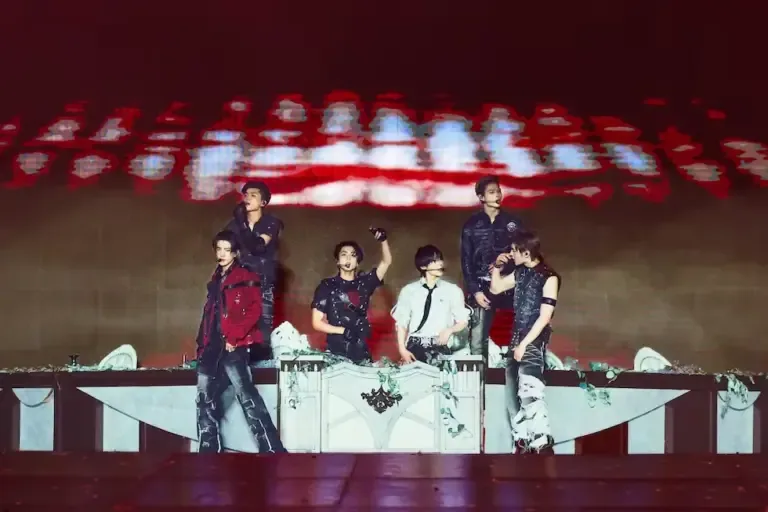
Between songs, the band members try to get closer to the audience. A translator reveals the simplicity of their words: “Good evening Peru! Hello Lima, are you having fun? The energy is incredible!” They also try to chew Spanish, thanking the warm welcome despite the rain. They surprise the fans with a repertoire of rehearsed phrases: “Hello, cause!”, “We have tried ceviche and anticucho,” “We want to see Machu Picchu!”, “We visited Barranco!” With each phrase, they draw screams from the crowd. My daughter had already confessed her frustration at not being able to find them after school. Minutes before, they had filmed a few blocks from home, on Unión and Génova streets, behind the old Municipal Market. Hours later, on stage, they exclaim: “Cool!”.

“These guys identify as vampires, right?” interrupts a father behind me who, like me, doesn’t understand anything. “Are they girls or boys?” he asks again. Uncomfortable. “They are boys, dad,” they answer, offended, shutting him down. I looked at my daughter. Listening to her scream, I recalled old Beatles videos on the Ed Sullivan show. The pop ritual transforms to stay the same in the next century. Songs like “Bite Me,” the most popular, as well as “Bills,” “Future Perfect” (Pass the MIC), “Stealer,” “Drunk-Dazed,” and “Shout Out” played then. Sometimes I imagine influences of melodic heavy metal, others of rap, even pop versions that could be signed by Bruno Mars or Robbie Williams. After the fade to black, they change outfits, from neo-gothic to urban casual. I see Montserrat jump with her friend, euphoric. She feels she was no longer in a stadium, that she had been transported to another universe, she confides to me.
Let it be clear, my eyes water from the strange atmosphere where the smoke of fireworks combines with the dense drizzle and red lasers. It’s the Martian environment that suffocated Arnold Schwarzenegger among the mountains of the red planet in Total Recall. I feel like I’m participating in a video game from inside, or in an expressionist film by the German F. W. Murnau. It’s a hyperbolic, intensified situation of music, dance, and images in different and unruly movements. “This weather favors the concert,” says the boyfriend of one of the girls in front. “Haven’t you seen those movies where they are in a gloomy place and a vampire appears? You should be grateful this is happening,” he tells the girl complaining about the cold.
With the band members, everything is kind, no impertinences. They promote a scream duel between their devotees gathered to the right and left of the San Marcos stadium. Unfortunately for my eardrums, the stand where we are seems to be the winner. Soon the game will turn into a video game: fans’ names appear on the screen for the audience to recognize, then the faces of each to be cheered. A karaoke proposal allows the girls from Lima to surprise with their fluent Korean. Near the end, they try to put on the chullos the audience throws at them, but it’s impossible; their hairstyles have too much gel to yield to the wool of the garment. They wave our flag, although at first they get the shield upside down. They say goodbye with the delicacy of someone leaving their beloved girlfriend on the balcony.
After the concert, my daughter asks me if I liked what I saw and heard. I comment on the complexity of the musical influences, and she points out even their dances, some of African roots. “Isn’t that cultural appropriation?” I ask. “That’s why they get canceled,” she answers. She then explains that the expressive quarry of K-Pop is not based only on appropriations. In all their music, there is a percussive base that refers to the great Korean drums. I researched for this article: percussion is the soul of traditional Korean music, known as gugak. While the Janggu stands out for its versatility and rhythmic complexity, the Buk provides the deep and powerful base that supports the rhythm in performances. Knowing this, I remember the young women around me wielding their lightsticks, hammering to the rhythm of the music, hitting the imaginary barrel drum covered in animal skin. I begin to understand something.
But in the stadium, there were no burly and martial percussionists, but introverted and hesitant young men of androgynous charm, who stir specific Korean references to include European gothic elements and Victorian aesthetics. For their consumers, however, the appeal of their music is not based on its Westernization or Korean-ness, but on its particular way of dealing with themes and aesthetics that today shape the sensibility of a generation seduced by the hybrid, dark romance, cosmic dream. K-Pop, that intensified zone of music often overlooked by music critics, is also forged around current tremors and essential emotions.
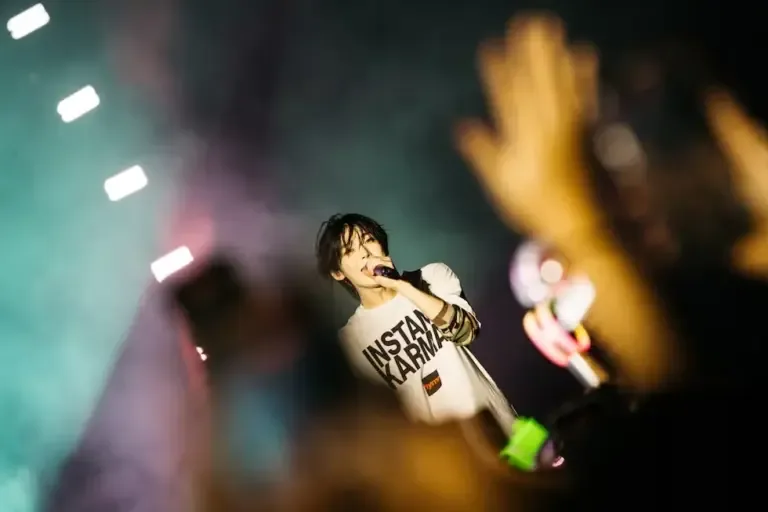
The concert lasted two and a half hours. “It’s one hundred soles per hour of show. Well paid,” says one of the girls next to us. Montserrat’s bag is full of gifts: stickers, postcards with each member’s face, drawings, also candies that help keep going, because bringing food to the concert is prohibited. She has three 100 soles bills with the faces of the band members.
“Epic!” they repeat as they head out. Wondering if my eardrums will return to normal, we look for the safest exit, but all paths lead to a chaotic procession, choked by the presence of vendors, food stalls, or delivery riders on motorcycles going against the crowd. I firmly hold my daughter’s and her friend’s hands, although, certainly, they are the ones guiding me. //
Read more Earthquake in Venezuela: magnitude, time, and location of today’s latest tremor, Monday, July 27
- Boston in 24 hours: a route to enjoy the city in the United States that attracts more Peruvians every day
- Will you travel with your pet by plane? The guide with everything you need to know before boarding the plane
- Is it too late to speak English? The challenges (and advantages) of learning after 30
- The invisible cost of the three-peat: Alianza Lima players tell everything they faced to reign in Peruvian volleyball
- The flavor that multiplies: La Pollerona opens a second location amid the gastronomic boom of North Lima