






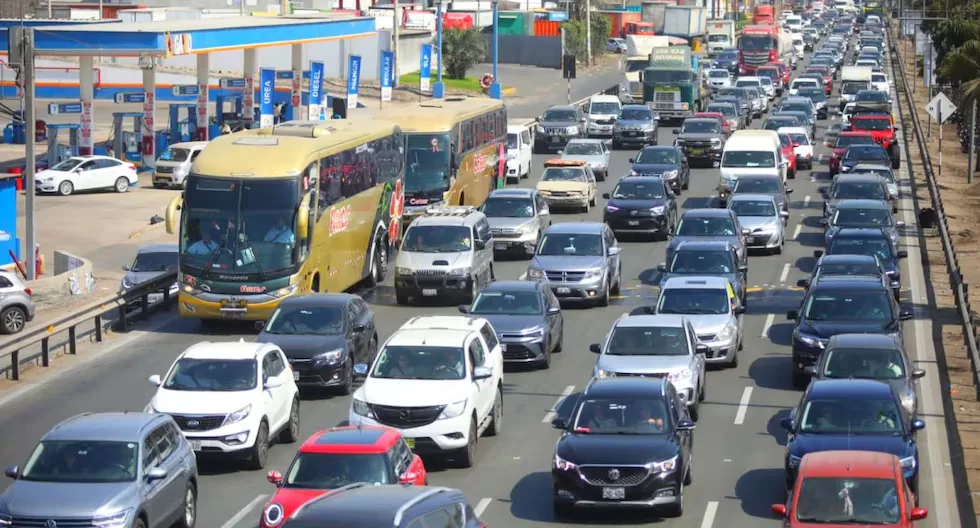
Thousands of Peruvians will take advantage of the long holiday for Fiestas Patrias to travel to the interior of the country. However, the real challenge will come with the return. Unlike the departure, which is spread over several days, Wednesday, July 29 will concentrate the return of most travelers to Metropolitan Lima, a scenario that could make that day the most congested of the holiday, with long lines of vehicles, prolonged travel times, and high demand on the main corridors entering the capital.
Read more Confessions of a K-Pop Dad: What I Experienced Accompanying My Daughter to See Enhypen in Lima
According to projections from the Superintendence of Land Transport of People, Cargo, and Goods (Sutrán), between July 25 and 29, 27,410 interprovincial trips will be made, moving 1,644,582 passengers on 6,389 authorized buses. Ronald Power, Deputy Manager of Electronic Supervision, mentioned during an interview with El Comercio that these figures represent an approximate increase of 4% compared to the same period last year.
Although the entity specified that it is not possible to determine how many travelers will specifically return to Lima until the operation concludes, it did identify that the greatest pressure will be concentrated at the accesses to the capital, mainly via the Panamericana Sur, the Panamericana Norte, and the Carretera Central, as well as alternate corridors such as Lima-Canta-Huayllay, Huaral-Acos-Huayllay, Cañete-Lunahuaná-Yauyos, and Pisco-Huancavelica-Huancayo.
On the other hand, the Municipal Company for Support of Strategic Projects S.A. (Emape) informed El Comercio that, until July 28, vehicle flow on the main exit routes from Lima will increase between 15% and 35% compared to a usual day. In this regard, it projects that the Panamericana Sur will register between 80,000 and 98,000 vehicles daily; the Panamericana Norte, between 70,000 and 88,000; and Ramiro Prialé Avenue, between 36,000 and 45,000.
The return concentrates the greatest risks
For Federico Battifora, expert in transport, road safety, and risk prevention in land transport, the most delicate moment of the entire trip is not the departure, but the return.
“The moment of greatest risk is always the returns. It is here where fatigue, the rush to arrive, and the great congestion at city entrances appear”, he explained to El Comercio.
According to the specialist, during the return, factors converge that increase the probability of accidents such as accumulated fatigue after several days of rest, pressure to resume work activities, and a high volume of vehicles circulating simultaneously.
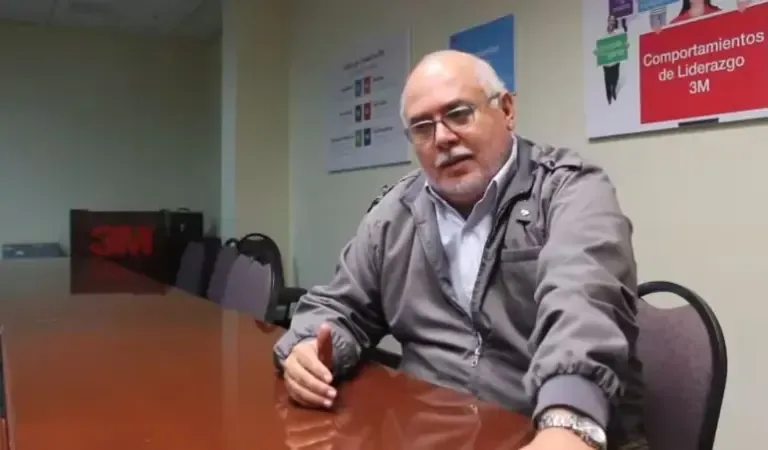
In this context, he stated that the Ministry of Transport and Communications (MTC) and Sutrán must strengthen supervision during these days, especially on the main entry and exit corridors of Lima.
Luis Quispe Candia, lawyer specializing in traffic and president of the NGO Luz Ámbar, agrees that the return represents a critical moment, although he warns that the main problem is the lack of planning by the drivers themselves.
“Many people leave the return for the last moment, forget that the next day they must resume their activities, and end up exceeding the speed limit to make up for lost time”, said the current congressman.
Bottlenecks that will complicate entry to Lima
From a road engineering perspective, Mario Candia, civil engineer specializing in traffic engineering and urban road design, stated that congestion begins to intensify as vehicles leave the national highways and enter the urban area of Lima.
On the Panamericana Norte, he explained, problems appear from Ancón and Santa Rosa towards Puente Piedra and Comas.
“The road has intersections that do not correspond to a highway category. It is supposed to be an expressway, but it has a series of ‘traffic light’ intersections that generate complete disorder”, he affirmed.
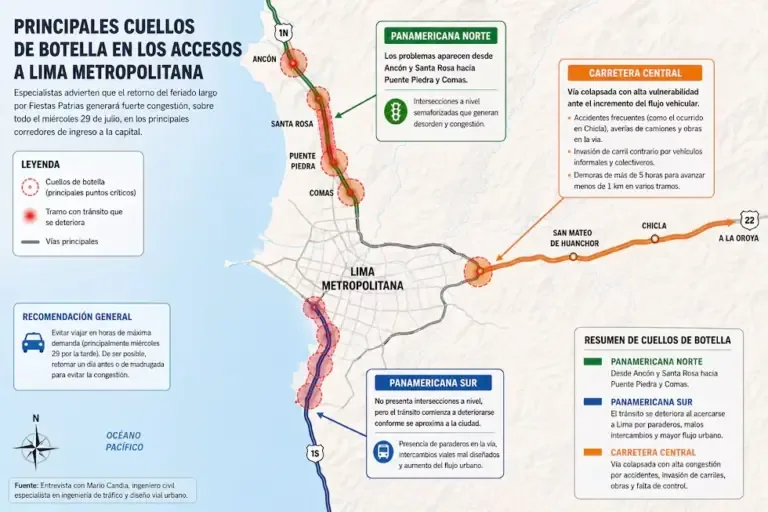
Regarding the Panamericana Sur, he indicated that, although it has superior infrastructure, traffic begins to deteriorate as it approaches the city due to the presence of bus stops on the road, poorly designed road interchanges, and increased urban flow.
His most critical diagnosis falls on the Carretera Central, which he described as a collapsed road due to its structural limitations.
“The underlying problem is the very deficient infrastructure we have”, he stated.
What are the authorities doing?
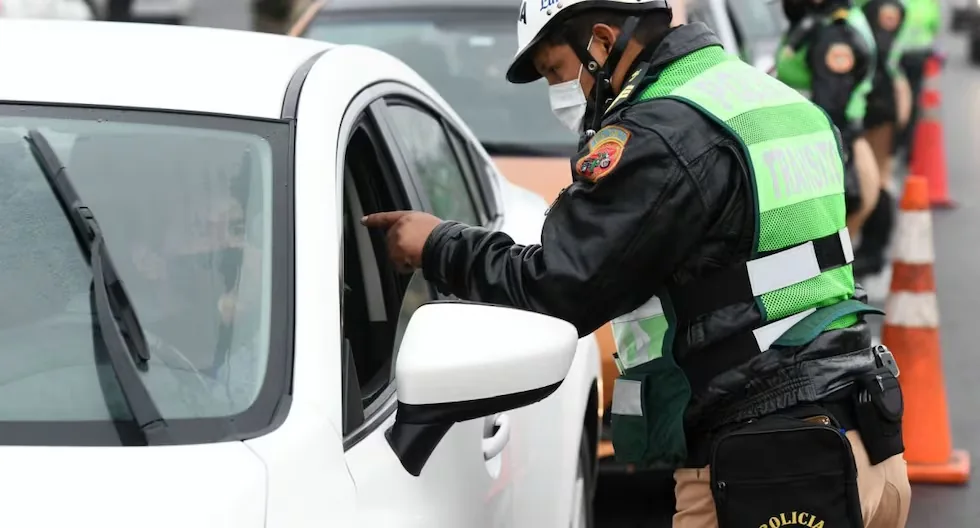
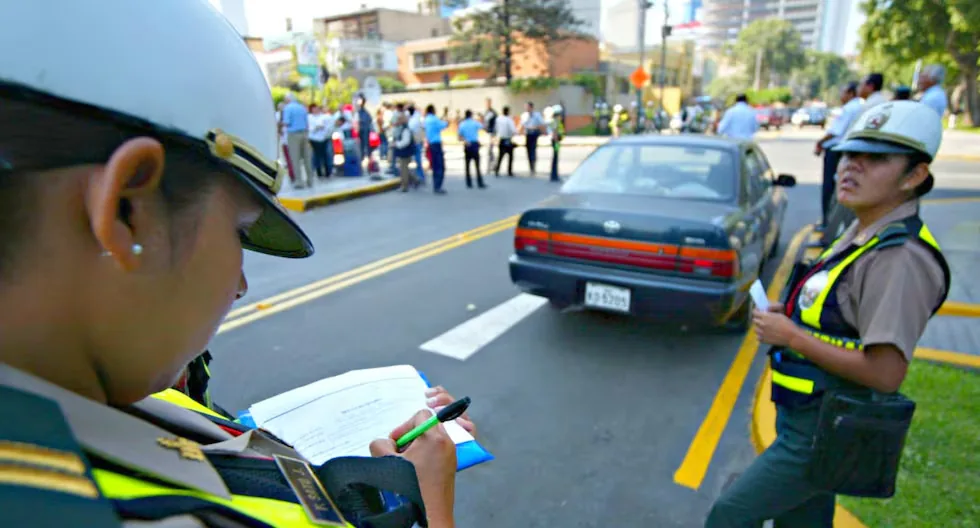
To face the increase in traffic during the long holiday, Sutrán launched the Safe Travel Plan, through which it will deploy 950 inspectors in 23 regions of the country to supervise land transport of passengers and cargo.
The inspectors will verify vehicle documentation, the mechanical condition of the units, compliance with speed limits through speed cameras, and continuous monitoring of the units via GPS systems.
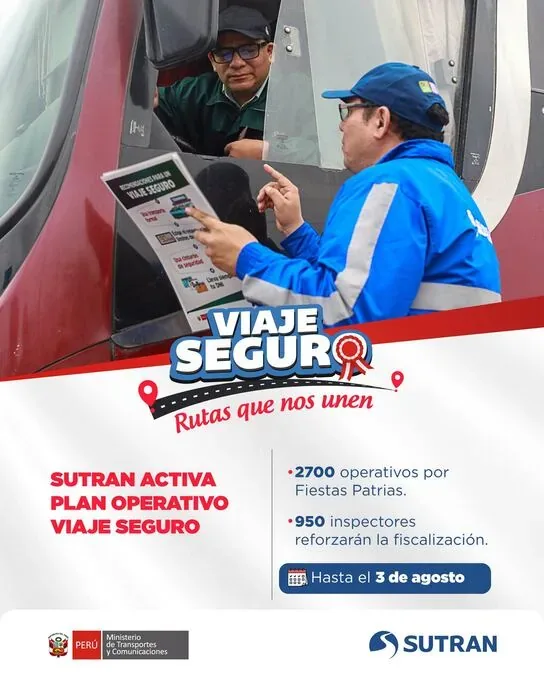
Additionally, the entity reminded that speeding continues to be one of the main causes of road accidents recorded in the country.
As a complement, the Metropolitan Municipality of Lima, through EMAPE, will implement the plan “Travel Safely with EMAPE”, aimed at maintaining traffic flow on the Panamericana Norte, the Panamericana Sur, and the Ramiro Prialé Highway.
Read more Take advantage of 15% off on international flights with Air Europa
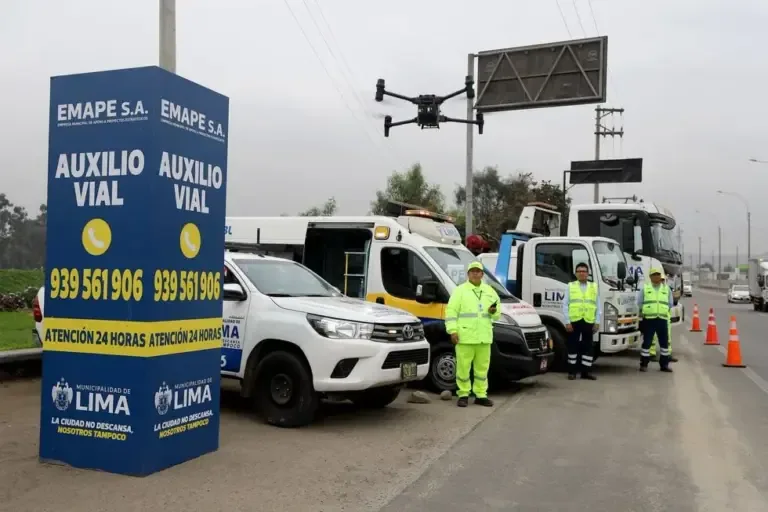
The operation includes municipal inspectors at critical points, permanent patrols, monitoring through 156 video surveillance cameras, immediate removal of broken-down vehicles by tow trucks, and permanent coordination with the National Police, ATU, Sutrán, SAMU, Firefighters, and district municipalities.
Likewise, the Roadside Assistance service will remain operational 24 hours throughout the holiday to attend to incidents that may affect traffic.
Chaos on the Carretera Central
Another measure adopted by the MTC will be the temporary restriction for cargo vehicles of 3.5 tons or more on the Carretera Central, between kilometers 19 (Ñaña) and 145 (Pucará).
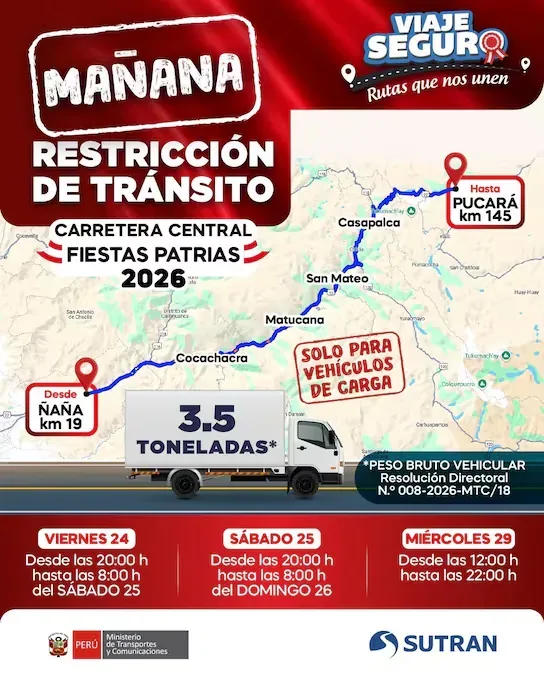
On the return to Lima, the measure will apply on Wednesday the 29th, between 12:00 noon and 10:00 p.m., with the purpose of facilitating the movement of interprovincial transport and private vehicles during peak demand hours.
The provision is especially relevant after the Carretera Central recorded more than 16 continuous hours of congestion between Corcona, Casapalca, San Mateo de Huanchor, and La Oroya during the departure for the long holiday, a situation that highlighted the high vulnerability of this road to increased vehicle flow.
The collapse originated after the accident of a semi-trailer that occurred at kilometer 108, in the Bellavista (Chicla) area, where the container of the unit fell on two smaller vehicles. Although the involved units were removed hours later, traffic continued to be seriously affected due to breakdowns of heavy cargo trucks, maintenance work in the Yanamate sector, and the invasion of the opposite lane by informal vehicles and collective taxis.
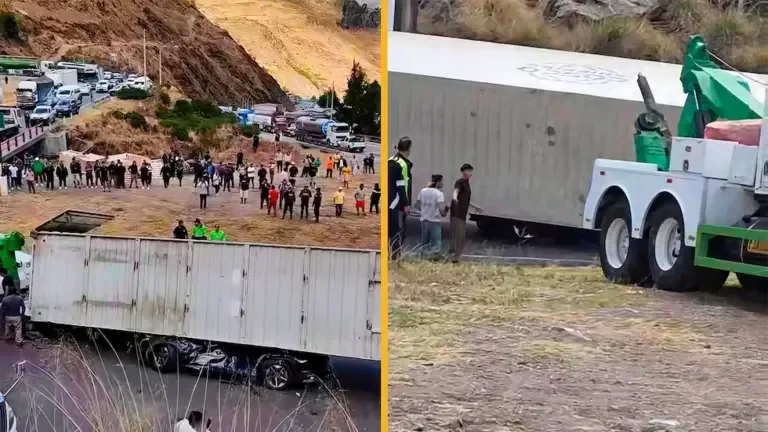
As a result, numerous drivers reported delays of more than five hours to advance less than one kilometer in some sections of the road. Likewise, users denounced the scarce presence of Highway Police officers to control informal transport and prevent lane invasion, as well as the lack of warnings to travelers about the magnitude of the congestion before entering through the Corcona toll.
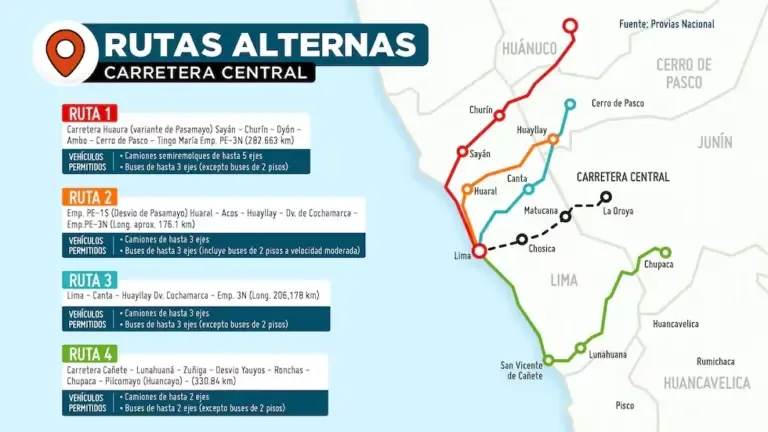
Additionally, the authorities remind that there are other alternate routes for traffic from Lima to the center of the country and vice versa.
Measures alleviate but do not solve the problem
For Mario Candia, the deployment of inspectors, tow trucks, and operations constitutes a necessary response, although insufficient to solve the structural mobility problem.
“They are palliative measures. A city the size of Lima should not need inspectors controlling traffic. The problem is not the lack of inspectors, but the very deficient infrastructure we have”, he stated.
Along the same lines, Luis Quispe Candia considered the increase in controls positive but proposed strengthening electronic supervision and moving towards the implementation of electronic tolls that reduce delays at toll points.
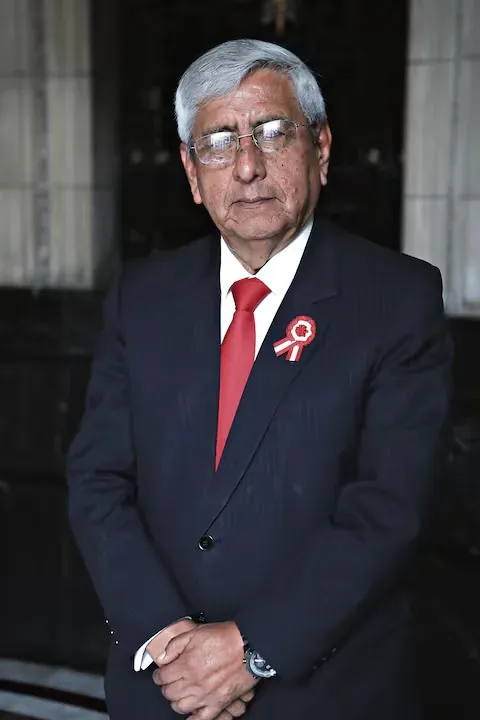
“There should be electronic toll collection at all tolls in our country, both on highways and in the city so that vehicles do not stop, as there is in other countries. Vehicles circulate freely, without any problem, because cameras capture the vehicle’s license plate and deduct from the owner’s account. That way there is no delay, no inconvenience,” he said in an interview with El Comercio.
Recommendations for a safe return
The specialists consulted by El Comercio agreed that the best strategy to avoid setbacks is to plan the return trip in advance.
Federico Battifora recommended checking the mechanical condition of the vehicle beforehand, verifying that the SOAT and the technical inspection are up to date, respecting safe speed, maintaining distance between vehicles, always using the seat belt, and taking breaks every three hours of driving.
He also advised not to drive immediately after meetings or celebrations and to avoid traveling between midnight and five in the morning, a period in which reaction capacity naturally decreases.
For his part, Luis Quispe Candia urged not to leave the return for the last moment and reminded that speeding, reckless maneuvers, and driving under the influence of alcohol continue to be the main causes of traffic accidents.
Meanwhile, Mario Candia recommended avoiding, as much as possible, peak demand hours.
“If you can return a day earlier, do it. If you can travel at dawn or very late at night, better. If you cannot avoid rush hour, go calmly and expect the trip could take up to three times longer than usual”, he indicated.

Finally, Sutrán reminded travelers that they can use the Safe Travel app, a tool that allows verifying if a bus is authorized, checking the road conditions, reviewing vehicle and driver information, as well as accessing alerts and sharing the route with family members, with the aim of making travel during these Fiestas Patrias safer.
- Firefighters estimate that extinguishing the fire at the factory could take up to three days
- Only 15 parties have guaranteed registration after the 2026 electoral processes: What will happen to the other 42?
- Bicameral Congress: elected senators were sworn in for the 2026-2031 parliamentary period