




![Alberto Beingolea: “If they insist on not giving [the powers], they are complicating life for Peru”](https://insightermedia.com/wp-content/uploads/2026/09/bb3fa9e11304ea13fe2cd333955007bc-150x150.webp "Alberto Beingolea: “If they insist on not giving [the powers], they are complicating life for Peru”")


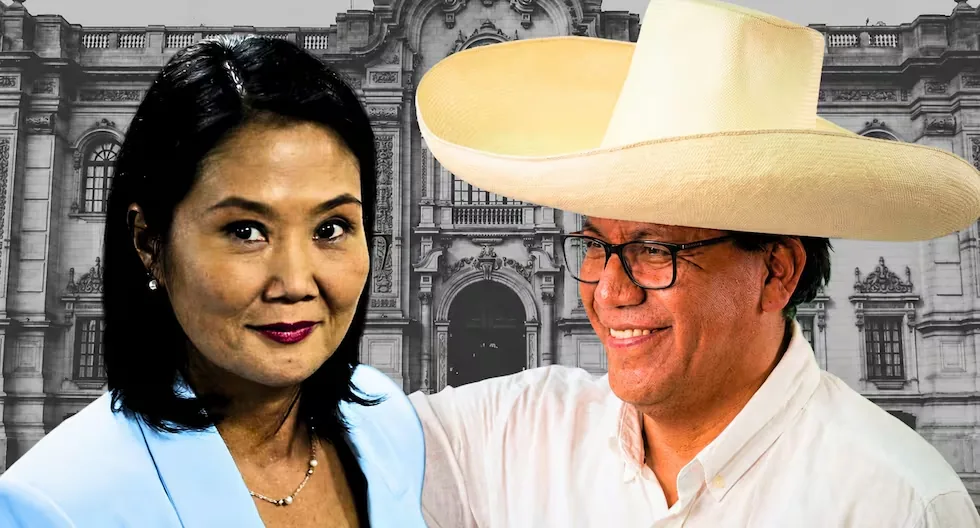
On the night of Sunday, April 12, the day the first round was held, it was learned that Alberto Fujimori’s daughter and political heir would compete in the runoff, but there was uncertainty as to who would accompany her: Sánchez or the former mayor of Lima, Rafael López Aliaga, candidate of Renovación Popular.
Read more Earthquake in Mexico today, Friday, June 5: recent earthquakes reported by the SSN
The official figures from ONPE determined that the representative of Juntos por el Perú surpassed López Aliaga by a narrow margin of 21,210 votes, who to this day refuses to accept the results and claims that fraud was committed against him.
Although Fujimori, who garnered just over 17% of the support, surpassed Sánchez (12.03%) by 862,564 votes, the first polls, conducted at the end of April, show that they start tied in the race towards the runoff.
According to Ipsos results, both Fujimori and Sánchez each accumulated 38% of preferences, while a significant block of 24% of support was in dispute: 17% indicated they would opt for blank or spoiled votes, and 7% did not specify their vote.
In the study by the Institute of Peruvian Studies (IEP), meanwhile, Sánchez achieved 32% and Fujimori 31%. Additionally, 24% leaned towards blank or spoiled votes, and 13% had not defined their decision.
“What is evident is that they are tied. In Fujimori’s case, it seems she has a better performance than in 2021, because she started with the discourse of order, a discourse that didn’t work as much in 2021, because we were in the midst of a health crisis, inequality, and the need for things to change. It was in that context that Pedro Castillo appeared,” explains sociologist Patricia Zárate, principal researcher at the IEP.
Now – adds the specialist – insecurity is the main concern of Peruvians, which is why “the context is more favorable for what she [Fujimori] proposes.” “The force of order” is the main slogan of Fuerza Popular in this campaign.
In Sánchez’s case, the vindication of Pedro Castillo – sentenced to 11 years in prison for having staged a coup in 2022 – was key to reaching the runoff. “Castillo is part of his identity; he cannot distance himself from that. Sánchez is now the one who has to aim to win more votes than Fujimori,” says Zárate.
One Peru, two countries
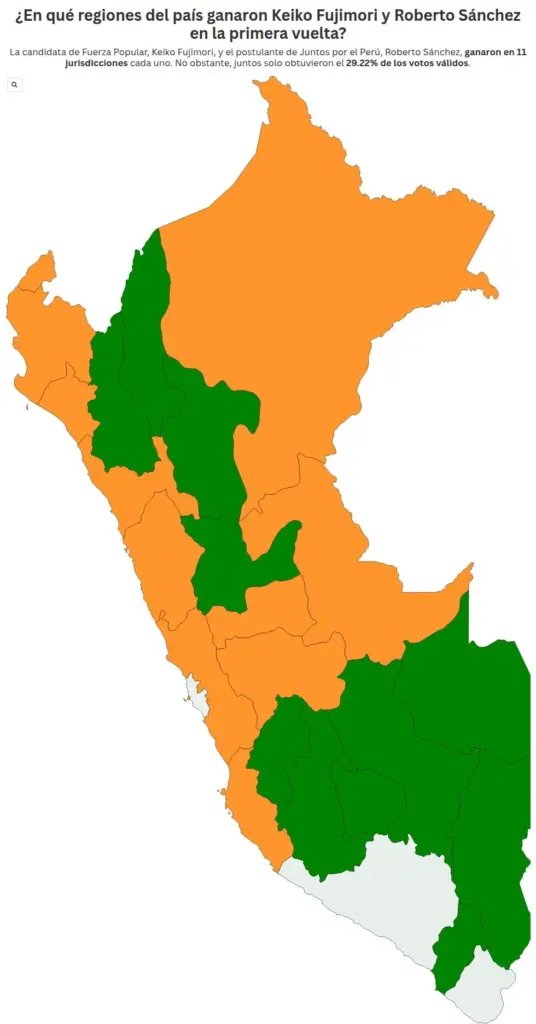
In the first round, Keiko Fujimori and Roberto Sánchez each won in 11 regions. The former had more success on the northern coast of the country, from Tumbes to Ica, and in part of the Amazon.
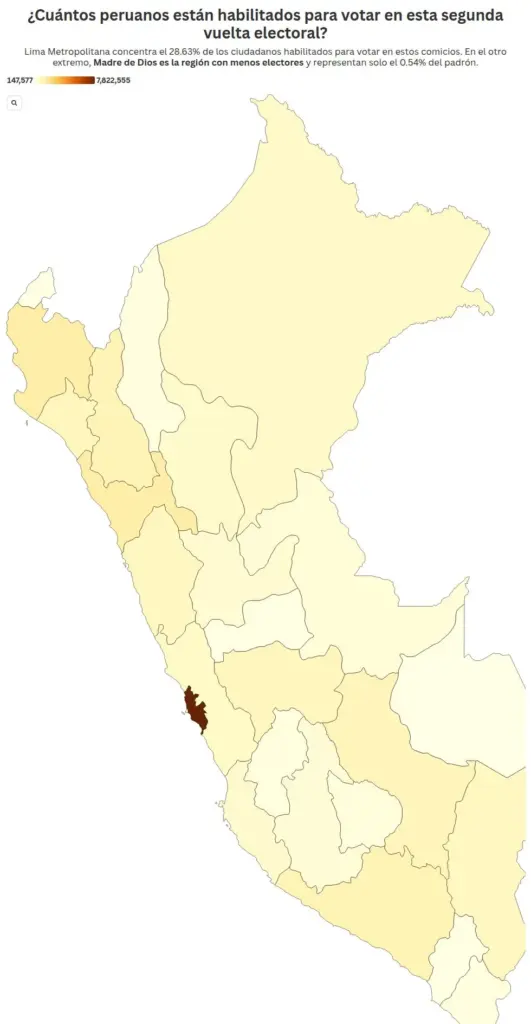
Although Rafael López Aliaga won in Metropolitan Lima – Peru’s most important electoral district, with 20.99% of the electoral population – the Fuerza Popular candidate clearly prevailed in the rest of the region.
Political analyst Miguel Rodríguez Albán, director of the School of Law at the National University of Trujillo, explains that even in the north, the division that has marked Peruvian politics is evident.
“In La Libertad, Fuerza Popular has won in the coastal provinces, but Juntos por el Perú especially in the Andean provinces. There are two well-defined segments: a rural and Andean population and a more urban one, where perhaps the fruits of economic development are more tangible,” he details.
On the other hand, Roberto Sánchez had his best results in the northern highlands and jungle and in the south, with the exception of Arequipa and Tacna, where Jorge Nieto (Government Party) and Ricardo Belmont (Obras), respectively, triumphed in this process.
“The rural vote is quite punishing, and Keiko Fujimori knows that she will always do poorly in the south; that is a pattern that has always been repeated. […] And in the south, something that doesn’t exist in Lima, assemblyism in rural populations is strong: people vote as a community, and the pull is very important,” explains Luis Idme, a communicator and political analyst from Puno.
Read more Second round: What are the electoral restrictions and when do they take effect?
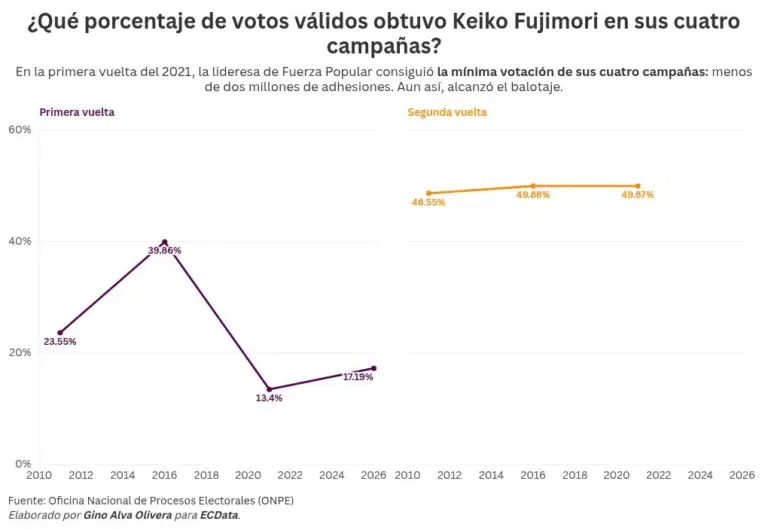
In her four presidential campaigns, Keiko Fujimori has never won in seven regions, all located in the south: Puno, Apurímac, Arequipa, Ayacucho, Cusco, Moquegua, and Tacna.
Identity and rejection
In 2021 – Luis Idme argues – Pedro Castillo’s campaign was not only sustained by the left and the rejection of Fujimorism, but by a deeper factor: identity voting.
“In the south, many did not vote for Professor Castillo, but for the peasant Pedro Castillo. This is how he attracted the rural vote. Sánchez vindicates Castillo through his discourse, which is important, but I don’t know if it will be enough to win,” he added.
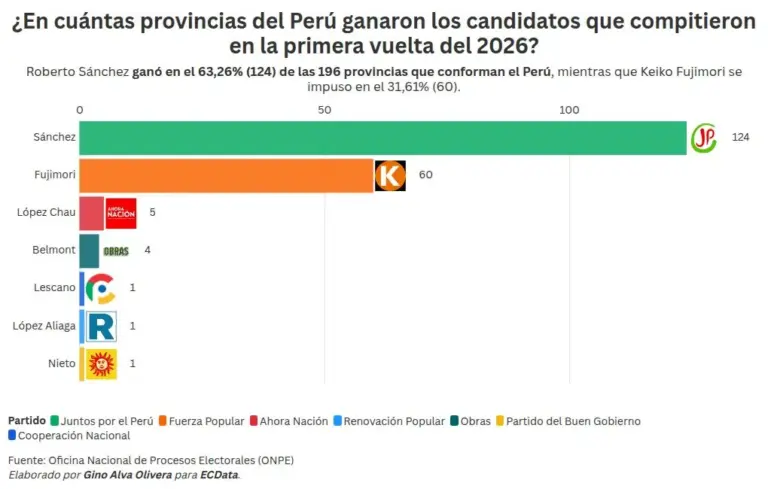
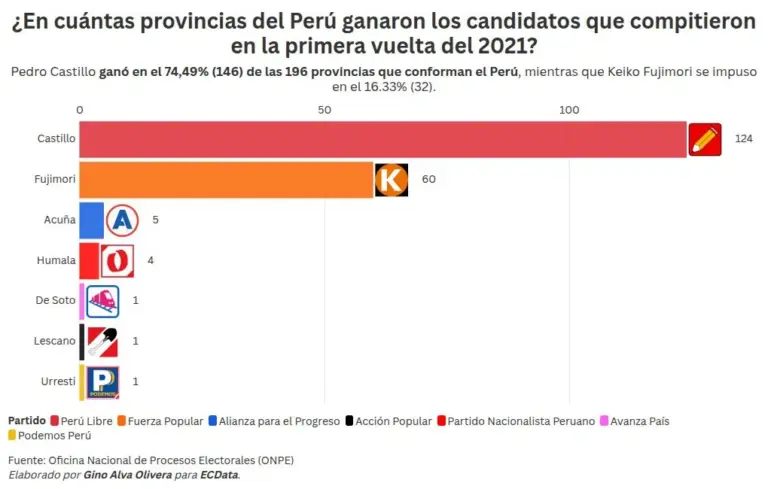
There is a key detail: in 2021, the now-imprisoned former president won in 16 regions and Sánchez in 11. The differences are also notable at the regional level: the former triumphed in 146 provinces and the leader of Juntos por el Perú in 124.
In Fujimori’s case, the opposite happened: she went from winning in 32 provinces in 2021 to 60 in this year’s first round. On a regional scale, she grew from seven to 11 jurisdictions won from one process to another.
Patricia Zárate also indicates that Sánchez cannot renounce the ideas and proposals presented during the first round, because “that is precisely why they support him.”
“In Lima, he will hardly get votes; the scenario there will not be favorable for him. He must consolidate himself in the south, in the east, the center, and the northern highlands, but above all, retain votes: Castillo retained approximately 90% of voters, but Sánchez approximately 81%,” highlights the researcher.
Precisely, the first IEP poll prior to the runoff highlights that “Keiko Fujimori presents a higher retention level among her own voters (89%) than Roberto Sánchez (81%). Fujimori primarily gathers votes for Rafael López Aliaga and to a lesser extent votes for Carlos Álvarez. While Sánchez gathers votes for Alfonso López Chau and Ricardo Belmont.”
The Peru of the Antis
The rejection of Fujimori was key in the defeats suffered by Fuerza Popular in the 2011, 2016, and 2021 elections. But according to Ipsos, the rejection of Keiko Fujimori has decreased from 58% to 48%.
Even so, the anti-vote against the former congresswoman is higher than that against Roberto Sánchez, which grew from 39% to 43%.
“There is fatigue in anti-Fujimorism. That fatigue is among young people, but not the youngest. The ‘No to Keiko’ no longer generates as much support as before, but there is more sporadic and anti-political protest: they don’t seek to do political work, but rather complain and reject politicians. There are new anti-Fujimorist generations, but not with the same level and intensity as previous ones,” notes Patricia Zárate.
On the other hand, Zárate adds, there is also strong rejection not only against Castillo, but “against communism and the so-called ‘caviarismo,’ a discourse that was very strong in the 2021 campaign. There is something very visceral in the anti-terrorism discourse.”
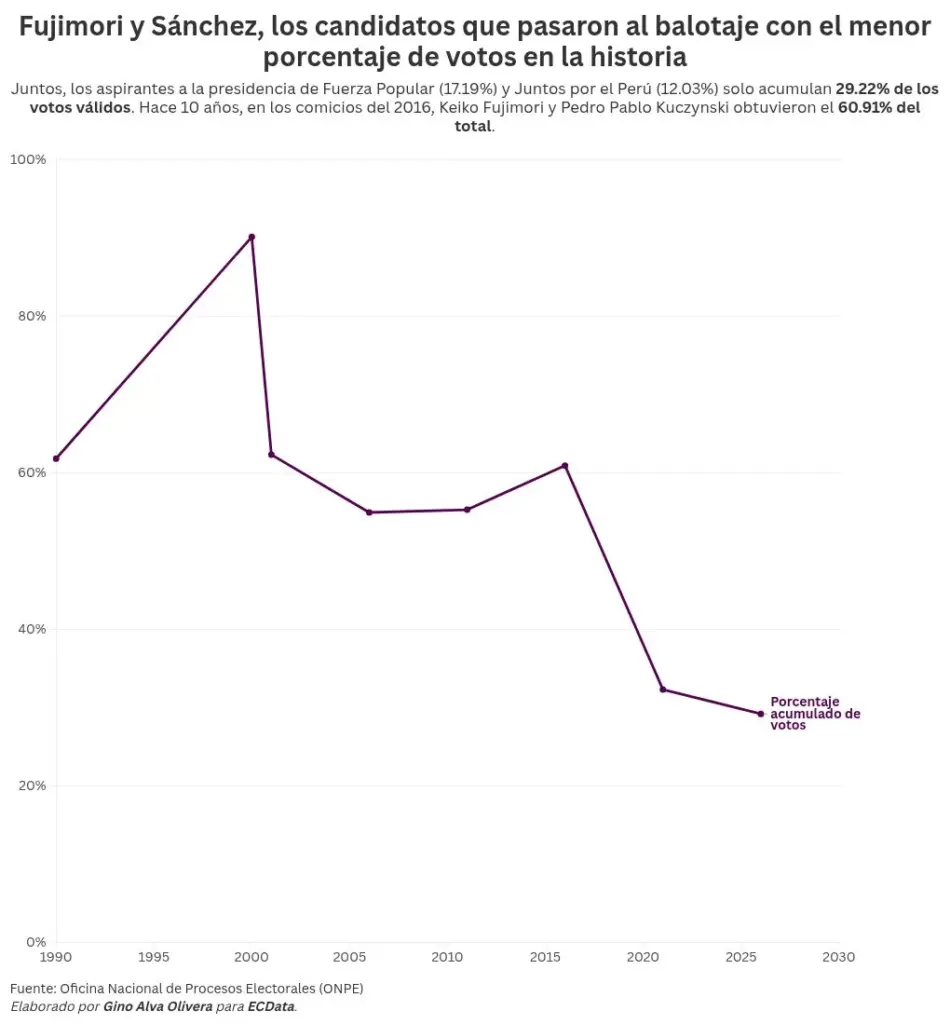
The truth is that Fujimori and Sánchez form the duo of candidates competing in the runoff with the lowest support in Peru’s history. Together, they barely reached 29.22% of the valid votes in the first round.
Read more Earthquake in Peru today, Friday, June 5: what was the magnitude and epicenter according to IGP
In this scenario, the second round officially begins.