




![Alberto Beingolea: “If they insist on not giving [the powers], they are complicating life for Peru”](https://insightermedia.com/wp-content/uploads/2026/09/bb3fa9e11304ea13fe2cd333955007bc-150x150.webp "Alberto Beingolea: “If they insist on not giving [the powers], they are complicating life for Peru”")



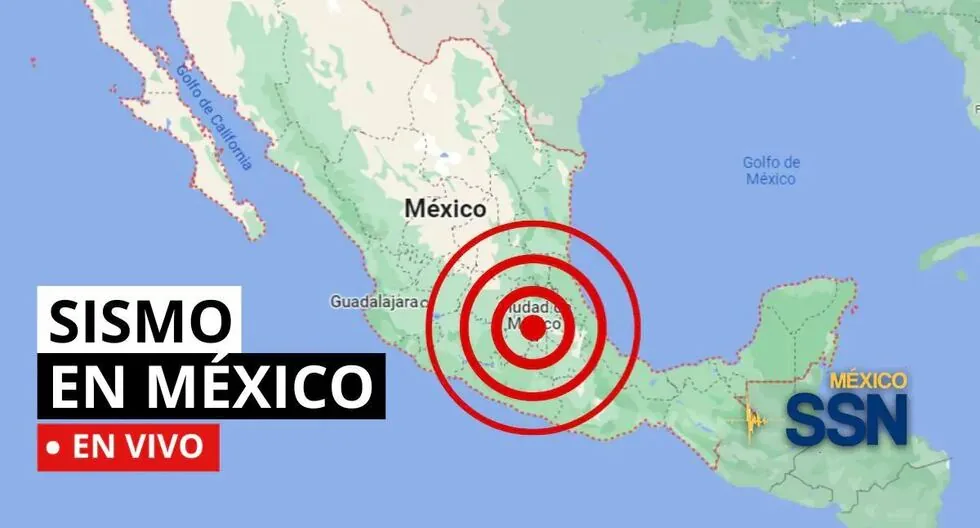
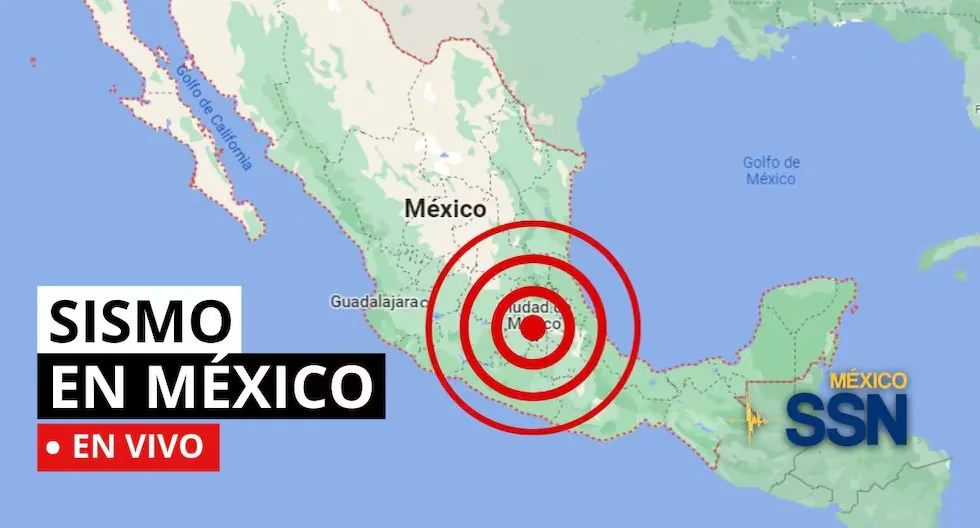
EARTHQUAKE IN MEXICO VIA THE NATIONAL SEISMOLOGICAL SERVICE
In the context of Plate Tectonics, Mexico is located in the so-called Ring of Fire, where a large part of the world’s telluric movements are recorded. The country is located on the North American Plate, bordered on its southern and western portions by the Cocos, Rivera, and Pacific plates.
Read more Second round: What are the electoral restrictions and when do they take effect?
Mexico is one of the countries in the world with the highest telluric activity, since, according to statistics, more than 90 earthquakes with a magnitude greater than 4 degrees on the Richter scale are recorded per year, which is equivalent to 60% of all telluric movements recorded in the world.
Based on statistical records, the states with the highest risk and where large magnitude earthquakes occur that can affect Mexico City are: Jalisco, Colima, Michoacán, Guerrero, Oaxaca, Puebla, State of Mexico, and Veracruz.
On the afternoon of Friday, June 5, 2026, a magnitude 5.2 earthquake was recorded with an epicenter 27 kilometers southwest of Ometepec, Guerrero, according to data from the National Seismological Service and the National Civil Protection Coordination.
- EARTHQUAKE SOUTHWEST of OMETEPEC, GUERRERO
- Magnitude 5.2
- Location: 27 km
- Date and time: 05/06/26 14:55:01
- Latitude 16.60
- Longitude -98.64
- Depth: 5 km
- What have been the strongest earthquakes recorded in Mexico in recent history?
Among the strongest are the magnitude 8.1 earthquake in 1985 off the coast of Michoacán, the magnitude 8.2 earthquake on September 7, 2017, in the Gulf of Tehuantepec, and other events greater than magnitude 7 in the Mexican Pacific.
- Does the seismic alert sound for all earthquakes?
No. The seismic alert is activated only for certain earthquakes that meet specific criteria of magnitude, location, and potential to cause damage. Micro-earthquakes and very close or very small events may not activate the system.
- Prepare your emergency backpack
When preparing your emergency backpack, keep in mind that the items you include in it should be sufficient for the first 72 hours after the disaster.
Adapt your backpack to any type of emergency and to the needs of infants, children, older adults, people with disabilities, and pets.
- Non-perishable food and bottled water
- Lighter or matches
- Directory of family members, schools, emergency services, and Civil Protection
- Personal hygiene items
- Two or three changes of clothes
- Warm clothing
- First aid kit
- Medicines
- Portable radio and flashlight with spare batteries
- Identification and important documents saved on a USB memory stick
- Crayons in case you need to write and the ink doesn’t smudge or run
- Tools for simple repairs and cash
- Feminine hygiene products
- Whistle
- Tool kit
- Copy of your house keys
- Photos of family members and pets.
It is advisable to store your backpack in an easily accessible place and have another one in the car or at your workplace.
- EARTHQUAKE 61 km SOUTH of SAN MARCOS, GRO.
- Magnitude 4.0
- Date and time: 2026-06-05 11:19:47 (Central Time)
- Latitude: 16.243º
- Longitude: -99.437º
- Depth: 15.8 km
- Can earthquakes be predicted in Mexico?
No. Currently, there is no technology capable of accurately predicting the time, place, and magnitude of an earthquake. What can be done is to monitor seismic activity, estimate higher risk areas, and strengthen prevention.
Read more Earthquake in Peru today, Friday, June 5: what was the magnitude and epicenter according to IGP
- Why are some earthquakes felt more strongly in Mexico City?
Due to the characteristics of the subsoil, largely formed by ancient lake deposits and soft materials that amplify seismic waves, making the movement perceived with greater intensity.
- Earthquake 62 km southeast of Salina Cruz, Oaxaca
Magnitude: 4.2
Time: 08:23:27
Latitude: 15.66
Longitude: -94.98
Depth: 16 km
- Earthquake 367 km southeast of Ciudad Hidalgo, Chiapas
Magnitude: 5.3
Time: 06:27:28
Latitude: 13.36
Longitude: -89.03
Depth: 10 km
- Earthquake 17 km south of Juan Rodríguez Clara, Veracruz
Magnitude: 4.0
Time: 00:03:52
Latitude: 17.83
Longitude: -95.40
Depth: 114 km
- Earthquake 28 km south of Ometepec, Guerrero
Magnitude: 4.0
Time: 23:24:06
Latitude: 16.43
Longitude: -98.40
Depth: 36 km
- Earthquake 31 km southwest of Técpan, Guerrero
Magnitude: 4.0
Time: 23:16:23
Latitude: 17.05
Longitude: -100.87
Depth: 5 km
- Earthquake 73 km south of Minatitlán, Veracruz
Magnitude: 4.0
Time: 22:42:28
Latitude: 17.33
Longitude: -94.47
Depth: 144 km
WHAT WAS THE LARGEST MAGNITUDE EARTHQUAKE TO SHAKE MEXICO CITY?
On September 19, 1985, Mexico City experienced a devastating 8.1 magnitude earthquake, with its epicenter on the Pacific coast.
It is estimated that at least 10,000 people lost their lives, affecting and collapsing thousands of housing, commercial, and public service structures.
WHAT IS AN EARTHQUAKE?
An earthquake is a sudden rupture of rocks inside the Earth. This sudden release of energy propagates in the form of waves that cause the ground to move.
HOW LONG DOES AN EARTHQUAKE LAST AND WHY DOES THE SSN NOT REPORT THIS DATA?
When we talk about the duration of an earthquake, we can refer to several different concepts: One is the duration of the movement perceived by humans, another is the duration of the instrumental record (which can even be several minutes), and another is the time the fault movement that originated the earthquake lasted (which can be a few seconds).
WHAT IS THE DIFFERENCE BETWEEN THE MAGNITUDE AND INTENSITY OF AN EARTHQUAKE?
These are scales to measure the size or impact of a tremor. The magnitude scale is obtained numerically from records obtained by seismographs and is related to the size and energy released during a tremor. The intensity scale is assigned based on the damage or effects caused to humans and their constructions.
WHY DO SO MANY EARTHQUAKES OCCUR IN MEXICO?
In the context of Plate Tectonics, Mexico is located in the so-called Ring of Fire, where a large part of the world’s telluric movements are recorded. The country is located on the North American Plate, bordered on its southern and western portions by the Cocos, Rivera, and Pacific plates.
Mexico is one of the countries in the world with the highest telluric activity, since, according to statistics, more than 90 earthquakes with a magnitude greater than 4 degrees on the Richter scale are recorded per year, which is equivalent to 60% of all telluric movements recorded in the world.
07:44
What was the magnitude and location of the last earthquake in Mexico? See live reports from the National Seismological Service (SSN) on earthquakes in the country here.
Read more Capeco: housing sales maintain dynamism, but supply begins to contract