




![Alberto Beingolea: “If they insist on not giving [the powers], they are complicating life for Peru”](https://insightermedia.com/wp-content/uploads/2026/09/bb3fa9e11304ea13fe2cd333955007bc-150x150.webp "Alberto Beingolea: “If they insist on not giving [the powers], they are complicating life for Peru”")


- Roberto Sánchez registers 356 absences in different congressional committees. Which groups did he not attend?
- Government dismisses ambassadors from key countries: the reasons behind it days before the second round
The political groups Fuerza Popular (FP) and Juntos por el Perú (JP) are preparing their representatives for this Sunday, June 7, the day on which citizens will elect the next president between Keiko Fujimori and Roberto Sánchez.
Read also | Roberto Sánchez did not have an “impeccable performance” at the head of Mincetur as he claimed
As of the close of Tuesday, June 2, there were 392 representatives officially registered with the Special Electoral Juries (JEE): 112 from JP and 280 from FP.
However, sources from Fuerza Popular detailed that the group is close to reaching 75,000 representatives nationwide, although their goal is to reach 100,000 to “cover all polling stations.”
“We have 65,000 and 70,000 in the filtering process,” they specified.
The sources indicated that they still need to gather 30% of representatives in various regions and that the main concern of the Fujimori organization is that citizens who registered to fulfill this role do not manage to get trained. “A representative without training is like a soldier without training,” they stated.
Of the total orange representatives, only 75% have managed to get trained, mostly virtually.
Other sources detailed that, in the southern regions (Apurímac, Arequipa, Moquegua, Tacna, Puno, and Cusco), Fuerza Popular still has not managed to gather even half of the representatives needed to cover the 92,766 polling stations, especially in Cusco and Arequipa, where there are 4,215 and 3,983 polling stations, respectively.
“Many people are afraid [to register as a representative] because they receive threats. So, what is being considered is to relocate,” they explained.
They also indicated that the orange group has entrusted the virtual senators and virtual deputies, as well as leaders, with the supervision of the deployment of representatives for polling places and polling stations this Sunday. For example, Martha Chávez, who will have a seat in the upper house of the new Congress, is in charge of the southern Lima area.
Virtual deputies Cecilia Chacón, Pier Figari, Rosangella Barbarán, and Flor Meza are supervising North Lima, the so-called modern Lima, San Juan de Lurigancho, and East Lima, respectively.
In San Juan de Lurigancho, in the first round, 663,533 people voted. Of these, 114,265 voted for Fujimori Higuchi. This represented 19.749% of the valid votes in the said district.
In the regions, Fuerza Popular also plans a deployment of representatives. In Piura, Karla Schaefer, virtual senator, will be in charge of the representatives.
This Newspaper sought to contact Juntos por el Perú, but they did not respond by the close of this edition.
Eder Quiroz, head of the JNE’s Cabinet of Advisors, pointed out that the role of the representatives “is very relevant,” because they are responsible for defending the interests of their political organizations at each polling station.
He added that, in the first round, there were more than 93,000 representatives.
Read also | Arithmetic in Deputies: These are the voting scenarios and the key blocs for the correlation of forces in Congress
Who are the representatives and what role do they play?
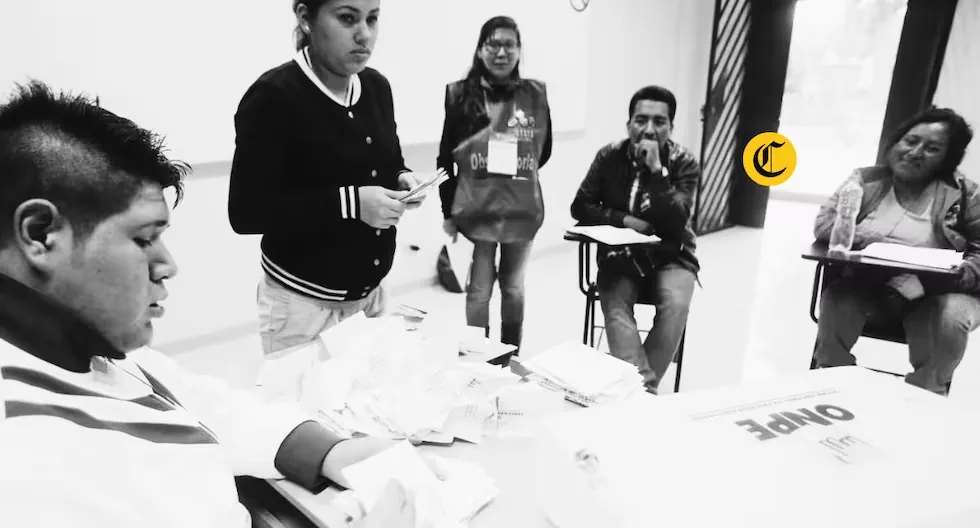
They are citizens accredited by a political organization to safeguard and defend its interests during the electoral process. Their behavior must be guided by four very simple principles: legality, that is, complying with the rules; transparency, informing clearly and honestly; impartiality, acting without affecting the neutrality of the process; and respect, maintaining an orderly and respectful conduct with everyone.
There are two types of representatives: those for polling places and those for polling stations. Both must carry their DNI and their credential on election day. In the case of the former, the polling place where they will perform their duties must be indicated, and for the latter, the number(s) of the polling stations they are in charge of.
It should be noted that candidates, polling station members, Electoral System officials, and active members of the Armed Forces and National Police cannot be representatives.
Polling Place Representative
The polling place representative must be accredited by the group’s legal representative registered in the Registry of Political Organizations (ROP) before the Special Electoral Jury (JEE).
Their function is to represent a political organization at a polling center. Their task is to observe what happens there to ensure that the election day proceeds normally. To this end, they coordinate with the polling station representatives at that location. Their work is carried out only on election day, from the beginning of the day.
According to information provided by the JNE, a citizen can be a polling place representative in one or more centers; however, it is not permitted for two representatives from the same political organization to be simultaneously present at the same location.
Polling Station Representatives
In contrast, polling station representatives are citizens accredited by the party’s legal representative before the JEE to witness how the electoral process unfolds at a polling station.
They have the authority to witness the installation, voting, and vote counting during the electoral act, but without interfering with the work of the polling station members. Likewise, they can report any act that violates the transparency and legality of the electoral process.
They could even request the annulment of the polling station in cases where they consider that the station has been set up in a different place than indicated, under conditions different from what the law states, or after noon.
They can also challenge the identity of an elector during voting when it is claimed that the person is not who they say they are. In such a case, if the polling station members declare the challenge unfounded, the elector is allowed to vote. Then, what they resolved is written in the observations field of the polling record. The representative has the option to appeal this decision.
Furthermore, they have the power, if they wish, to sign the last page of the voter list, the polling record, and to make observations and claims during the voting period.
In the event that they consider that the polling station members have exercised intimidation or violence against voters, they have the right to request the annulment of the polling station.
During the scrutiny, they can witness the reading of votes, examine the content of already read ballots, and challenge a vote. This right allows the representative to object if they consider that the polling station’s decision regarding whether the vote is valid, null, or blank affects the interests of the political organization they represent.
When a vote is challenged:
- The polling station members resolve by majority.
- If the challenge is declared unfounded, the vote is counted as valid.
- However, if it is considered founded or the representative appeals the polling station’s decision, the vote is counted as a challenged vote. The ballot is kept in the challenge envelope, in which the polling station president’s details are completed for their signature. Likewise, the signature of the representative who challenged the vote is requested. The fact is recorded in the Observations field of the corresponding election scrutiny record.
The representative can sign the scrutiny record, if they wish, and make observations or claims regarding the scrutiny.
They can also request the annulment of the polling station if it has been proven that votes from people not listed in the “Voter List” for that station were admitted or rejected in sufficient numbers to alter the election result.
They also have the right to request a complete record signed by the polling station members (if they wish) and to verify that the counted ballots are stored in the corresponding envelopes and handed over to ONPE staff at the end of the scrutiny.
At the end of May, Fuerza Popular candidate, Keiko Fujimori, introduced businessman Luis Dyer Fernández as the head of her representatives’ command and launched “Defensores del Perú” (Defenders of Peru), a website through which the orange representatives will be registered and trained, and which also seeks to gather cash, food, and water donations to cover the mobilization and food expenses of these volunteers.
Can representatives record the vote count?
Yes, the representatives of Juntos por el Perú and Fuerza Popular signed an agreement on May 22 in which they agree to record the moment of the vote count for the second electoral round, scheduled for Sunday, June 7. However, if this action interferes with the work of the polling station members, they will have the authority to limit it.
The decision was adopted at a technical meeting at the central headquarters of the National Office of Electoral Processes (ONPE) between the interim head of the electoral body, Bernardo Pachas, and the representatives of both groups.
At that meeting, it was also established that the credentials of the representatives at the polling stations and voting centers will be on bond paper, with the name of the political organization, without a logo, with a scanned or handwritten signature, complete data, and with the number of the polling station(s) where they will perform their function.
Likewise, there will be no live transmission, only video or photo recording of the counting of ballots during the scrutiny.
It was also agreed that the instruction for delivering a copy of the scrutiny record to the representatives would be reinforced, and that political organizations could designate a representative to accompany, from the ONPE command center, the monitoring of the movement and arrival of electoral materials.
Similarly, the electoral body will make the multipurpose room available to the representatives and political organization representatives to learn about the functioning of the applications used for result tabulation, as well as the representatives’ room.
In the case of vote counting at polling stations abroad, ONPE detailed that representatives will not be able to record the faces of polling station members in video or photographs, in compliance with the personal data protection laws of each country.
Furthermore, if the recordings affect the count, instead of calling law enforcement, polling station members may request the support of the consular official to order the suspension of such action.
Meanwhile, the president of the National Jury of Elections (JNE), Roberto Burneo, emphasized that the final decision on recording the scrutiny will rest with the polling station members.
“We have discussed this, and what we have talked about [is] not only that the agreement signed between ONPE and the political organizations is viable. We welcome it. In that sense, we consider it important to facilitate a way for representatives to record or accredit these incidents through the use of this type of recording,” Burneo expressed in an interview for the JNE’s YouTube channel.
“Finally, it should be highlighted that the highest authority at the polling station are the president and the polling station members. They are the ones who could allow or restrict these recordings. Even, eventually, use public force, we hope it doesn’t come to such extremes. But it is a very useful tool that can be used as long as it is within the framework of due respect and respective guarantees, and also that it is accepted by the authority at the polling station, which are the polling station members,” he added.
How are representatives accredited?
The JNE has made the Declara+ app available to political organizations to facilitate the registration of representatives for voting centers and polling stations until election day.
However, political organizations can register their representatives for voting centers and polling stations with the JEE up to seven calendar days before the elections.
Political parties can also do so in person before the ODPE coordinators or polling station presidents, on June 7 itself.
Mass training of representatives
The JNE, through its Electoral and Governance School (ESEG), will hold the virtual conference series “Your role counts: representatives for democracy,” aimed at representatives of political organizations within the framework of the second round.
The academic activity will be free and will take place from June 1 to 5 via the ESEG’s Zoom platform. Sessions will be held from 6:00 p.m., and the general public can also participate in this training space with prior registration.
The purpose of this series of talks is to provide clear, accessible, and pedagogical information about the role that representatives play during election day, highlighting their importance in monitoring the process, respecting electoral guarantees, and defending the citizens’ will expressed at the polls.
During the five sessions, fundamental topics will be covered, such as the accreditation of representatives, the installation of polling stations, control and surveillance during the electoral act, scrutiny, challenges, nullities, and vote recounting.
Read more Tourism: the strategic commitment that the next government cannot postpone